A general’s selfless actions on October 7
How Noam Tibon ultimately saved his family and Barry Avrich made a movie about it
“I think this movie, even though it is universal, it’s a story about a family on a chaotic day. You know, Barry and I talk about it. We want. I want, at the end of the day, somebody will watch the movie, and on his way back in a car, he will talk with his wife and say, ‘What would we do? How would we react in such a terrible situation?’ This is the discussion we want to raise.
“Number two, it’s not the purpose of this movie, but, yes, the movie tells the story of October 7. And this is very important. To tell the story of October 7.”
The speaker is retired Israeli Defense Force Maj. Gen. Noam Tibon. There were three of us on a Zoom call, General Tibon from Tel Aviv, noted documentarian Barry Avrich in Toronto, and me in Westwood, to discuss their film, “The Road Between Us: The Ultimate Rescue.”
While his English may be a tad imperfect, as anyone who sees this film will recognize, the general’s determination and bravery are not.
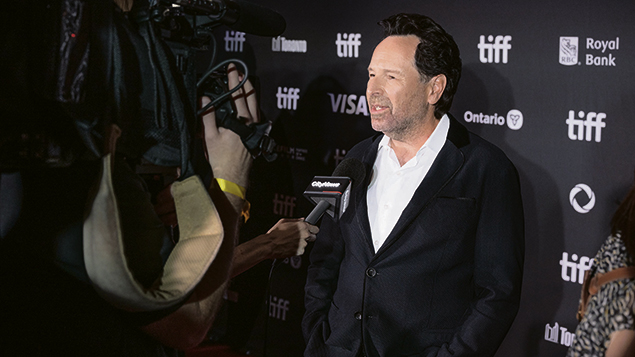
And the same can be said of the filmmaker, who put up one heck of a fight when the powers-that-be denied him entry at the Toronto International Film Festival, supposedly because he had not secured permission to use footage Hamas had aired to the world. But that came later.
On the early morning of October 7, 2023, sirens sounded at Nahal Oz, a kibbutz on the border with Gaza. The general had family there: his son, journalist Amir; his daughter-in-law, Miri, and two granddaughters.
Sirens are a regular part of life at Nahal Oz, so at first the family was unconcerned. They went into their safe room to await an all-clear. Like many if not most Israelis who live along the border, part of their home is supposedly impregnable, made of special concrete immune even to a direct mortar hit.
But there was no all clear. That was unusual. And relatively soon, the family heard automatic weapon fire, indicating an enemy was nearby.
Amir texted his father and described the situation as he knew it. He hoped his dad could provide clarity. General Tibon called his contacts, but no one answered. Meanwhile, his son’s texts were becoming more desperate. So he decided that he would go to the kibbutz to rescue his family. His wife, Gali, said she’d drive, freeing him to make calls and assess the situation along the way.
There was no arguing with her or her logic.
It’s a little more than an hour’s drive from Tel Aviv, where Miri and Noam Tibon live, to the kibbutz, and the Tibons were surprised to discover the roads strangely empty. But as they got closer, the highway suddenly became littered with bullet-riddled cars and bodies.
In the film, General Tibon says he was “35 years in the military, so I have seen many, many dead bodies. I never saw something like this.”

At one point, a young couple jumped out of a hiding place. They’d been at the Nova Festival, fled when the shooting began, and hid under leaves in the woods for hours, hoping for rescue.
This presented the Tibons with a Hobson’s choice. They couldn’t leave the couple there, and they couldn’t take them along into likely danger. The most viable of unattractive options was to retrace their steps and take them to safety — even though it would delay their arrival at Nahal Oz.
The Tibons took the couple out of harm’s way and started their journey a second time. The next obstacles they encountered were a pair of police roadblocks. They drove their Jeep through bushes to avoid one and ignored the other. They had to keep going.
At one point they encountered a small group of soldiers in a firefight with Hamas troops. General Tibon joined the fight and killed at least one enemy soldier before they ran off. But one of the IDF troops was severely wounded, leaving the Tibons with another choice. If he did not receive advanced medical care, the soldier would die. So, once again, General Tibon abandoned the journey to Nahal Oz to save the life in front of him.
Meanwhile, the situation at the kibbutz was getting more desperate. Electricity had been cut. The safe room was getting hotter, making it more difficult to breathe. Amir could not open the door because he did not know who was lurking outside. And the batteries on his and Miri’s phones were draining rapidly. So he sent his parents a final text:
“Don’t know if we’ll make it. Thanks for being the best parents and grandparents in the world.”
Of course, Noam and Miri did make it, thanks to an ending straight out of a video game or a Marvel movie.
When our Zoom conversation begins, it is just me and the general. While we’re waiting for Mr. Avrich to join us, I ask:
Curt Schleier: I’m curious where you stood on the political spectrum before October 7.
Noam Tibon: Why is this important?
CS: I want to get a feeling about where you stood and how October 7 changed you, if at all.
NT: I was a critic of the government, okay?
CS: What now? Do we know what happened? Do we know where the failures are?
NT: I think October 7 is the biggest failure and crisis in the history of the state of Israel. That’s why I don’t think that there are clearcut answers, and I’m pushing, like most of these rallies, for a formal investigation run by a Supreme Court judge, just like, you know, what happened after the Yom Kippur war 50 years ago. I think this can answer the question what happened on that day. And the more important question, how can we avoid such a crisis in the future?
[Note: This interview was conducted before the joint announcement about the new peace initiative.]
CS: As an American Jew, I don’t know how I can properly assess what’s going on in Israel, because I’m not there. But you are. Lots of people are protesting. They want to end the war and bring back the hostages. What do you think?
NT: I think right now, at this moment, it’s in the interest of the state of Israel, from a security point of view, to end the war and bring the hostages back home. I think this hostage issue reflects our deepest values. We don’t leave anyone behind.
And this is what I did on October 7. I worked according to those values as a retired general, the father of an officer serving right now [their son Uri is a doctor with the IDF]. I think this is in the interest of the state of Israel to end the war. Bring the hostages back home.
CS: Was there any doubt in your or Gali’s minds about what you were going to do when you left that morning?
NT: We didn’t have a clue how big it is. We knew only this: there were terrorists in the neighborhood of our son’s kibbutz. So at the beginning, I thought it was maybe a squad, you know, five or six terrorists who came in a tunnel. But later, I start to understand that it was something totally different.
In the beginning, you are surprised, and then you fight for your life. And basically, the journey in the movie made by Barry, you could see what I saw in my eyes. You know the chaos, the bodies, and this basically it was a journey. I left home at 7:30 in the morning and I met my son at 4 p.m. So you know it was a long journey.
CS: I tried to ask his views on the current government, but General Tibon was single-minded about bringing the conversation back to the film.
NT: Let me tell you something. The movie is not political. The movie is a universal story. My beliefs are well known in Israel, but it’s not the main issue in the movie. I believe the main issue is to end the war and to bring the hostages back home. I don’t want to deal with Netanyahu, his wife, whatever. I want to talk about the movie, and one day when we will do an interview about my political views, we can discuss it.
What Barry did in the movie, which I like very much, is basically leave politics aside, and focus on the story, which in many ways is a universal story: a father, a grandfather, a mother, a grandmother going to rescue their family. This is the big deal, and that’s why I believe it is talking to many people all over the world, not only to Israel or Jewish people.
CS: Looking back, is there anything you would have done differently?
NT: I don’t know, because it was such a chaotic day and basically, I made decisions from minute to minute. The whole picture was not clear to me. What was behind the next corner? Is it full of terrorist ambushes?
I can tell you that I’m very happy that I worked according to my values and my gut feelings. I think that at the end of the day, it’s really hard to think, how would you act differently? I think the most important issue is to get out to the journey, not to stay at home, staring on the TV or expecting someone else will do the work for you.
I think this is the most important decision that my wife and I took that morning. And once we were on the journey, it was, you know, from battle to battle, from surprise to surprise.
CS: By now, Mr. Avrich had joined the Zoom. He said that someone had told him about the story, and then he watched a segment about it on “60 Minutes.”
Barry Avrich: Watching “60 Minutes” emboldened me in that I could see he was the real deal. I reached out to him, expecting that I would be 14th or 15th in line behind somebody else from Hollywood or wherever would’ve gotten to him before me. When I spoke to him, he said the most frightening thing that any director or producer will hear: ‘You have to speak to my daughter-in-law. She’s an agent.’
CS: How did you fight what was clearly silly thinking on the part of the TIFF (Toronto Interational Film Festival) executives?
BA: We had three things going for us. One was defiance. I’ve entered films in festivals many times before and I’ve been rejected. That’s life as a filmmaker. But this made no logical sense whatsoever. So defiance was one thing going for me.
Secondly, hoping that the film community and Hollywood would rise up. The Toronto International Film Festival relies on Hollywood, and if Hollywood reacted in an adverse way to pulling this film, withdrawing the film wasn’t going to look good for TIFF. So there was a lot of hope in that.
I think we also thought we’d have the Jewish community behind us in Toronto. I never expected the global response to this, the New York Post, the New York Times, CNN, on and on and on, but everyone wrote about this, so that was incredibly validating and humbling. And then when Hollywood spoke out, 2,000 signatures [on a petition] that said this is not right, the film festival ultimately reconsidered, and this gave us a ray of hope.
NT: I want to thank all the people who supported this movie. That really touched my heart. I felt a victory twice. First, when it was shown in this huge theater, and there was a wonderful standing ovation. And then we won the People’s Choice award for documentaries, which is basically the number-one prize.
“The Road Between” opens around the country on Friday, October 3; locally it will be in Teaneck, Paramus, Clifton, and West Nyack.