A perfect match … medically speaking
Wyckoff man receives ideal kidney from daughter-in-law’s friend
In 1987, Gary Haar, who’d left a career in food distribution in his North Bergen-based family business, explored food service in Connecticut and financial trading in Manhattan, moved to Wyckoff with his wife, Natalie, soon became a Dunkin’ Donuts franchisee, and opened his first store, on Cedar Hill Avenue, in 2003.
After his father, George, died of a brain aneurysm in 1998, Mr. Haar was determined to work with doctors to monitor his health closely. In 2005, a scan showed that he had polycystic kidney disease. But because he was asymptomatic, it just meant that he’d need more regular scans. In 2012, his blood pressure began to rise and so did his creatine level. That’s a kidney function marker, so his doctor sent him to a nephrologist for a consultation.
Back then, “I was in my late 50s, the father of three sons, and my wife and I had expanded our small business franchise as owners of Dunkin’ Donuts shops in New Jersey to another location in Wyckoff, stores in Ramsey, Franklin Lakes, Glen Rock, and Fair Lawn, and eight franchises in West Los Angeles,” Mr. Haar said.
After a thorough evaluation, Mr. Haar was prescribed Jynerque, a medication that had been tested and approved by the FDA to slow the decline of kidney function in adults who are at risk for rapidly progressing ADPKD (autosomal dominant polycystic kidney disease).
“For the period of time I was on the medication — less than 18 months — my quality of life was being compromised,” Mr. Haar said. “I also learned that clinically, the drug was most effective for patients in the 30 to 50 age bracket.”
In 2018, a friend suggested that Mr. Haar see Dr. Jon Blumenfeld of the Rogosin Institute at Weill Cornell Medicine in Manhattan. “I consulted with Dr. Blumenfeld, who confirmed that there was no treatment for the disease and it was just a watch-and-wait,” Mr. Haar said. “But he recommended I undergo genetic testing. The results revealed a positive mutation for congenital PKD1.”
Mr. Haar’s children were tested as well; fortunately, they do not carry the mutation. He also learned that not only might the mutation cause more cysts, it made it more likely that aneurysms might occur anywhere in his body. “I was put on a schedule for brain scans every five years,” he said.
Mr. Haar’s blood was monitored twice annually to check his kidney function, and his kidneys were scanned regularly by ultrasound. “Dr. Blumenfeld was on top of my care and didn’t mince words,” he said. “The gradual decline in my GFR” — his glomerular filtration rate, which checks kidney function — “revealed significant disease.”
In 2022, when Dr. Blumenfeld decided to leave his clinical work in favor of research, he transferred his cases to Dr. James Chevalier, also at the Rogosin Institute at Weill Cornell. Dr. Chevalier continued to observe Mr. Haar closely. “By July of 2023, my creatine was spiking and my GFR had declined to 20, a marker for being tested for a kidney transplant,” Mr. Haar said.
“I went through the testing necessary to learn if I might be a candidate for a kidney transplant,” he said. He had prostate cancer in 2015; luckily, the surgery he’d undergone then had removed it, and there had been no metastasis. This made him a suitable candidate.
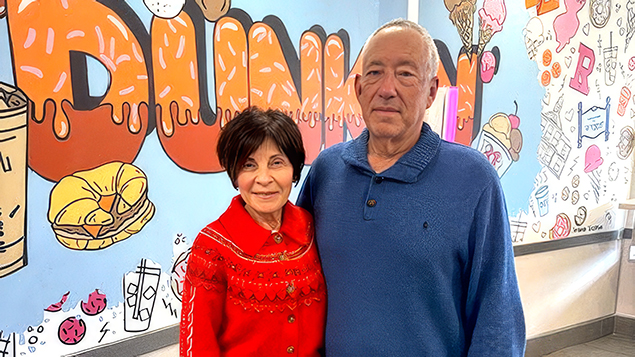
The screening also determined whether a potential kidney recipient would be compliant in following directions and taking medications as prescribed. In September 2023, Mr. Haar was approved.
, The first option to explore was a cadaver donor. “My team coordinator alerted me that the wait time for a cadaver donor is five to seven years,” he said. “I knew that patients with a GFR of 10 needed dialysis and since my GFR was 20, I figured, somewhat thoughtlessly, that since I was not yet at high risk, I had time.” But the transplant center team knew how quickly a patient’s GFR could decline. “They recommended I become educated in all possible options,” Mr. Haar said. “That included receiving a kidney from a living donor.
“My blood type was O, which meant I could be a universal donor, but not a universal recipient. My wife and my children were not a blood type match,” he said.
Mr. Haar and his wife explored programs at the Brooklyn-based organization called Renewal, a Jewish nonprofit for kidney donors and recipients, and at UCLA’S CORE Kidney. They talked to members of kidney transplant support groups.
His family helped him create a flyer outlining his situation. “I was 68 years old,” he said. “I’d been married for 40 years and was the proud father of three sons, Joshua, Jonathan, and Marc. I had a daughter-in-law, Julia, and two grandchildren, Ben and Sophie. I wanted to see them grow.
“As the owner of a company that employed nearly 200 individuals who depended on me for their livelihoods, I was driven by a sense of responsibility. I knew that losing my life to PKD would deeply affect my family and those in my employ, and it was becoming clear that my options were limited.”
So in January 2024, Mr. Haar posted his flyer in his stores and on Facebook and Instagram, detailing his circumstances and asking for a kidney donation.
“While six to 10 people responded with interest in helping me, it was my daughter-in-law Julia’s 34-year-old best friend, Samantha Simon, who not only had the same Type 0 blood, but signed up at Weill Cornell and started the process of getting tested,” Mr. Haar said.
Ms. Simon, who now lives in West Palm Beach, attended Rutgers University with Mr. Haar’s daughter-in-law. “We were in the same sorority in college and I was a bridesmaid in her wedding in 2017,” Ms. Simon said. “I knew Gary had PKD and had been dealing with it for years.”
Ms. Simon had worked as an administrator for a surgeon at Memorial Sloan Kettering after college, but in 2023, when Mr. Haar had placed himself on the transplant list, she was at Davidson Kempner, a hedge fund in midtown Manhattan.
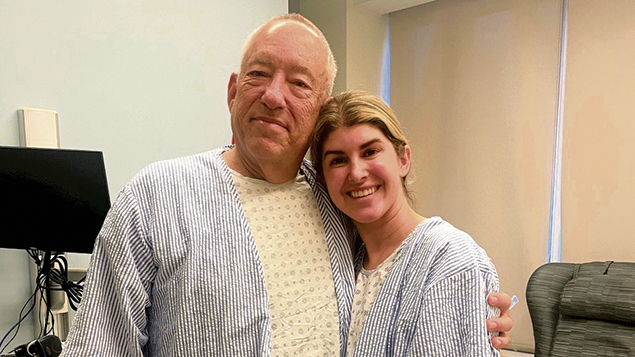
When Ms. Simon saw Mr. Haar’s posting on Instagram, she was curious, she said. She’d always checked the box to be an organ donor on her driver’s license, but “I never thought I’d know someone who actually needed one.”
Since she was also O positive, she decided to complete the questionnaire and “within a very short period of time” was contacted by a transplant coordinator at Weill Cornell. After a consultation with a social worker, Ms. Simon underwent multiple rounds of testing and bloodwork.
“Type O can only receive Type O,” she said. “I knew Gary’s pool of donors was minimal. I wanted to continue with the process, even though Julia had no expectation that I would.” Extensive discussions with a psychologist, step-by-step descriptions of the surgery and post-operative care, and support from her family and friends helped her to think her decision through. “I was physically capable of being a compatible donor, there was no risk to my life, and the Haars were like my second family,” she said. “It was a no-brainer.” Ms. Simon also learned that if she ever were to need a kidney, she would go to the top of a transplant list.
“It was the third week of February 2024 when I received a Facetime call from Samantha Simon,” Mr. Haar said. He gets choked up every time he replays her words in his head. “I was just approved as a kidney donor, and it would be my honor to give you my kidney,” she told him. Mr. Haar was “blown away by her generosity.”
The transplant surgery, scheduled for the end of March, was unexpectedly delayed when a vascular surgeon found an aneurysm behind Mr. Haar’s left knee during pre-operative testing. Surgery to repair it was scheduled for April 6.
“I was afraid Samantha might not be willing to wait,” Mr. Haar said. “But then she called me and said: ‘I’m not going anywhere.’”
Both the donor and the recipient’s surgeries took place on May 16, 2024. “We met at the hospital at 6:30 a.m.,” Mr. Haar recalled. “It was a moment I’ll never forget.”
His transplant was performed by Dr. Sandip Kapur, an internationally renowned transplant surgeon and the director of surgery at the Weill Cornell transplant center. It was good timing because Mr. Haar was approaching kidney failure. His own kidneys were not removed during the two-hour surgery. To do so can take up to 12 hours, and it’s dangerous. But his new kidney was placed next to his stomach in his peritoneal cavity.
Since that transplant surgery, Mr. Haar’s original kidneys have shrunk by about 50 percent, which is expected. “As a patient with PKD, I have been, and will continue to be, scanned regularly,” he said. “So even though the cysts in my native kidneys can still become cancerous, my medical team does not believe there’s imminent risk.”
The surgery to remove Ms. Simon’s kidney was performed laparoscopically by Dr. Joseph Del Pizzo of Weill Cornell Medicine. “My surgery was also about two hours,” Ms. Simon said. “Other than some post-operative soreness, I felt like myself within a few weeks. In May 2026, assuming all is well, I will graduate from the program.”
Mr. Haar stayed in the hospital for four days after the surgery. After more frequent checkups soon after the procedure, he now returns for monitoring three times a year.
At a follow-up appointment this month, Mr. Haar’s new transplant nephrologist, Dr. Pablo Loarte-Campos, gave him some fascinating news. “He felt after reviewing my file that, genetically, not biologically, Samantha Simon was so close, she could be my daughter,” he said. “There were zero antigens, which means there was zero chance for my body to reject her donated kidney.”
Mr. Haar is still amazed at how quickly he received his gift of life. “From posting my need for a kidney to receiving a donor match, I only waited five months,” he said. “From all I’d read, it never occurs that quickly.
“I guess I was lucky,” he added. “No other word would describe it better.”
For more information, go to kidneyregistry.com