A sacred journey home
Czech Holocaust scrolls leave Temple Sholom for restoration in London
In mid-March, 11 Czech Torah scrolls — each between 200 and 300 years old and long safeguarded at Temple Sholom of West Essex — were carefully bubble-wrapped, boxed, and prepared for shipment to the Memorial Scrolls Trust in London.
These scrolls, originating from Jewish communities in Bohemia and Moravia (now the Czech Republic), survived the Holocaust despite the widespread destruction of Jewish life and culture.
Jeffrey Ohrenstein, chairman of the Memorial Scrolls Trust, said that there are two theories explaining why these Czech scrolls were spared. Some people believe the Nazis intended to create a museum for what they imagined would be an “extinct race.” Others say leaders of the Jewish community persuaded the Nazis to preserve them. Whatever the reason, the scrolls, together with more than 200,000 other Jewish artifacts, were brought to Prague, catalogued, and placed in storage, where they remained until after the war.
In 1964, philanthropist Ralph Yablon bought 1,564 sifrei Torah and other scrolls, saving them from further loss and destruction under the communist regime. They were shipped to the Westminster Synagogue in London, which set up the Memorial Scrolls Trust as a not-for-profit charity to be responsible for the scrolls.
“It’s important that our children remember this history,” Mr. Ohrenstein said, highlighting the trust’s mission as the global Jewish community prepares to observe Yom HaShoah (Holocaust Remembrance Day) on Tuesday, April 14.
Temple Sholom’s relationship with the trust began in 1975, when the congregation became the permanent guardian of a small Torah from D’vur Králové — a once‑vibrant Jewish community built around textile factories for weaving, dyeing, and printing cotton and jute. When Hitler occupied the area in 1938–39, the factories were seized, synagogues were shuttered, and Jewish residents were deported to concentration camps. Almost none survived. One of the area’s five sifrei Torahs now rests at the center of Temple Sholom’s ark. The others are in synagogues in Australia, Canada, upstate New York, and California.
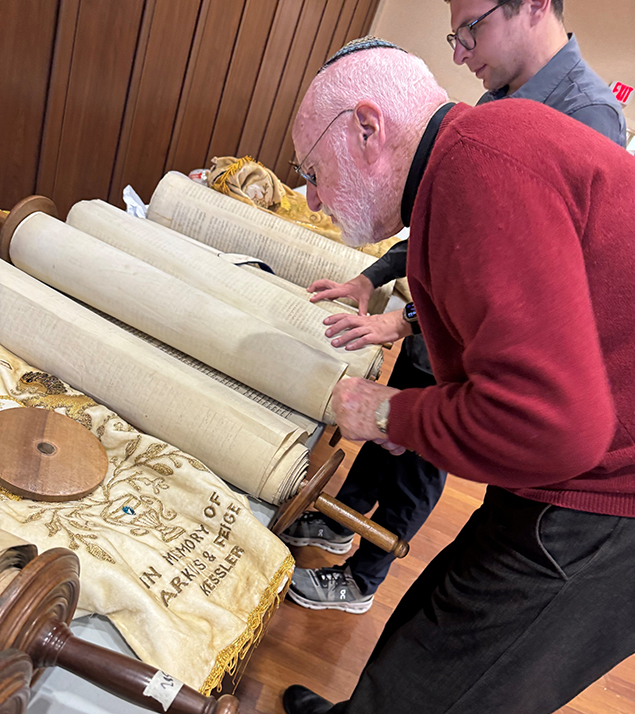
“Our b’nai mitzvah read from this scroll, and we carry it and read from it with joy tinged with sadness on Simchat Torah,” the shul’s rabbi emeritus, Norman R. Patz, said.
The names of the Jews of D’vur Králové, who were murdered by the Nazis, are included in Temple Sholom’s kaddish list and in its annual memorial book, its rabbi, Lawrence Groffman, said.
Since 1964, the Memorial Scrolls Trust has allocated scrolls on permanent loan to 1,300 synagogues and institutions worldwide. The scrolls are never sold or given away; if a community closes or merges with another that already holds a Czech scroll, the Torah must be returned to the trust.
Over the years, as congregations across the tristate area merged or shut their doors, Temple Sholom became known as a safe haven for these irreplaceable artifacts, ultimately curating more than a dozen scrolls as they awaited their return to London or new homes here. Some scrolls later were entrusted to new or growing synagogues committed to preserving the memory of the communities destroyed in the Holocaust, Rabbi Patz said.
Mr. Ohrenstein recently visited the United States for the opening of Binders of the Covenant, an exhibit at Fordham University showcasing Torah binders from the Memorial Scrolls Trust, on display at the school’s Bronx campus through the end of May. “There are about 1,000 of the scrolls in the Americas,” he said. “We thought we would collect the ones being safely kept by Temple Sholom while I was here. Temple Sholom has been a safe haven for these important pieces of history, but now we believe it is best to centralize the scrolls in one place.”
The scrolls will be shipped to the trust’s headquarters in Kent, where they will be assessed and restored as needed. From there, they either will be loaned to new communities or placed in the trust’s museum, joining 150 other scrolls on permanent display. One scroll will be exhibited permanently in the Czech Parliament. Other than in Israel, it will be the only one in a parliament anywhere in the world.
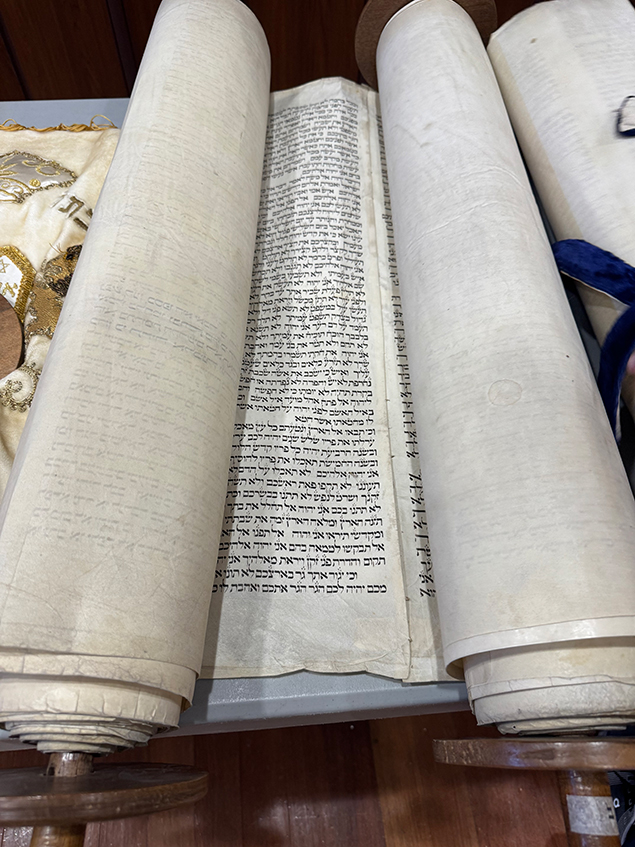
“A rabbi once told me that remembrance was immortality,” Mr. Ohrenstein said. “Our Memorial Scrolls Trust Czech scroll-holders immortalize the Jews and Jewish life so tragically destroyed in the Holocaust.”
In 2008, Temple Sholom and the town council of D’vur Králové jointly sponsored the placement of a monument on the site of the destroyed synagogue. It was dedicated in the presence of students of that year’s synagogue confirmation class, their parents and grandparents, town dignitaries, including Christian clergy, a representative of the U.S. ambassador to the Czech Republic, and Eva Noskova, the last Jew to live in the town.
Two books by Rabbi Patz’s wife, Naomi, “Thus We Remember” and “Thus We Remember: The Continuing Story of our Holocaust Torah Scroll,” now document the history of that Jewish community and Temple Sholom’s enduring connection to it. Copies are in the Library of Congress, Yad Vashem, the Center for Jewish History, the American Jewish Archives, and the library of the Jewish Museum in Prague.
Rabbi Groffman says that the efforts by Rabbi and Ms. Patz “is a mitzvah.
“Through the tremendous work they have done over the last several decades creating a relationship between our congregation and the community of Dvůr Králové, the Patzes have helped perpetuate the memory of the members of that destroyed Jewish community who perhaps otherwise may have been forgotten.”
To learn more about Temple Sholom’s scroll, go to www.sholom.net. For more information about the Memorial Scrolls Trust, go to www.memorialscrollstrust.org.