Dance, community, and fixing the world
Carolyn Dorfman Dance performs hope and balance at NJPAC
On the one hand, life is a constant balance — between individuality and community. Between abstraction and specificity. Between seriousness and fun. Between reality and hope.
One the other hand, Carolyn Dorfman said, “My mother, who survived the war” — that’s World War II — “tells me that she never lost hope.”
So Ms. Dorfman, a choreographer whose Union-based company, Carolyn Dorfman Dance, has been performing for more than 40 years, has chosen to listen to her mother, always be aware of the balance — both metaphorically and literally — and put all that wisdom in her art.
The company will perform at a benefit in Maplewood on April 23 and then present “The Power of One” at NJPAC on May 14. (See box.)
“Art has great power to speak about contemporary life,” Ms. Dorfman said. “What drove me to this art form — dance — is the ability to speak about the full range of human experience, particularly during these very complicated times.”
Dance can tell a story, and it can be entirely abstract, or it can merge the two, in some balance or other. The program set for NJPAC has reality and truth, and also hope.
“My mother’s never losing hope is remarkable, and it is an important part of who I am,” Ms. Dorfman said. “My parents choosing hope shaped me. There were many survivors who chose life. Many others couldn’t. But my parents chose to live in defiance of what had happened to them. When I asked my mother why she made that choice, she said if she didn’t, it would mean that Hitler won. She refused to abdicate her life to that.”
Her parents, Henry and Mala Weintraub Dorfman, didn’t talk much about the Holocaust, but they passed their understanding of how to survive and live after horror to their daughter.
Ms. Dorfman grew up in a community of survivors in suburban Detroit, with the understanding that “one person can come in and change the course of someone else’s life. That’s the power of the individual, the power of our unique selves.” That’s particularly important now, “at a time when we can feel so powerless. The power of one.
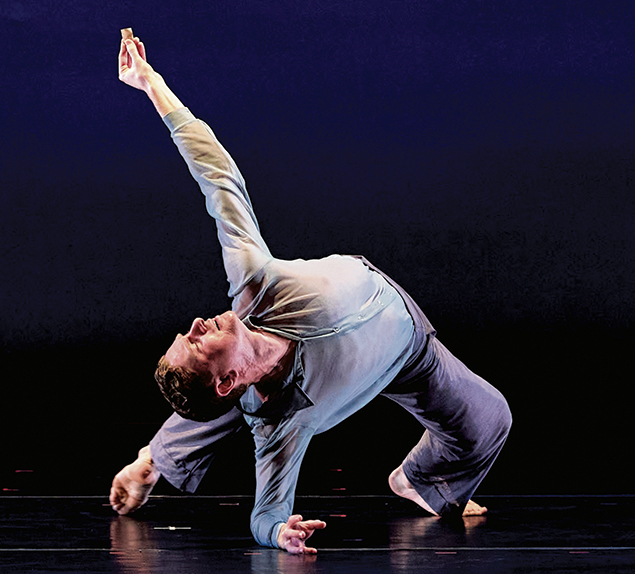
“Yes, that can be negative. There are powerful people who do terrible things. But this performance” — of “The Power of One,” an evening of three dances, and specifically one of them, “The Hero Within” — “is about the best in each of us, which I do believe is what these times call for.”
“The Hero Within” is the story of Max Heller, who was born in Vienna and left it in 1938, just before the Anschluss, when the Nazis annexed Austria. The story of his escape is extraordinary, and so is what he did once he got to America. Basically, he moved to Greenville, North Carolina, and reshaped the city, with kindness and decency, in ways that still mark it today. “When he got out of Vienna, he never forgot what it was like to be othered,” Ms. Dorfman said. “To be berated, to watch people turn on each other, to watch people die.
Ms. Dorfman says that she is basically a storyteller; her stories are told mainly with bodies as they move through space and time, interact with each other, and shape and reshape themselves. Had she not been a dancer and choreographer, she said, she would have been a therapist; she loves talking to people, and listening to them. She is able to turn their stories into movement.
She didn’t know Max Heller or his wife, Trude, but she was able to talk to some of their children and grandchildren. She learned that in some ways the Hellers’ children’s stories were not unlike her own. “Our parents’ stories were different, but they had a desire to live life, work hard, and make it in America.”
Max Heller’s improbable story started in 1937, when “he and five friends went to a dance in Vienna. They had just come back from a Jewish summer camp, where he had met Trude. He was 14, she was 17, and when they met he told her ‘I will marry you.’
Back in Vienna, at the dance, he and his friends saw five young American woman, with a chaperone. He danced with Mary Mills. “It wasn’t romantic, but he offered to show them some sights,” Ms. Dorfman said. He didn’t speak much English, and they didn’t speak German, but he had a German-English dictionary, so he, the young women, the chaperone, and the handy dictionary toured the city. “At the end, Mary gave Max his card, with her address on it, and he told her that when he learned would English, he would write to her.
“Then the Anschluss happened, and then his best friend, who wasn’t Jewish, threw him to the ground and stomped on him, and goes home and says to him parents, ‘Let’s get out of here.’ And they say, ‘Where can we go?’ and he says, ‘To America.’ So he pulls out the card, and he writes to her, and she goes to her father — she could have just thrown the letter out, but she doesn’t — and her father is a big businessman. And he goes to Shepard Saltzman, who owned of the Piedmont Shirt Factory” — Mr. Saltzman was a Russian Jewish immigrant, and the factory was in Greenville — “and Saltzman got Max papers to get out.” Eventually Max — “he was Moses at the time,” Ms. Dorfman said — his parents, Trude, and her parents, all escaped Europe, went to Greenville, and worked in the Piedmont Shirt Factory. Max flourished, eventually started his own business — but he promised never to compete with Mr. Saltzman, and he kept that promise — and not only did well but also did good.
Despite the Jim Crow laws then enforced in the South, Mr. Heller integrated his factory. The idea of a colored fountain was ridiculous, he said, unless it meant that the water coming out of it was tinted. He became Greenville’s mayor and is widely seen as the creator of its renaissance. He started a synagogue there; the Jewish community thrives. He is working out the Jewish value of tikkun olam — fixing the world — one person, one step, one goal at a time.
All this is in Ms. Dorfman’s “The Hero Within” — the performance at NJPAC will be its world premiere.
The evening will open with “Now,” by Jules D. Lane, who “started his career in my company and has grown into a national choreographer,” Ms. Dorfman said. “He made a lot of this movement during covid, in isolation. That’s all he could do, And then it began to celebrate community in a different way, and also it was about moving into the unknown.”
It also includes “Echad” — Hebrew for one — an earlier, iconic work by Ms. Dorfman.
The piece features a 120-pound wheel onstage “that embodies my art, my artistic and process philosophy, . Each of us is unique. In a perfect world, we each bring our full self to the equation, as unique individuals existing in relation to each other.”
Is it all about tension? “You can put it that way, or you can say that it’s all about balance,” Ms. Dorfman said. “There’s a delicate balance between what I want and what we need.” In “Echad” that balance is tangible, and the stakes are real. “It is how we function as a company,” Ms. Dorfman said. “If you don’t embody it as you perform it, it is literally dangerous. People are riding a wheel. They are lifting a wheel.
“Everybody works as their own unique self, in concert.
Each of these pieces is its own journey, but it’s a journey.”
Ms. Dorfman’s work is rooted in New Jersey. Her husband, Gregory Gallic, an orthopedic surgeon, graduated from Rutgers and started a practice in Union. Ms. Dorfman started her company in his office. Throughout her long career, she’s been supported by the New Jersey-based Blanche and Irving Laurie Foundation — because, particularly in the Jewish world, the foundation’s executive director, Gene Korf is Max Heller’s nephew. “He’d known me for forever, 22 years, and he’d never said a work about his uncle until the company toured North Carolina.” That’s how “The Hero Within” was born.
She’s also been supported, both as a choreographer and as a dance educator, by the Geraldine R. Dodge Foundation, and NJPAC co-commissioned the work.
The audience at NJPAC will be able to see for themselves how realism and abstraction, story and movement, reality and hope, move on a stage together, individually and in community. Ms. Dorfman hopes that they see all of that, and that they leave with hope.
Who: Carolyn Dorfman Dance
What: Holds Reach, a benefit to “build community through the power of dance”
When: On Thursday, April 23, at 6:30 p.m
Where: At Maplewood Country Club in Maplewood
Featuring: dinner and performances
Tickets and information: carolyndorfman.dance
*****
Who: Carolyn Dorfman Dance
What: Performs “The Power of One”
When: On Thursday, May 14, at 7:30 p.m.
Where: At NJPAC in Newark
Tickets and information: At njpac.org or carolyndorfman.dance