Dart frogs, trade gambits, and enriched uranium
The rules are changing around the world; Ukraine was just the beginning
“We live in medieval times,” Alexander Smukler of Montclair said.
He’s the Moscow-born American Jew who draws on his background and wide network of sources to analyze Russia’s war in Ukraine for us.
“The rules are completely nonexistent,” he said. “In the global game of thrones, everybody does whatever they want to do.” That is, he clarified, as long you understand that “everybody” means almost nobody except the strongmen whose whims and needs shape our lives. “They can do whatever they want, and nobody is really paying attention. Everything is possible today. Everything is permitted.”
In February, almost exactly two years after he died in a Russian prison, the world learned that Alexie Navalny’s death — which the Russians had attributed vaguely to natural causes — was caused by epibatidine, a poison found in South American dart frogs. Navalny was the charismatic Russian opposition leader whose increasingly successful opposition to Vladimir Putin landed him in a sub-Arctic prison. Dart frogs are hard to find in northern Russia, according to a statement from the foreign ministries of Britain, France, Germany, Sweden, and the Netherlands. “Only the Russian government had the means, motive and opportunity to deploy this lethal toxin against Alexei Navalny during his imprisonment in Russia,” the statement concluded.
“The poison was produced in the same lab that made the Novichok that the Russians used to try to murder Sergei Skripal,” a former Russian spy who’d made a new life for himself in England, Mr. Smukler said. In 2018, the Russians tried to assassinate Skripal by putting the poison on his doorknob; he and his daughter, Yulia, were badly hurt but survived the attack. (An entirely unconnected Englishwoman, Dawn Sturgess, died, and her boyfriend was badly hurt, when the boyfriend found the perfume bottle that had held the poison and gave it to her.)
“They used a different poison against Navalny than the Skripals, but it did come from the same lab,” Mr. Smukler said. “It reminds me of medieval times, when poison was used to eliminate political leaders.” The Borgias were particularly given to advancing themselves in that way, at least according to myth. “Now we are back in that same situation, where strongmen can use poison against enemies.
“And the reaction in the world, and the media, and the U.N. is that they’re just barely covering it.”
And now, Mr. Smukler continued, the Supreme Court’s decision that President Donald Trump’s tariffs are not legal “changes the whole ball game on the world scene, not only in the economic field but in the military field as well.”
The midterm elections are coming in November. It’s likely that Trump will lose the House and increasingly less impossible that he might lose the Senate too. “And now this Supreme Court decision basically has annulled his economic policy, which he strongly advertised as a huge success. It’s a fiasco for Trump. And it put him in a very serious corner. A corner that Putin has been in before. Now, he has to do something to get himself out of this internal political mess.

“And then there’s Epstein, which has created enormous turmoil in the global game of thrones, because now it’s shaking the monarchies in Europe. Great Britian, obviously, and Norway.” (Norway’s crown princess, Mette-Marit, was close to sex offender Jeffrey Epstein, who is said to have killed himself in jail in 2019.)
“And now there is a growing conspiracy theory about Epstein, that says that he was the product of the KGB, and his connections with the Russians are obvious.”
According to this conspiracy theory — which has been neither proven nor disproven yet, and is not implausible — Epstein collected and preserved information, Mr. Smukler said. He not only created a network where he sold the services of young women, and offered them to political influencers, “but he also protected his files. He never erased anything. A guy who’s doing this for fun wouldn’t be that careful.
“This guy was keeping information in order to let people know that he had it,” the theory goes. “He was like a huge spider drawing people into his net, obviously thinking that it would protect him in the future.
“It didn’t.”
So how does this affect Donald Trump? “Trump is now involved in major internal political turmoil with these files, what he sees as his debacle with the Supreme Court, his failing negotiations with the Russians over Ukraine, the unclear situation with his Board of Peace and Gaza, and the looming midterm elections,” Mr. Smukler said.
“So he has to do something to get out of this. To jump out of the corner. There’s only way for him to get out of the corner he’s trapped himself in.”
This is exactly what Mr. Smukler had said about Vladimir Putin a few years ago, “when he got trapped by the unsuccessful blitzkrieg he started in Ukraine. For Putin, the only way out was to jump out of his corner and use all the strings he could pull in the Middle East.”
Eventually, that — not only that, but along with other precipitating factors — led to October 7, Mr. Smukler said.

So now, “I am predicting that sometime soon after the State of the Union address” on Tuesday night, February 24, “he will start a military operation against Iran.
“He didn’t want to start it before his speech to Congress, because that would have created questions, and it would have moved public attention away from the speech, where, of course he talked about what he sees as his enormous success with the economy, with his peace efforts, and in foreign affairs.
“So I predict that the operation will start next week.
“My prediction is based on one thing only. It’s the only way for Trump to get out of the corner that he’s in now, not only internally but also in foreign affairs, where he’s obviously failing in negotiations with Putin.”
That’s not what Steve Witkoff, the real-estate developer whose friendship with Trump has made him the president’s special envoy to troubled spots around the world, despite his lack of any background in diplomacy or global affairs, has been saying. Witkoff and Trump’s son-in-law Jared Kushner, whose background in diplomacy mirrors Witkoff’s, have been involved in trying to end Russia’s war in Ukraine. “Witkoff gave an interview a few days ago saying that we are moving forward, and that the results of the latest negotiations in Geneva have been partially successful,” Mr. Smukler said. “Witkoff said that he’s really hoping that we’re moving toward a meeting between Putin and Zelensky, and that hopefully President Trump will participate, but that would be his own decision.
“But I believe that the idea that a summit between Putin and Zelensky will happen is 100 percent garbage.
“Zelensky keeps saying that in order to solve the problems about the territorial issues” — that’s the 20 percent of Ukrainian land that Russia occupies — “he has to meet with Putin. But he 100 percent understands that Putin will never meet with him unless Zelensky is going to sign a complete capitulation in front of him. Putin cannot afford to meet with Zelensky without putting a victory ticket in his pocket.”
Why? “Because Putin considers Zelensky to be a clown. He considers himself at the top of the KGB intelligence, which is the intellectual elite in Soviet society. In his mind, he is a superman. And not only that, but a superman who won the lottery.
“He is the ruler of a country that he believes to be an empire, and he’s had the longest rule of anyone in Russia since Catherine the Great. Very soon, it will be longer not only than Stalin’s and Peter the Great’s, but also Catherine’s. Those three Russian rulers played the most significant roles in the Russia empire, and soon Putin will have ruled longer than they did. He has no equal anywhere in the world.
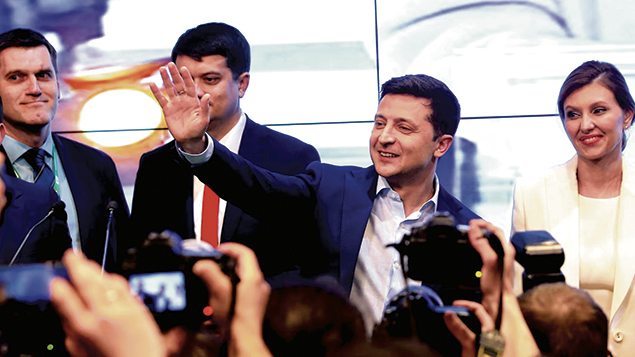
“Putin met with Bush Senior, then Clinton, then Bush Junior, then Obama, then Biden, in between Trump I and Trump II.” So now the idea that he would meet up with this jumped-up clown, this comedian — it would be so far below his dignity as to be impossible.
“I can think of only two reasons why Putin would meet with Zelensky,” Mr. Smukler summed up. “Either he and his country would be so totally exhausted that they realize that they cannot win this war, which would be a fiasco for him, or to sign the Ukrainian capitulation, and then go to the press to announce the full victory.
“So when Witkoff says that they are moving forward, and they have strong reason to believe that Putin will meet with Zelensky, it means that even after nine meetings with Putin, Witkoff still has no idea who he is dealing with. So when Putin says, ‘Of course, Steve, I can meet with Zelensky. I’ll invite him to the Kremlin. I’ll feed him black caviar. We will drink vodka together, and we’ll sit in the banya,’ the bathhouse, ‘together,’ Witkoff believes it.
“‘And maybe, after that, I’ll let him go,’ Putin says.
“More likely he’ll be poisoned by another dart frog.
“That interview showed me that Witkoff has no idea who he’s dealing with. Putin is having enormous problems today, but he is not going to meet with Zelensky because he has not seen any sign that Zelensky will give up and capitulate. We are seeing a stalemate not only in negotiations but in the war, which obviously will continue.”
Back in Washington, “Trump is very annoyed with Putin,” Mr. Smukler continued.
Remember back on the campaign trail, when Trump insisted that he could end the war between Russia and Ukraine within 24 hours after reassuming the presidency. “Trump really believed that he could do it,” Mr. Smukler said. “He thought that he could pick up the phone and call Putin and say, ‘Vladimir, by the way, I’m back in power. Let’s stop that war. Let’s just make money. We don’t need to fight any more. Let’s go back to business.’
“But it didn’t work. After that failed, Trump told himself, ‘Okay, I’ll meet with Zelensky and see what he has to say.’
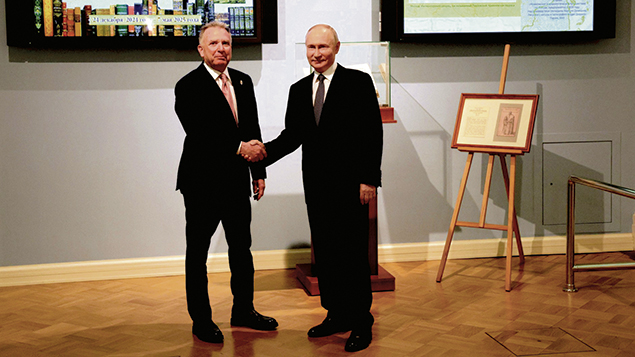
“He didn’t realize how tough Zelensky is. He thought it would be easy to influence him, but it turns out that he’s a tough nut to crack. Trump saw that Zelensky had principles, red lines that he was not going to cross.
“So Trump said to himself, ‘Okay, let’s go. We’ll send Putin a signal. We’ll tell him, You have time to take the other part of the Donbas so you can announce full victory to your people.’ But now, after a year of these games, Trump realizes that Putin was not able to succeed in that year because he wasn’t able to break through Ukraine’s front lines and defeat them.”
He was wrong last year, Mr. Smukler said. “I admit it.” Like most analysts, he believed that Russia slowly but inevitably would win the war because eventually it would break through the frontlines. That didn’t happen. “Russia didn’t have the capacity to do that. Miraculously, the Ukrainians were able to hold on. It is unbelievable. Putin was able to advance several thousand square kilometers, which is nothing compared to the casualties. To the loss of so much human life. He gained nothing, and he was not able to reach the goals that he’s promised his people.
“He said that Ukraine would be demilitarized,” Mr. Smukler said. It’s not. “He said that Ukraine would be denazified.” An impossible goal, since it wasn’t “nazified” in the first place. “And all of our territories, Nova Russia, New Russia, will become ours.” It didn’t. “None of that happened.
“So Putin needs more time to exhaust the Ukrainians or he has to stop the war where he is now. The Ukrainians have agreed to freeze the frontlines where they are now, so that the territories that Russia has occupied will not be recognized internationally as Russian but they will be under Russian supervision.” But the Russians didn’t accept that.
So Trump doesn’t get to proclaim his diplomatic victory in Ukraine any more than Putin does. “If he wants to distract from yet another failure, he will have to look elsewhere. It is much easier to start a war than to finish it.”
One problem with starting a war with Iran is “that his military experts cannot guarantee the outcome.”
There are many reasons for that, but one of those reasons is that “Trump rarely finishes a job. He’s everywhere in the world. Now he says that he’s concluded not just eight wars” — that used to be his claim, although neither he nor anyone else could name all of them — “but now he’s claiming 20 wars. So every time he says he’s ended a war, he doesn’t dig deeply enough to really end it.”
That’s the situation in Gaza now, Mr. Smukler added. “Yes, the military operations there have stopped, but nobody knows what to do with Gaza now.”
There is one war that the Trump administration did end, Mr. Smukler said. That’s the one between Armenia and Azerbaijan, which had been going on for more than 35 years. “And now Armenia and Azerbaijan are allies of the United States, and absolutely out of the Russian orbit. Historically, they were part of the Soviet Union. That was a huge hit for Putin.”
But what about the looming war with Iran? How will Trump sell it to Americans, most of whom, polling shows, are against it?
“I have a theory,” Mr. Smukler said. “You know that last June, in that 12-day war, we destroyed the Iranian facility that enriched uranium. There is a huge question about what happened to the 400 kilos of enriched uranium. Some Israeli sources are saying that it’s enough for 12 nuclear bombs.”
Although last summer Trump said that he had destroyed Iran’s ability to make more nuclear weapons, “now he will explain that Iran is rapidly rebuilding its nuclear facilities.” And there is all that missing uranium.
“My personal theory is that Iran was able to transfer that enriched uranium to Russia through ports on the Caspian Sea, and now it’s stored in Russia,” Mr. Smukler said. “It’ll be returned to Iran when Iran has restored its nuclear facilities and again be able to assemble nuclear bombs. Because the Caspian is an internal sea between Russia and Iran, it’s very hard to monitor, and there’s an intensive trade exchange there. All kinds of container ships are always there. So it’s hard to follow what’s going on, even by satellite, and it’s hard to figure out where the uranium is stored.
“Trump will never admit that the enriched uranium is now in Russia” — that would be too mortifying an acknowledgement — “but he will say that we’re going after the possibility that there is enough uranium in Iran to make bombs, and they’re only months away from doing that.”
If Trump can make this work, if he can get the credit for having made it work, that will help him in the midterms, Mr. Smukler said. It will be a useful distraction from his failures. “And Trump has only this one option today in order to get credit before the midterms after his fiasco in the Supreme Court, and the huge economic turmoil he’s caused. He needs this in his portfolio.
“His goal is to say to the American public that we demolished the regime. Maybe we killed Khamenei. We’re not bringing back the son of the shah.” (That’s Reza Pahlavi, the son of the deposed Shah Mohammad Reza Pahlavi, who lives in exile in the United States and has been mentioned as a possible replacement for Iran’s current government.)
There’s a deep, sad story here. “I feel terrible for the Iranian opposition,” Mr. Smukler said. “They’ve already sacrificed 35,000 lives to destroy the mullahs’ radical regime, and Trump did not come to help them, although he was telling the whole world that help was on its way.”