Hate in Livingston
Demonstrators try, fail to disrupt Yoav Gallant’s talk
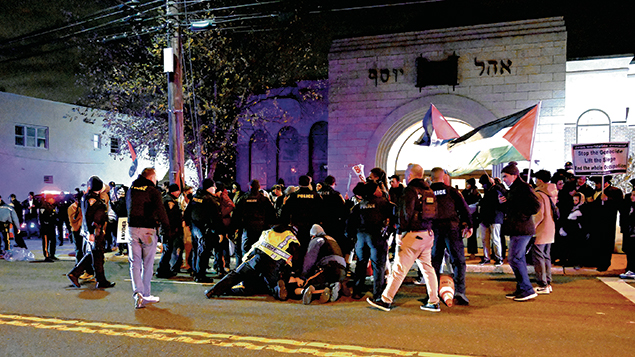
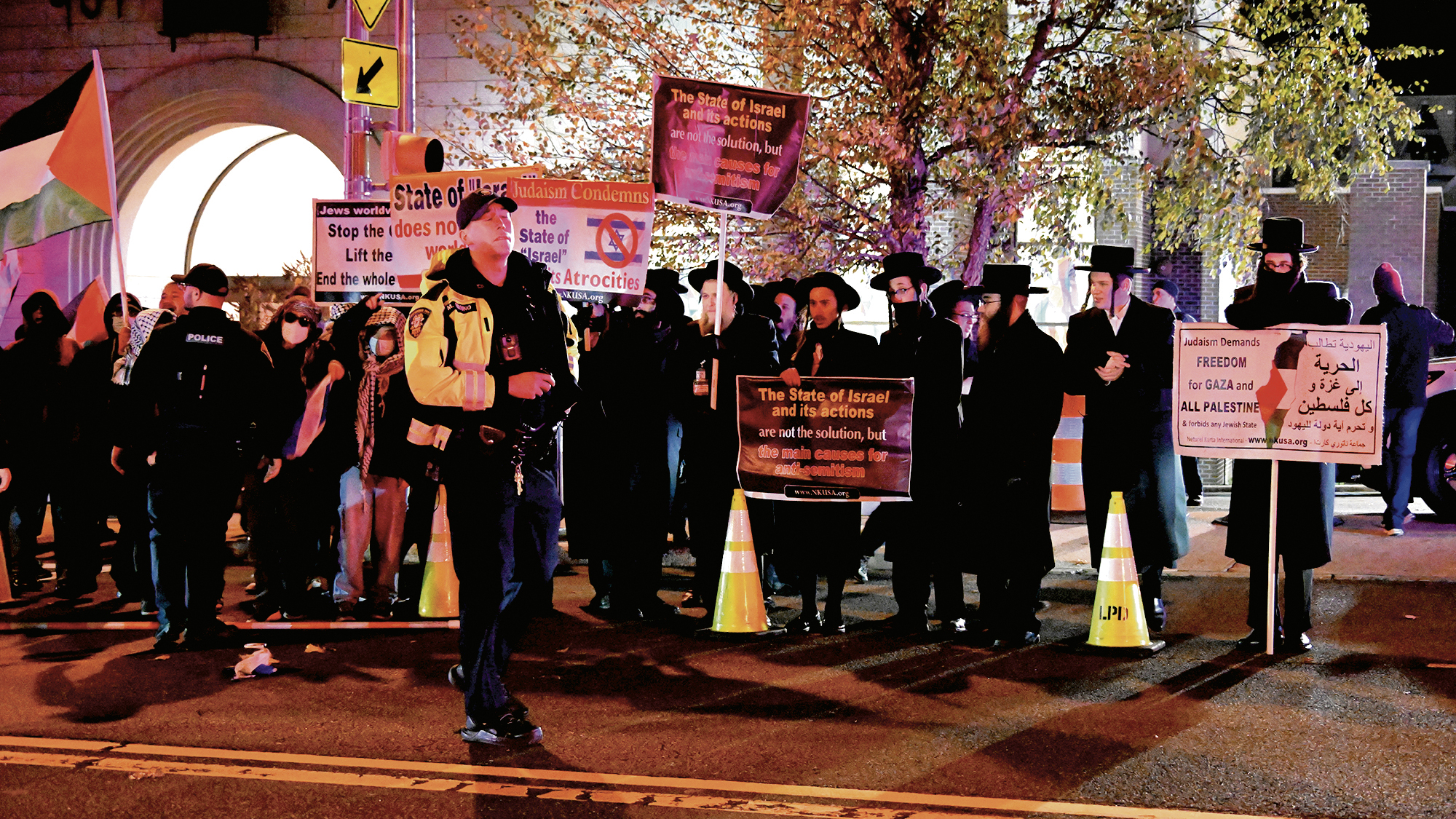
On Tuesday, November 11, about 100 or so pro-Palestinian protesters gathered outside the Suburban Torah Center in Livingston to make clear their rage at the speaker inside the building. Eventually, six of them were arrested.
The speaker was Yoav Gallant, the Israeli politician who most recently was its defense minister.
Jeremy Siskind of Livingston, a retired engineer and professional photographer who was on his way to his own shul, not far from Suburban Torah, for a men’s club meeting, hadn’t heard about the Gallant talk. It hadn’t been advertised, but somehow word had gotten out. “It was a dark, windy night,” he said. “I got a text from some friends, saying, ‘Hey, we just passed Suburban Torah. There’s a big demonstration going on there.’ So I drove down Route 10.
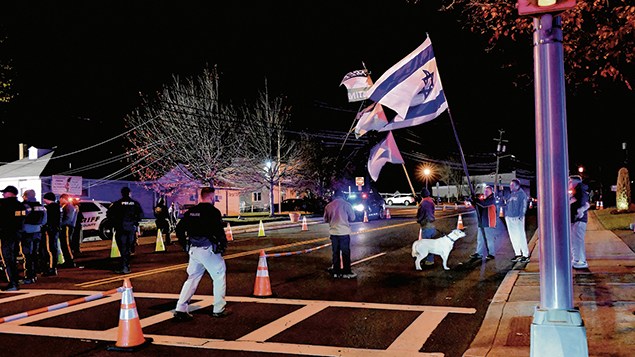
“When I got close to Suburban Torah, I saw that the police had closed off one lane in each direction on Route 10. There were maybe 75-plus people there then, plus maybe two dozen cops.
“It was pretty intense, but then it got much worse,” he said.
That’s when his photographer brain turned on. Mr. Siskind took photos.
“They” — the Livingston police — “kept calling in the cavalry. More and more cavalry. There were about 10 departments represented” — including county and state police, the county sheriff’s department, and some groups from Morris County.
The protesters “started blocking the road, and then they sat down in the road. The police ended up closing Route 10,” Mr. Siskind said.
“By the end, they had five guys with long guns, state troopers from Bloomfield. I’ve seen reports that some of the police officers were slightly injured, but I didn’t see that. I did see some demonstrators on the ground, and six or seven cops on each one of them. I know that six protesters are reported arrested; I saw two or three of them get arrested.”
He was impressed by the police officers. “They really kept their cool,” he said. “The chief is really good, and his guys and gals — lots of gals, they’re very diverse — are very well trained.
“They told me they knew that this might happen a few days before it happened, but I don’t think they expected it to be this bad.”
Edward Meinhardt is the mayor of Livingston. He’s lived in town for 30 years, and he’s been on the town council for 11 years. He’s Jewish. And he’s never seen anything like what happened on Tuesday before.
His engagement with the protesters — or to be more accurate, their engagement with him — began in the afternoon, when one of them doxed him online.
An anonymously posted video “said that you should be complaining to your elected officials — Governor Murphy, Governor-elect Sherrill — but the most important person to complain to is the mayor of Livingston,” Mr. Meinhardt reported. “He said a whole bunch of words that I don’t want to repeat, but basically he said that the mayor is not going to help you, because he’s a Zionist, Israel-loving, Jew-loving bastard.
“It showed me testifying in Trenton earlier this year, trying to move the bill about the IRHA,” defining antisemitism. “And they put my full name and street address and cellphone number up on the video.
“And then, at the end of the video, there was the sounds of two shots. Two guns going off.”
The video was taken down about 12 hours later, Mr. Meinhardt said; he got about a dozen threatening texts and phone calls during that time. “I had to have police protection at my house,” he said.
The police are looking for the person who posted the video.
There are five synagogues in Livingston, Mr. Meinhardt said, and although there are fewer Jews in town than there once were — the demographics are changing, as demographics always do — “there still is a substantial Jewish population.”
As to Suburban Torah’s speaker, Yoav Gallant, “he might be a controversial figure, but that doesn’t give anyone the right to do what they did,” he said. “They were upset at me for letting him speak, but I have no authority to tell anyone who can or can’t speak at their private place or at a house of worship.”
He had to go somewhere else that evening, but he was able to hear some of Mr. Gallant’s talk, Mr. Meinhardt said, and “it was very interesting.”
He praised Livingston’s police department for their professionalism and skill. As soon as they realized how big a deal this speaker in this venue would be, they started planning, and they ably coordinated the many other agencies that sent officers for mutual aid. He mentioned the police chief, Gary Marshuetz, and the two police captains, for ensuring that there were no serious injuries that evening.
Chip Michaels is the Jewish Federation of Greater MetroWest’s chief security officer. “Suburban Torah reached out to me a couple of days before, basically touching base to see if I had any suggestions for security,” he said. “I went through our protocols for best practices for securing special events. They already had implemented some of those things.
“The only thing I did stress was that I said, ‘I know you spoke to Livingston, but I’d like to take the lead with the police department. It’s important that they understand the potential here.” The potential for trouble. “So I spoke to them, and then I reached out to the intelligence analyst we have on staff, and had them start looking into the event.
“We quickly identified that there were lots of groups out there that were really upset, so I relayed that back to the Livingston Police Department, and they were very responsive.”
The police department initially sent about 30 officers and supervisors to the protest. “It’s a small department,” Mr. Michaels said. “It’s not a 1,000-person department. Thirty percent of their staff were there. It’s a huge commitment.
“The police were very responsive, very forward-leaning, and very well prepared — as well prepared as they could be,” he continued. When the first person was arrested, “it escalated. To avoid being overwhelmed, the Livingston police department called for mutual aid. At one point, there were at least six towns involved, and at least 100 police officers.
“Route 10 was closed for almost two hours. Traffic must have stretched back to Sussex County. Obviously, with that sort of presence, order was quickly restored. And then, once the event was over, everyone just left. The protest just kind of broke up.”
The whole thing lasted for less than two hours.
The six protesters who were arrested came from all over, Mr. Michaels said — from Belle Mead in central Jersey to Croton-on-Hudson in northern Westchester — and “they were arrested for varying charges, from disorderly conduct to unlawful possession of a weapon.”
Afterward, “one of the guidances I sent out to all of our institutions was reinforcing the close coordination between law enforcement” and the institution planning anything that might be even slightly controversial,” Mr. Michaels said. “If we can get information to law enforcement, it will be better prepared when it gets there.” The fracas in Livingston “is an example of what happens when you’re prepared.”
James Proops is the rabbi at Suburban Torah.
“Truth be told, the situation looked a lot worse for most of us, who were inside the building, than it did for people outside, because other than when we were walking or driving by, we didn’t know what was going on. We had everyone come in through the back entrance, so we were very well shielded. We couldn’t hear anything because we were deep in the shul, in the main sanctuary. The only reason that anyone inside could have come face to face with the protesters would be if they went against what we suggested, and went to see what was happening.
“Many people did that, of course, but they did not need to do that.”
Because they knew that something nasty might well happen, the evening’s organizers thought about canceling Mr. Gallant’s talk, Rabbi Proops said. “It was a discussion, as Tuesday unfolded, about whether we should go ahead or not. The last thing we wanted to do was put anybody’s life in danger. Not the police, not anyone else. But at the same time, we wanted to welcome a Jewish and Israeli war hero, who then is a contemporary Israeli politician. We felt that we shouldn’t have to cancel. And certainly it was a worthwhile evening for the community. I’m glad we didn’t.”
Part of the reason Rabbi Proops was able to be so positive about the evening was because “the Livingston police and the surrounding police departments they brought in did a fantastic job in keeping everything contained,” he said.
The evening was “a joint program between us and Chai Center Chabad in Millburn,” he continued. “We had over 300 people registered to attend.” Although there’d been no publicity about the program, “somehow word leaked out. We sent emails to our community and our friends. We kept it off social media. And we didn’t say where it was going to be.”
Of course, registration was necessary. “We did our very best to vet registrants, but we had some bad actors try to register,” Rabbi Proops said. Once the registration was done and those bad actors were removed from the list, “we send out an email to all registrants as to where it would take place.”
Videos from the protests show raw hatred. “There was a very nasty one of a protester from a group called Wheels of Palestine calling out everyone.” (There are many videos on the group’s Facebook page. It’s public and easy to find.)
Rabbi Proops has seen the video of a protester who “suggested that people go demonstrate outside our local mikvah, and outside the Friendship Circle,” in Livingston’s extraordinary LifeTown, which provides cutting-edge services to children and adults with development disabilities, and has nothing to do with Israel. “The police went to both places, just in case,” Rabbi Proops said, but the threats did not materialize into action.
He also noted the doxing of Mr. Meinhardt. “The police had been taking it very seriously before, but when you threaten the mayor, that is very alarming,” Rabbi Proops said.
The protesters included either members of Naturei Karta, the far-right chasidic group whose identity is based on its virulent loathing of Zionism, or people paid to dress like them. (That’s a tactic the group often uses.) “There is no way of knowing, but for all intents and purposes, Naturei Karta was there,” Rabbi Proops said.
“A number of police officers were injured, and at least two ended up in the hospital,” he continued. “One got stitches. One had a broken thumb. No one was seriously hurt, though.”
The talk itself was a conversation between Mr. Gallant — who has had a long, storied, at times controversial career that has taken unexpected turns and will be the subject of a fascinating biography some day — and Harry Gross, who lives locally and “is a longstanding personal friend” of Mr. Gallant, Rabbi Proops said. “Harry arranged the program. He and Gallant were very comfortable with each other.
“Mr. Gross did not shy away from asking difficult questions, and Mr. Gallant did not shy away from answering them. He was measured, and his answers were well thought out.”
Despite the assumptions the protesters outside made, “we had a diverse crowd,” Rabbi Proops said. “Not everyone was in the Bibi camp, but from the feedback I got, even those who were a little skeptical were impressed with how he answered difficult questions.”
He was asked about the intelligence failures that led to October 7, “and he didn’t push those questions aside,” Rabbi Proops said. “He gave thoughtful answers. He spoke about Israel’s relationships with almost every country in the region, and he was very insightful.
“He spoke at length about the years of planning that went into the attacks in Iran. Basically, they were just waiting for the final piece of the puzzle, which was America’s involvement. He spoke a lot about the hostages coming home, and the American president’s involvement in it. He said he doubts whether it would have happened without that involvement, and that was very interesting.
“He spoke very broadly about the future of the people of Gaza, and his hopes for the future. He has very strong and seemingly well-thought-out opinions. Everything he said is very much based on his experience in the military.
“He talked about how much harder it is to send young men and women to war than it is to go to war yourself. He talked about the weight of sending in the troops versus being one of the troops.
“He was cordial and amusing and thoughtful,” Rabbi Proops concluded. “He was great.”
His talk — full of nuance and introspection — was a marked contrast to the fury outside.