It’s all about the threads of Art
A conversation with English Jewish director Sir Nicholas Hytner
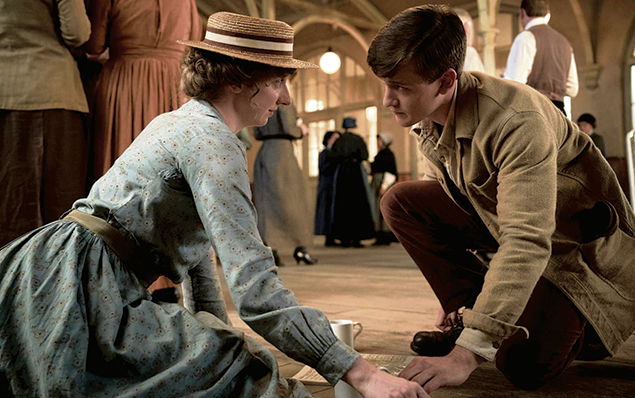
“The Choral,” which opened around the country in late December, is a remarkable movie about the power of art — in this case, music — to heal people (or at least help us cope) with the problems life throws at us.
It is set in the fictional town of Ramsden in Yorkshire, England. It’s 1916, and the War to End All Wars is almost two years old. Telegrams bearing devastating news are being delivered to loved ones daily.
Until recently, Britain’s army was all volunteer. But the war has taken its toll. Troop numbers need to be bolstered, so draft notices start to arrive at the local post. The choral master and many members of the ensemble have already been called away, threatening this year’s cherished annual concert. How the townspeople — with typical British stiff upper lip — carry on is at the center of the film.
“The Choral” is at once complex and subtle, and any attempt to summarize it is like using a single thread from a designer gown to describe the dress. But when you gather the tiny threads together, they collectively create a much larger whole, providing a sense of time, place, and mindset.
For example, many aren’t pleased with the newly hired concert master, Dr. Guthrie (Ralph Fiennes), in part because his last job was in hated Germany but also because he is a “bachelor,” a euphemism in use at the time.
Similarly, there is opposition to Dr. Guthrie’s suggestion of performing Elgar’s oratorio, “The Dream of Gerontius,” because it is based on a poem by Cardinal John Henry Newman; its Catholic roots made it something of an anathema in Church of England territory.
But over the course of rehearsals, working toward a common goal, attitudes change, people pull together, all leading to a denouement that is very real and — if you’ll excuse the musical reference — pitch perfect.
The tailor who pulled all the threads together is Sir Nicholas Hytner, a much-honored director of film, theater, and opera, working from a script by Alan Bennett.
They are regular collaborators and “have been working together since 1990, and what interests him interests me,” Sir Nicholas told me in a recent Zoom call.
“When he gave me the initial sketch for this, the main themes, the main characters were already there: the idea of a community undergoing a terrible catastrophe, a kind of trauma. In the middle of that catastrophe, that they can find something that heals them in the performance of music, that was my way into the film.”
Sir Nicholas, 69, has been finding his way into projects since 1982, when he directed Alan Ayckbourn’s “Absurd Person Singular.” If his name is not familiar to Broadway and film buffs, his work certainly is. He directed “Miss Saigon” and “Carousel,” Tony nomination and Tony win respectively, for best direction of a musical, and “The History Boys” and “One Man, Two Guvnors,” Tony win and Tony nom respectively, for best direction of a play.
For Sir Nicholas it always has been about Art (with a capital “A.”) “I’ve been particularly lucky to work nonstop since I started,” he said. “Nothing I’ve done has freed me from feeling compelled to work.
“The most important thing I did was in 2003, to decide what I really wanted to do was take responsibility for the National Theater for, as it turned out, 12 years. I was going to stop directing my own gigs and be responsible for this great national institution and produce 20 plays a year.”
During his tenure, he revitalized the organization, introducing new plays and younger playwrights to the theater’s roster, filming productions to show around the world, and lowering ticket costs, all of which greatly expanded not only audience numbers but audience diversity as well.
In 2017, he co-founded the London Theater Co. and opened a new 900-seat theater. He considers his time at the National Theater and his work with the London Theater “of all the things I’ve done, the things I’m most proud of.”
Sir Nicholas grew up in a prosperous Jewish family in Manchester. “We were, in North American terms, Reform,” he said. “I would say we were moderately observant. But what I was steeped in, particularly through my grandparents, was Jewish culture. I did not have a Conservative or Orthodox upbringing.”
He attended Sunday school and had a bar mitzvah. “But the deal always was I would get to my bar mitzvah and then decide what to do. And like a lot of 13-year-olds, I decided that the religious aspect of Judaism had nothing to say to me. I went through the bar mitzvah and decided that I was, as many Jews before me, secular.”
I wondered about his experience with antisemitism growing up, in school, and in life. “There was a large Jewish contingent at my school, so there was, if you like, safety in numbers,” he answered. “But the situation is complicated.
“It’s actually as good a place as any in the world to be Jewish, but antisemitism certainly exists, from the left and the right. The play I’m bringing to Broadway in March, “Giant,” is about Roald Dahl. It’s a wonderful play about antisemitism and how you deal with a narcissistic monster of great charm and enormous talent.”
“Giant” is set in 1983, shortly after Dahl published a literary review of a book about the siege of West Beirut during the 1982 Lebanon War. The review was widely considered to be antisemitic.
“It had a huge success in London, to my enormous surprise,” Sir Nicholas said about “Giant.” “I thought it would enjoy only minority interest, because I think the majority view in the U.K. right now is to be repelled by extremism and certainty, of people yelling at each other. That’s not where most people are, in my experience. In my experience, they are agonized by the complexity of everything around the Middle East and very hospitable to Jews. I personally have never had a problem.”
“Giant” is not a one-off. Sir Nicholas has worked on several plays with Jewish threads. In “Traveling Light,” for one, he has Hollywood director Motl Mendl reminiscing about his early days at his father’s cinema in the Pale of Settlement.
He also did a National Theater production of Israeli playwright Joshua Sobol’s “Ghetto,” about a troupe of actors who form a theater company in the Vilna ghetto.
The publicist is counting down the seconds I have left with Sir Nicholas, so I quickly ask if he has favorite assignments. “My home is the stage,” he says. “It’s where I spent most of my life.”
And while there certainly are differences, there are similarities, too. “I love working with actors and telling stories,” he said.