Joachim Prinz was never silent
Documentary highlights rabbi’s efforts for civil rights everywhere
Rabbi Joachim Prinz, who headed Temple B’nai Abraham, first in Newark and then in Livingston, from 1939 to 1977, is most recognized from the 1963 photograph in which he stands alongside Martin Luther King Jr. and the other leaders of the March on Washington as they meet with President Kennedy in the Oval Office. Rabbi Prinz was fearless in voicing the prophetic message far and wide. There’s no need to wonder what Rabbi Prinz would say about our current moment, because everything he would say now, he said during his lifetime.
After Rabbi Prinz’s unique life came to an end, his message was at risk of being lost to history. Fortunately, his family preserved his papers at the American Jewish Archives, making possible the publication of his memoir, “Rebellious Rabbi,” edited by Michael A. Meyer, and the production of the documentary “Joachim Prinz: I Shall Not Be Silent.” My co-producers and I have made the hour-long film available for free on YouTube starting on August 28, the 62nd anniversary of the March on Washington, to ensure that Rabbi Prinz’s message can be heard now.
Joachim Prinz was born into an assimilated Jewish family in a small German village in the early years of the 20th century. He rebelled against that upbringing by joining the Zionist Blau Weiss movement as a teenager, ultimately studying for the rabbinate at the Seminary in Breslau. He was serving as a rabbi of the Berlin Jewish community when Hitler came to power. An outspoken critic of the Hitler regime and proponent of Jewish pride, Rabbi Prinz drew large crowds to his sermons and speeches, and also repeatedly landed in jail at the hands of the regime. In one sermon, he told a story about a village where the clock in the town square was stopped at midnight. “Now the time is midnight for the Jewish people, and it is time for us to pack up and go,” he said.
Expelled from Germany in 1937, Rabbi Prinz immigrated to America with his young family under the sponsorship of Rabbi Stephen Wise. He was in a precarious financial position and sought a job as a local rabbi. Yet as he traveled the country for the Palestine National Fund, Rabbi Prinz made many American Jews uncomfortable by warning about the perilous state of Jewish life in Europe. They were so uncomfortable that the renowned rabbi Abba Hillel Silver sent an angry letter to Rabbi Wise, asking him to quiet the young rabbi. Rabbi Wise replied that America was a free country, and that he could not silence Prinz even if he wanted to (which he did not).
When Prinz was offered an interview at Temple B’nai Abraham in Newark, he had to borrow cab fare from Rabbi Wise to get there. Nevertheless, Rabbi Prinz told the synagogue board that if he were to take the job, he would have to be free to speak his mind.
He did get the job, and as the rabbi of B’nai Abraham and as a leader of the American Jewish Congress, Rabbi Prinz did speak his mind.
During his early travels in America, Rabbi Prinz encountered racial segregation enforced by law and violence. He recognized the profoundly irreligious nature of racist ideology, which ranked human beings in a hierarchy, affording some no rights and others every privilege. It was the same ideological foundation underneath the Nazi persecution of the Jews and it was an affront to God, who created all human beings as equal.
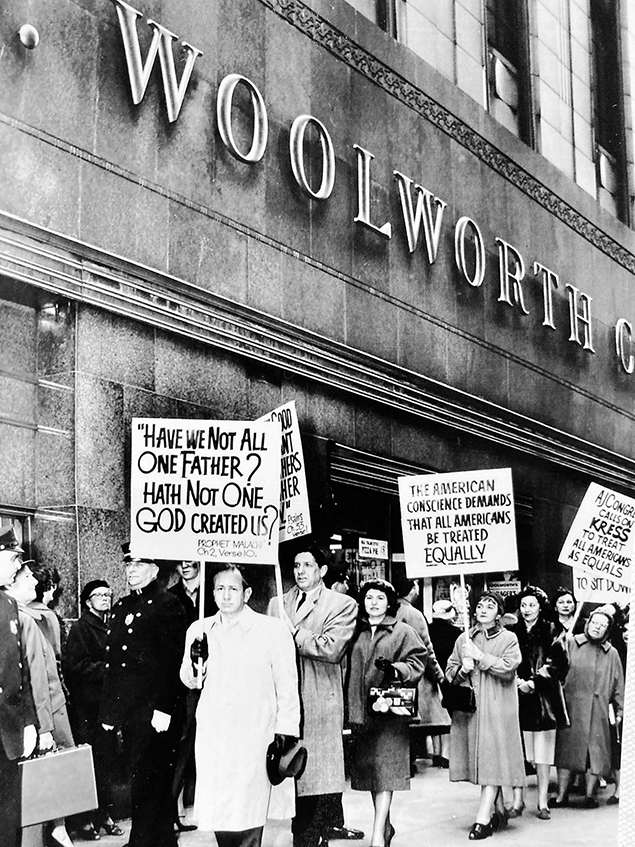
Rabbi Prinz committed to helping his new nation break free of that erroneous mindset so it could be truly democratic. He fully embraced the civil rights movement, advocating for civil rights from the 1950s onward and speaking at the March on Washington. In his speech, Rabbi Prinz said, “When God created man, he created him as everybody’s neighbor. Neighbor is not a geographic term. It is a moral concept. It means our collective responsibility for man’s dignity and integrity.”
Rabbi Prinz took the responsibility of being a neighbor seriously. He celebrated the founding of the State of Israel, which many of his family members called home, and was an intimate interlocutor of many of its early leaders. He loved Israel so dearly that in the 1950s, he was not afraid to declare, “Zionism is dead. Long live Israel.” With this shocking phrasing, Rabbi Prinz tried to warn of the danger of clinging to messianic fantasies when there was a concrete country to defend and protect through strategic politics and diplomacy. He tried to convince American Jewry to develop an independent Jewish identity based on love of Jewishness and Judaism, and to have a healthy diasporic relationship to the state of Israel, one in which Zionism did not replace other forms of Jewish religion, philosophy and culture.
Rabbi Prinz advocated strongly for American support of Israel when it was attacked in 1967, saying “I do not hope America is ‘neutral in thought.’” After Israel occupied the territories, Rabbi Prinz visited them, thinking it would be his last opportunity to see them before they were returned. He advocated to Golda Meir that Israel should engage in a “peace offensive,” later writing despairingly in a private letter, “Eban’s plan for a ceasefire was voted down. The new plans for the solution of the refugee problem are too meager. Altogether, Golda has always made light of my suggestion [for a peace offensive] which, if I were to speak to her, I would repeat again.”
After the 1973 war, as Israel began to build settlements on the West Bank, Rabbi Prinz spoke out against that practice as a grievous moral and strategic mistake. He denounced Palestinian terrorism, calling terrorists “enemies of peace,” and advocated strongly and publicly against preemptive war by Israel. Once again, other Jewish leaders tried to stop him from speaking out. In one letter, he replied, “I have always been, and still am, against any war as a solution to the problems of the Near East. I believe that neither victory nor any other military triumph will solve the situation…. I have tried for many years to convince Golda and the government that the Palestinian entity has to be taken seriously. I met with derision, ridicule and insult. Now it is too late…. We are not yet a muzzled community. We can still speak…. Those of us who love Israel will remember the Biblical adage, ‘For the sake of Zion, I shall not be silent.’”
Rabbi Prinz’s words could be lifted directly into our own time.
At this moment of crisis, Rabbi Prinz would be compelled to speak out once again in his own country, the United States. After all, when he took to the podium at the Lincoln Memorial just after Mahalia Jackson sang, his opening words, voiced in his immigrant’s accent, were, “I speak to you as an American Jew.” From his pulpit today, he would advocate for independent thought, freedom of speech, and the equality of every person before the law.
“Prinz did what he thought was right,” Rabbi Sy Dresner of Temple Beth Tikvah in Wayne said. (Rabbi Dresner, who died in 2022, was a Freedom Rider and a lifelong civil rights champion.) “And sometimes, what he thought was right was not yet popular. That’s the nature of people who are ahead of their time.”
Perhaps the time to hear Rabbi Prinz’s words is now.
Rachel Eskin Fisher is a writer and filmmaker with a Ph.D. in religious studies. She co-produced and directed “Joachim Prinz: I Shall Not Be Silent.” The film is now available free on YouTube.