Making books
Noam Sienna talks about Jewish printing presses at Rutgers
Books hold ideas, intangible, ethereal wisps of knowledge and emotion and plot and conversation.
Books also are physical objects, made of specific materials on particular machines; the ideas are made tangible as paper is imprinted with ink.
Mystics have said that the most basic Jewish book, the Torah, is black fire on white fire, both physical and metaphysical.
Rutgers is acknowledging that truth and encouraging its students to explore it with its Book Initiative, a combination of “talks, workshops, field trips and studio sessions,” as well as access to its makerspace, where undergrads, graduate students, and community members can try the hands-on experience of making a book, according to its website.
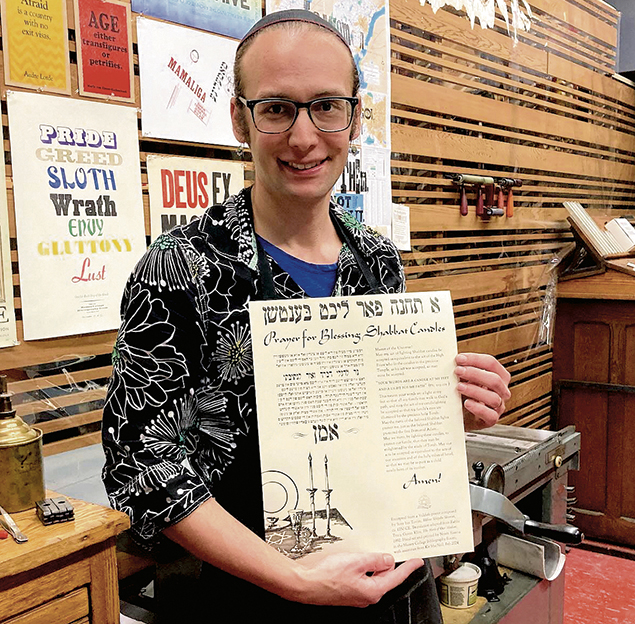
Jews, of course, are people of the book. The Bildner Center for the Study of Jewish Life at Rutgers is tying some of its offerings to the Book Initiative. It’s bringing Dr. Noam Sienna in from Minneapolis as its visiting scholar; he’ll be on campus, where he will work with students, and he’ll teach a three-session online course, open to the public, about Jewish books in the Islamic world, from the Middle Ages through to our own Modern Age. (See box.)
“Basically, every faculty member at Rutgers who is teaching a Jewish studies course this semester is trying to do some programming that brings bookmaking into the class,” Dr. Sienna said. “For example, Gary Rendsburg,” the Blanche and Irving Laurie chair in Jewish History, “is teaching an introduction to the Hebrew Bible. So — how do people transmit the text of the Bible in manuscript? What happened when they started translating the Bible? We’re going to do a workshop about that.
“And Nancy Sinkoff” — a professor of Jewish studies and history and the Bildner Center’s director — “is teaching modern Jewish history in Europe. Well, you can’t talk about Jewish history in modern Europe without talking about the Yiddish press and the Hebrew press.”
And those are just two of many teachers at Rutgers who will incorporate information about the art and craft of bookmaking and the influence of physical books on the Jewish community this semester. “In other words, in every facet of Jewish studies there will be some connection to calligraphy, printing, manuscripts, book binding, paper-making, illumination, type casting, type setting…” Dr. Sienna paused for breath.
In fact, Dr. Sienna is a perfect fit for Rutgers’ initiative. His doctorate is in both history and museum studies; his specialty is “Jewish book culture in the medieval and early modern Islamic worlds,” according to the biography on the Bildner Center’s website. He’s also a book artist; his expertise is not only intellectual but also hands-on.
The Rutgers Book Initiative comes at a fraught time for books.
Now for many people, “all communication is done through a screen,” Dr. Sienna said. “They read on a screen, they write on a screen, they text on a screen. You can take a college course and never put pen to paper. Your reading is online, you submit papers online, and they’re graded online. You finish the semester and you’ve never made a mark on a piece a paper.
“So because of this, I see a resurgence of interest in my students in decoupling the reading experience from the digital world, and thinking about what it means to experience a text in the digital world.
“I have taken students to the library, and said, ‘Look, here’s a scroll, of the Book of Esther. Here’s a manuscript of the Bible. Here’s the first edition of the King James Bible.’
“And I had to drag them out of the library. They were so engrossed, so engaged, and asking so many questions about how the experience of reading and understanding a text is shaped by the form you’re encountering it in. It can be a handwritten manuscript or a printed book. A very large book meant to sit on a lectern or a small book that you’re meant to carry in your pocket. Does it have just the text, or the text and commentary on the same page, or the text and commentary in different parts of the book?
“All of a sudden the students realize, wait a second, how we encounter the book is mediated through the material.
“Media studies has been saying this for a long time, but now there’s also a new attention not only to the materiality but to the experience of making the book.
“And that’s where I come in. They don’t need to take students to the library. And there are librarians. But what I’m doing, which is new to this program, is that I have training in the field of book art. In the process of creating the book as an object.
“How do we actually get these objects? How does someone set a page of Yiddish newspaper in type? What does that look like? What are the technologies you need access to? What are the bodies of knowledge you need? How much training does it take? What materials do you need?
“And then the students say ‘okay, now I’m starting to understand.’”
Dr. Sienna turned to the subject of the three online courses that are open to the public. They’re linked but each one is self-contained; participants need no special knowledge to take them, he said.
His doctorate, from the University of Minnesota, is in Jewish history, he said; he focused on “Jewish-Muslim relations in the Islamic world, meaning Jewish communities living in Islamic environments in North Africa, in the Ottoman Empire, in medieval Spain. How did they interact with their environment, their neighbors and the culture around them? And vice versa.
“So that’s on the one hand, and on the other hand there’s my training as a book historian and my interest in the book as a material object, which leads me to the question of what we can see about Jewish life in the Islamic world when we look at their books as material objects.
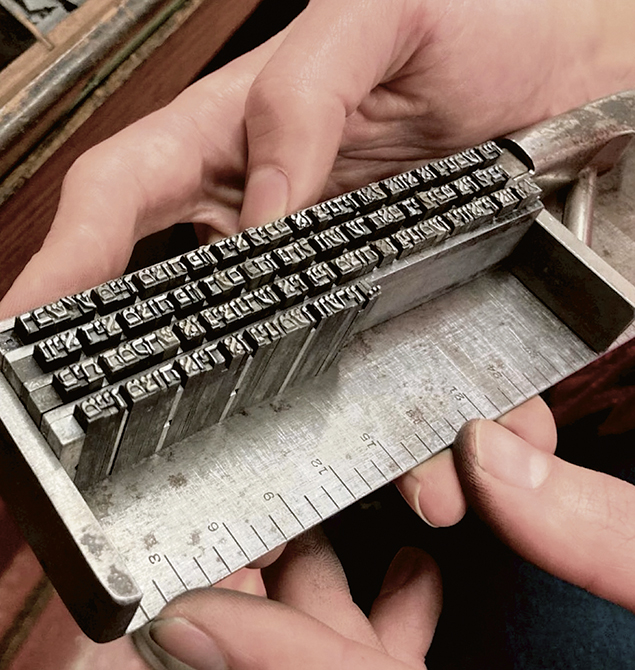
“I’m going to answer that question in three different case studies. In the first, we’ll talk about the Cairo Genizah and the different kinds of books and other things that were in there.” (A genizah is the room where books and documents, particularly those containing the name of God, that were tattered, incomplete, or otherwise no longer useful or usable, were kept until they could be buried properly with the respect due them. The Cairo Genizah was a storeroom with nearly 400,000 such objects that provided scholars with an extraordinary look at Jewish life in medieval Egypt.)
“We’ll talk about Maimonides,” Dr. Sienna continued. “We’ll talk about the vibrancy of the medieval Jewish world, through the Cairo Genizah.
“That’s week one. On week two, we’ll talk about what happens to Sephardic Jews after the expulsion from Spain in 1492. We’ll look at it through the case study of the first printing press established in the Ottoman Empire, in Istanbul, in that first generation, basically from 1493 until the 1530s. What were Jews printing? What were they reading and writing? What kinds of books were they making?
“Week three is the modern period, meaning, for me as a historian, the 19th century.
“We’ll be talking about all the questions of modernity — that is the haskalah, the enlightenment. We’ll talk about Zionism, citizenship, education, secularism — all the questions that Jewish communities faced in the 19th century.
“What does it mean to be a Jew in the modern world? What does it mean to be a Jew and a citizen of a state? What about nationalism? What about secularism?”
There’s a lot of information available about how Jewish communities in Europe worked through those questions, Dr. Sienna said, but there’s far less about how Jewish communities in the Islamic world — North Africa, the Ottoman Empire, and other parts of the Islamic world — handled them.
“That’s the subject of my first book,” he said. “Jewish Books in North Africa: Between the Early Modern and Modern Worlds” was published last year.
In the class, “We’re going to look at some of the modern books that were written and printed in North Africa and the Middle East in the late 19th century, and use them to think about what parts of the story of Jewish modernity have we been missing, and what new angles might we learn when we focus on this material.”
Dr. Sienna is working on his second book, which will focus on the topic of his second talk in the Rutgers series — Jewish printing in Istanbul in the 16th century, and on the newly created world in which they lived.
The refugees who found their way from the Iberian Peninsula to Istanbul “had an immense task ahead of them, which was to rebuild what Jewish life means in a whole new context,” Dr. Sienna said. “They’re now living on the other side of the Mediterranean, under Islamic rule, in an Arabic- and Turkish-speaking world.
“They arrive, they’ve lost family members, they’ve lost all their property, and now they’re pulling themselves together. It’s a very interesting community.”
One thing that has most piqued Dr. Sienna’s interest is one of the community’s first actions once it regrouped in Turkey. “I’m interested in where the technology of printing intersects with this community. Because in 1493, literally the year after they’ve first settled, they build a printing press.
“Remember, this is only about 50 years after Gutenberg” — the German inventor Johannes Gutenberg began to operate his press in about 1450 — “and that’s what they do.”
It’s not clear if the community managed to buy a press or make one, Dr. Sienna said, but making one would have been easy, because the machine itself was so basic. It was a block of wood, a screw, and a lever. Any competent local carpenter could have done it. And it wouldn’t have been hard to make or buy paper and ink. (“Ink’s basically just soot and oil,” Dr. Sienna said dismissively.)
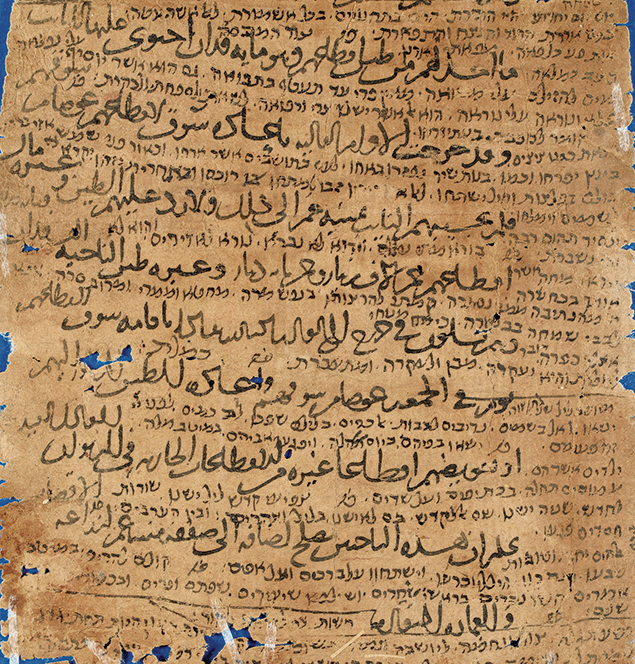
But what about the letters? The physical pieces of metal that shape the symbols that make up the words at the heart of the book? They would be hard to recreate from scratch. “I’m pretty sure that they brought a set of matrices, molds for making letters, with them,” Dr. Sienna said. “They were refugees, they were fleeing on boats, they couldn’t bring along a whole big machine, but they needed just one mold, maybe 30 little slabs of brass that you could put in your pocket.”
That would have been all they needed.
“When they landed, they had to build a press, and within a few months they had done it. That’s the genius of the technology of printing. It takes you months to set it up, but then you could print whatever you want, as many copies as you want — 50 copies, 100 copies, 1,000 copies — and then you clean off the ink and you do it again.
“You can print the Bible. You can print the Talmud.
“The alphabet they used was Hebrew,” Dr. Sienna continued. “They had four different fonts. Three of them are square letters; one set was big, one set was medium, one set was small, and they also had one in Rashi script.”
Most of the printing was done by the Ibn Nahmias family, who were “using technology — in this case the technology of printing — for theological reasons,” Dr. Sienna said. “They were saying to the community, ‘We have the power and the strength to rebuild and to thrive in this new environment, because we have everything we need with us. Most of all, we have God with us. We have the covenant still with us.
“The exile from Spain was an enormous trauma, and people asked themselves what it meant. Did it mean that the promise was broken? That we were being punished for our sins? That Jewish history is over?
“And the books being published were telling the people that, no, it’s not over. We’re going to rebuild. We’re going to regroup, and we’re going to come back stronger than before. It’s a story about technology, and it’s a story about community.
“It’s an incredible story, and it’s not been told yet. These books are very rare. Some of them are lost, and bits of some of them have been found in the Cairo genizah.” Which brings us back to the lectures.
There is much more information about the Jewish community in Istanbul — how it flourished, how well its members did as part of a larger, extraordinarily diverse city, in many ways the New York City of the early modern Middle East, a glorious mosaic.
Dr. Sienna will write about that in his new book, and he’ll talk about some of it at Rutgers. He might tell a story that describes the Jewish community in Istanbul.
This story is from the 16th century, he said; “it was recorded by a German who was in the Ottoman court. There wasn’t a lot of diversity where he was from; his town had expelled its Jews 100 years earlier. He was a Lutheran, and until he’d gotten to Istanbul, he’d met only other Lutherans.
“So he comes to Istabul and he’s shocked — there are Jews, there are Muslims, there are all kinds of people. He meets with the vizier and asks him about it. ‘What’s going on here?’ he says.
“So the vizier says, ‘I’ll tell you a story. The vizier before me had wanted to expel the Jews from Istanbul. So he went to the sultan and said, ‘Sultan Suleiman, I think we should expel all the Jews from the city.’ They’re out in the garden, and Suleiman leans over and plucks a tulip.
“The Ottomans were famous for their incredible tulips, with their multicolored, variegated petals. So the sultan plucks the tulip and says to the vizier, ‘How do you like this tulip?’ ‘It’s beautiful,’ the vizier replies.
“So the sultan plucks off all the petals except the yellow ones from the flower, and he says, ‘How do you like it now?’ And the vizier says, ‘I have to say, Your Highness, that I don’t like it. it displeases me. It’s lost its elegance.’
“And the sultan says, ‘God has ordained that the strength of the city of Istanbul comes from the Jews in their yellow turbans and the Muslims in their green turbans and the Greeks in their black turbans and the Armenians in their blue turbans. All the colors of the city, literally and figuratively, make up this city. What gives the city its beauty and its excellence is the diversity.’
“I wouldn’t have thought that this was a true story, but I found it in a 16th-century travelogue,” Dr. Sienna said. (It’s not that the story itself is true — who knows? — but that someone told it in the 16th century, which means that a writer back then thought that the point was worth making.)
And he found it in a book.