Menorah Chapels turns 50
Founding family of Union County’s only Jewish funeral home proudly serves community
Herbert Ross was an ad agency executive, not a licensed funeral director. But as an experienced Chevra Kadisha volunteer for Jewish burial societies in Bayonne and Jersey City, he felt that his parents’ funerals weren’t handled properly at the local funeral home.
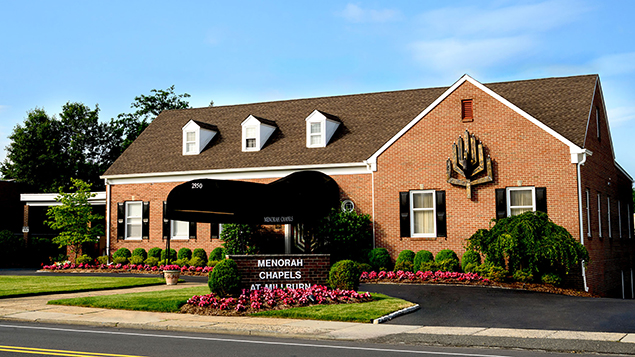
So in 1975, as a meaningful project following his retirement, he established a Jewish funeral home: Menorah Chapels at Millburn, about five miles north of the house he shared with his wife, Selma, in Mountainside. The chapel, at 2950 Vauxhall Road, remains the only exclusively Jewish funeral home in Union County.
Today, the late Mr. Ross’s daughter, Karen Ross Kerstein, is manager and president of Menorah Chapels. In recent years, her 32-year-old son, Eric Shawn Ross Kerstein, joined the family business as a licensed funeral director.
At the 50th anniversary of Menorah Chapels, celebrated on October 28 at the Crystal Palace in Livingston, Rabbi Ethan Prosnit of Temple Emanu-El of Westfield remarked that Herbert Ross and his family had essentially “stepped into the unknown” 50 years ago, “founding a Jewish funeral chapel rooted not only in professional excellence, but in compassion, dignity, and faith.”
They built not just a business, he continued, “but a sacred trust: to serve our community in its most tender and vulnerable moments, with true and selfless kindness. Karen, Eric, and their entire team continue to carry on this legacy by making sure Menorah Chapels is a source of light, a place where grief is met with gentleness, and where memory is honed with love.”
Mr. Kerstein, a third-generation member of Temple Emanu-El, said the golden anniversary “is not just about our family — it’s about the entire community that has supported us, trusted us, and walked with us through some of life’s most difficult and sacred moments. My grandfather served this community faithfully for more than 20 years. My mother has now carried that torch for over 40 years, guiding families with strength, empathy, and devotion. And now, it is my privilege and responsibility to continue in their footsteps.”
When her father started Menorah Chapels in 1975, Ms. Kerstein was studying toward a master’s degree in counseling and guidance. She worked for Jewish Vocational Service of MetroWest until deciding, with her father’s encouragement, to enroll in mortuary school in 1982. She became a licensed funeral director in 1983 and was well qualified to take over after her father died in 1999; her mother died in 2020.
“My background seemed to be a good fit for this business,” she said. “To be a good funeral director, you need compassion and an understanding that there are many ways to conduct a Jewish funeral and to help bereaved families through one of the most difficult times in their lives.”
What made her son follow suit? “I made him an offer he couldn’t refuse,” Ms. Kerstein quipped.
All kidding aside, the young Mr. Kerstein didn’t need persuading. Having worked at the funeral home since he was 18, he wasn’t squeamish about corpses. He has a business degree from Drexel University. And, most importantly, has the right personality for the public-facing part of the job.
“I have the gift of gab,” he said. “Socializing comes easily to me. You have to be able to talk to people and listen to people. That’s really what this is — forming a relationship with people during a very sad time, listening to them, consoling them, and making sure all their needs get fulfilled. Not everybody can do that.”
Rabbi Shawn Zell, former rabbi of Temple Beth O’r in Clark, has worked with Menorah Chapels since 1985 and has written several books on the mourning process. At the anniversary celebration, Rabbi Zell presented an original wordplay on the word “menorah.” He said, “It is generally translated as ‘candelabra,’ but I said that it is really a portmanteau comprised of ‘orah,’ light, and ‘men,’ for mensch.”
In other words, he sees the funeral home’s owners and employees as extraordinarily good people.
“I’ve had congregants who asked me to join them in preplanning funerals, and I watched how the funeral directors at Menorah interacted with them,” he said. “They have a wonderful, warm approach when dealing with people at a most difficult time of life.”
Though the notion of preplanning funerals is uncomfortable for many people, the Kersteins stressed its importance, especially when grown children live far away or don’t have the time, the money, or the awareness of their parents’ wishes to make fitting arrangements after the fact.
“If you don’t write it down and tell people what you want, you’re probably not going to get what you want because you can’t speak for yourself,” Mr. Kerstein pointed out.
Many clients don’t know if their parents would have wanted a tahara — the purification ritual performed by a Chevra Kadisha — or a shomer, a “watcher” who stays with the body from the moment of death until burial. Menorah Chapels works with the Chevra Kadisha led by Rabbi Mendy Bogomilsky of the Chai Center Chabad in Short Hills.
“Reform Jews don’t do it, some Conservative do, and the Orthodox require it,” Mr. Kerstein said. “Also, some cemeteries require it and some rabbis require it. And many Jews never even heard of these Jewish rituals before.
“It’s much easier if everything is preplanned,” he continued. “Everything’s laid out, everything’s paid for. Your children just have to pick a time, get a rabbi, and show up. If you preplan — and also buy a cemetery plot if you desire to go that route — it takes the stress and worry away from your family,” Mr. Kerstein said.
His mother added that preplanning has become more relevant and necessary as people live longer, because they must manage the spend-down of assets before applying for Medicaid to pay for eldercare.
Often, the Kersteins are requested to dress the deceased in favorite items of clothing, such as pink fuzzy slippers or a Yankees jersey, or to put cherished objects into the casket. Golf balls, hot dogs, candy, beer, whisky, Oreo cookies, and letters from grandchildren are among the myriad items that have been buried with loved ones.
“If it makes someone feel better to put a teddy bear or pictures of the grandkids in the casket, most rabbis don’t have a problem with that,” Ms. Kerstein said.
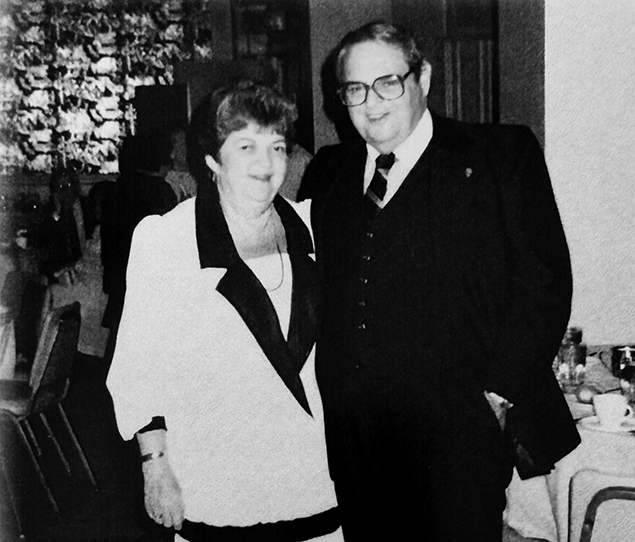
Her husband, Gary, also worked at Menorah Chapels. When he died last July, she and their children — Eric and daughter Elyssa — selected several items to accompany him.
“My father was a DJ, so we put in CDs and a 45 rpm record and a headset,” Mr. Kerstein said. “He liked Atlantic City, so we put in a deck of cards, and he loved Hershey bars, so we put some of those in, too.
“A couple of years ago, someone whose mother loved martinis brought a martini set and ice. She shook the martini at the graveside, and we put the whole set in with her mother so she had a drink for the way up.”
“Someone once wanted a mink coat in the casket, but the rabbi would not allow it,” Ms. Kerstein added.
She noted that some changes in custom have occurred over the past half century. “Many people have shortened the shiva period. And due to distance, the time between death and the funeral has increased. Many times, we hear we must wait to have the funeral because ‘my family is living in Europe or Asia or California, and they need to arrange travel back home,’ while 50 years ago maybe it was Florida,” she said.
With a staff of six licensed funeral directors, Menorah Chapels can make funeral arrangements in conjunction with a corresponding entity pretty much anyplace, she added.
“We have received and sent deceased to Europe, Canada, Israel, and the Caribbean, just to list a few places. We can coordinate shipping to almost anywhere. As well as receiving remains for burial from anywhere.”
Another significant change is that the number of funerals performed annually at Menorah Chapels has decreased,” Mr. Kerstein said. “We just passed the 25,000 mark in total. Back in the 1990s, we were doing 800 funerals a year. Now we do about 275, 300 a year.” Not only has average lifespan increased, he explained, but the demand for cremation over burial has greatly increased as well, despite the Jewish taboo against this practice.
“A lot of the funeral homes are moving toward cremation because it’s cheaper and easier. I have a good friend who owns a Christian funeral home, and while his numbers have been going up, ours have not,” he said. “Reform and Conservative Jewish people are a little more comfortable with the idea of cremation and some rabbis are relaxing a little more about it because people want it. But I don’t see us becoming a cremation service.”
Rather, he sees a continuing essential role for Menorah Chapels in the fabric of life for the many Jewish families living in the surrounding area.
“We know that without death there can’t be life, and without life there can’t be death,” Mr. Kerstein said. “But death is still hard.”
Given that inevitable reality, his mother added, “We feel we are helping people and trying to make their life easier at an exceedingly difficult time.”