Remembering Dena Mendelowitz Horn
Dena Mendelowitz Horn of Summit, who died on January 2, was a bridge between worlds, her husband and children say.
Specifically, the worlds of European Jews — Chabad and the Slabodka Yeshiva, and those were very different worlds — and of Brooklyn. The world in which the wife of a rabbi, whether or not she wanted to be called a rebbetzin (Ms. Horn did not), took care of her husband’s congregants, deftly and intuitively and with sensitivity and warmth, and the world in which a woman, married to a rabbi or not, had her own life.
The day after her shloshim, in early February, her three children and her husband described her.
“She was one of a kind,” her younger daughter, Dassy Horn Mark of Wayne, said. “She was a role model as a Jewish woman, as a woman, as a parent. She cared for people in a way that most people don’t or can’t.”
“I once asked her how she can feel so deeply about so many people,” her widower, Rabbi William Horn, rabbi emeritus of Congregation Ohr Shalom/The Summit Jewish Community Center, said. Her father died when she was 7, “and people really weren’t kind to us,” he reported her saying. “People really weren’t kind to us. So. Now, if I see a person who needs kindness, I jump on the case.”
Ms. Horn was born in 1932 in Crown Heights, to parents who were born in Russia and married there. Her father, Moshe Yaacov Mandelowitz, was the family member who’d learned at the Slabodka Yeshiva; to be able to say that, in at least some circles, was like saying that you’d studied at Harvard. He was an eighth-generation rabbi, Ms. Mark’s sister, Ora Horn Prouser of Teaneck, said; he’d also gotten a degree, most likely in philosophy, from the University of Berlin, and pictures taken not only in Brooklyn but also in Europe show him nattily dressed in a suit and tie. The Mandelowitzes were brought to New York in 1925 so he could lead a congregation as its rabbi. He was president of the va’ad harabonim — the rabbinical council — in Brooklyn.
He also had a business, shipping kosher meat to the Midwest.
But he died young, in 1940, with much of his promise unfulfilled. He simply hadn’t gotten to it yet.
“We don’t know much about him,” Dr. Prouser said. “We know that he was an unusual man, but we only know about him from stories. We were told that he taught Hebrew to Catholic priests, and that priests followed his coffin at his funeral. And we know that he allowed women to say kaddish at his shul.
His wife, Rachel, also was unusual. She was a firm believer in women’s education; her shtetl didn’t have a high school for girls so she lived with a brother, in a town that did have a school for her, so she could go to it. She had just two children, Sam and Dena; before Dena was born, she took Sam on a boat to Europe to visit her family. “Who did that in the 1920s?” Dr. Prouser said.
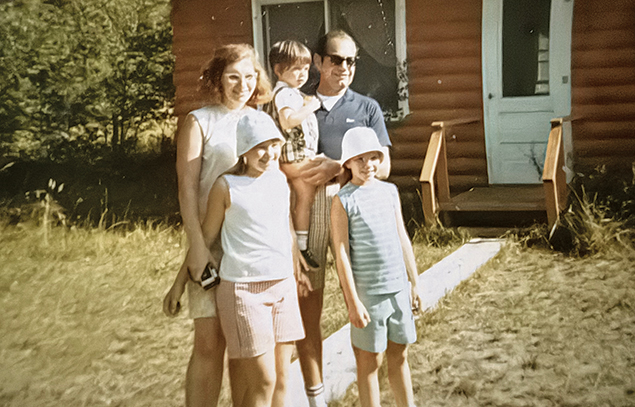
Rabbi Mandelowitz was 12 years older than his wife; when he died “she was in a very bad financial situation,” Ms. Mark said. She had been the wife “of a prominent rabbi, but that status changed very quickly when he died.” She worked teaching Hebrew school, she worked in a store, she continued the meat shipping business until her partners got ugly — “they tried to squeeze her out,” her son, Moshe Horn of Manhattan, said. “They were very gangsterish.” Meanwhile, the country was just coming out of the Depression and headed toward the Second World War; many of the family back in Europe were murdered, and “there was even more loss and grief,” Dr. Prouser said.
But Dena got her education. At Samuel Tilden High School, she won the Golden Ayin award for Hebrew studies, her family said. “Her life — like our father’s life — revolved around Young Judea,” Dr. Prouser said. “They had very strong Zionist beliefs. That’s an important part of who she was.”
“We would call the family” — that’s her mother, her uncle, and her grandmother — “Orthodox at that point,” Dr. Prouser said, but their behavior was heterodox. “They would sometimes go to a Reform shul on Eastern Parkway with a famous rabbi because they liked his sermons. And she was always connected to 770” — that’s 770 Eastern Parkway, the world headquarters of Chabad Lubavitch — “even though they didn’t go to shul there. They always were tied in to the rebbe. He would always tip his hat to her — she was one of the few women he’d do that for — because of who her husband was.”
Dena Mandelowitz went to NYU, on a scholarship — and met her future husband, Bill Horn, there.
Her mother was not pleased.
“When they got engaged, my grandmother tried to block the wedding,” Moshe Horn said. “He wasn’t what she wanted. The only way she’d let him marry her daughter would be if he met with the rebbe.” That’s the Lubavitcher rebbe, the last one, Menachem Mendel Schneerson.
Rabbi Horn continued the story.
“I met the rebbe,” he said. “My brother-in-law studied in the Lubavitch yeshiva, so he had a connection. So I met the rebbe. It was remarkable.”
Before the meeting, the rebbe’s staff told Rabbi Horn what would be expected of him. “They instructed me how to comport myself,” he said. “They said ‘don’t sit down in front of the rebbe. Don’t do anything until the rebbe grants you permission. Don’t speak English. Only Yiddish.’”
Luckily, “I knew a little Yiddish.
“I was scheduled to meet the rabbi at 8 o’clock; at 11 o’clock — 11 at night — I went in. He shook my hand, which was a no-no, according to what I was told. I was thinking, ‘Doesn’t he know that?’ But I had to go with the flow.
“Then he said to me, ‘Sit down.’ Again, that was a no-no. But I sat down. He said, ‘What language should we speak?’ And I said I can speak a little Yiddish, and I can speak a little Hebrew, but English is my best language.’ So he said, ‘Why don’t I speak to you in Yiddish, and you speak to me in English?’ And that’s what we did.
“We talked for about 30 minutes. It was a long time. He didn’t give me the feeling that he was in a hurry. We just talked. And then he said to me, ‘I understand that your mother is sick.’ I said yes, and he said, ‘I hope she can attend the wedding.’ And then he wrote down my mother’s name, and it took him a really long time to write it.
“So I realized that the interview was over, and he didn’t want to embarrass me by seeing me back off, so I backed off and he kept his head down so he didn’t see me, and that was it.
“It was wonderful.
“We had two other meetings. And then I said to him that I am going to study for the rabbinate, and I am going to go to the Jewish Theological Seminary,” the leading Conservative rabbinical school. “He didn’t voice an objection. He said I should try to study with Profession Lieberman, he’s a Talmud chachum.” Rabbi Saul Lieberman was a professor of Talmud and an academic star at JTS. “And when I registered at the seminary, I got word that Rabbi Zlotnik, a teacher of Talmud, wanted to see me.” That was Rabbi Dov Zlotnick, another JTS luminary. “He said, ‘I got word that you are here from the rebbe, and I want to see if I can help you in any way.’
“The rebbe worried about me. It was incredible.”
The Horns got married in 1954, with the blessings of both her mother and the Lubavitcher rebbe.
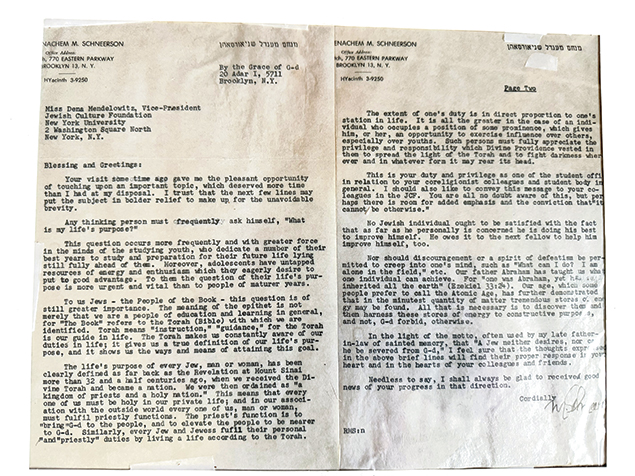
Dena Horn majored in psychology and minored in Hebrew, and then she earned a master’s in education and sociology. She worked in the Jewish Culture Foundation; she received a letter there, in response to a question, from the Lubavitcher rebbe. The family has that letter today. She was a lifelong Jewish educator.
When they first married, the Horns lived in Ridgefield Park, where not-quite-Rabbi Horn had a student pulpit. Once he was ordained, in 1962, they moved to Summit, and have lived there ever since.
“Our mother had a strong role in community building,” Ms. Mark said. Some of that work was public — she taught in the Hebrew school. With a congregant, Judy Lax, a formidable presence in the Conservative movement in general and United Synagogue in particular, she created Jewish Family Living, a course that taught “how to have a Jewish home. That class developed in three books and all sorts of other texts. They continued teaching it into their 80s; during covid they taught it online.”
Ms. Horn was part of a group of women, which included Sylvia Orenstein and Golda Och, among others, who “would read modern Hebrew novels and talk about them,” Ms. Mar said. “They met well into their upper years.”
“She really was a bridge between the Chabad model and the egalitarian model,” Mr. Horn said. “She was a bridge in the sense that a generation or so ago being a rebbetzin was a full-time job, and it changed over time. It was a partnership between two people. But at the same time, she got a master’s degree, worked full time, became a principal at Schechter” — that was the Solomon Schechter School of Essex and Union, which is now renamed as the Golda Och Academy. All three of the Horn children went all the way through that school, which their parents had been instrumental in starting.
Mr. Horn described how surprised his wife, Leslie, was the first time she spent Shabbat with her then-boyfriend Moshe’s family. “People just came to the house and stayed,” he said. “You never know who would be coming to Shabbat dinner, or to a seder. It could be five people you didn’t know were coming walking in.” And somehow the table would have enough settings, and enough food, for everyone. “My father would send me to run on ahead from shul to add more places,” Ms. Mark said. Still, “how do you shop to always have enough food in the house?” Dr. Prouser asked.
At kiddish in the shul, “my mother worked the room,” she continued. “My father was the first Conservative rabbi not to sit on the bimah” when his presence was not required there. “They always sat together. And they would work the whole room, talking to people, checking people out. That was the rebbetzin model, and also a very modern professional model.” It was the rebbetzin as social worker.
“She lived two full-time lives in one body. She touched lives, both as a professional and as a person.”
“She listened,” Ms. Mark said. “She was a really good listener. And she remembered what she heard. If we would tell her about a friend, two or three weeks later she’d ask how that friend was. She paid attention and she remembered.”
“After her funeral, one of my friends said to me, ‘I thought I had a special relationship with you mother. And then I realized that everyone thought that.’
“During shiva, people from Summit were outstanding in how they took care of us. ‘Your parents trained us well,’ someone told us.”
“She had lists of people to call on Friday afternoon,” Mr. Horn said. “And not only did she make those calls, she told us to do it too. In no uncertain terms.”
It was an exemplary life; Ms. Horn was not only a bridge but also a role model. She leaves her husband, three children; two sons-in-law, both rabbis, and a daughter-in-law, all six greatly accomplished; nine grandchildren, and so far seven great-grandchildren.