‘The Fix’ is in
Israel director draws on his own ‘Fauda’ service to make the film
The genesis of the film “The Fix” is an urban legend of sorts.
According to a former CIA operative, a story that made the rounds of the agency’s grapevine claimed that in 1979, when the American embassy in Tehran was about to be overrun, the station chief took wads of cash used to pay local assets, checked into a hotel, and buried it in a wall.
Folklore? True? It actually doesn’t make a difference. In either case, it is the perfect basis of a great caper movie. And, yes, a screenwriter, Ron Hutchinson, prepared a script about the cache of cash for a film he called “Hotel Teheran”: A group of former soldiers make their way into modern-day Tehran, find the cash, and make it out, presumably unscathed.
That script was offered to Israeli-born director Guy Moshe, whose reaction, essentially, was been there, done that. As an Israeli, he’s served in the IDF. “When I read this, I thought there have been films in the past about a group of guys, ex-military, that go on some sort of rogue mission to find money or gold,” Mr. Moshe said during a Zoom conversation.
Something else about it bothered him, too. He felt the script had a lack of nuance; it was a black-and-white story in a shades-of-gray world.
“I believe it could be possible that somebody would have done this, stashed away hundreds of thousands of dollars, he said. “I don’t think anyone would be crazy enough to try to get it,” not for money alone, which is the way it was portrayed in the original script.
But, he quickly added, they might do it for the rush. It’s not something that’s much discussed, but a sensation that Mr. Moshe experienced himself.
“I felt that as somebody who served, who’s experienced what it is to be under fire with your brothers in arms, I wanted to focus on the real reason they’re going on the mission, which is, as the film’s new name alludes, ‘The Fix.’
“It’s very hard for people who serve to stop doing this work. I remember when I got out of the IDF, I was seriously contemplating all kinds of bizarre jobs, like going to the Congo to train people. I remember I was offered a job to be on the protective detail of a Russian oligarch.
“I didn’t do any of that stuff in the real world, but your mind constantly wants to go back to that danger zone. I wanted the film to explain where that addiction comes from. There is something about that experience that becomes part of you and you keep trying to find an outlet for.”
In addition to searching for an adrenaline rush, Mr. Moshe understands from personal experience that many soldiers yearn to make sense of what they were asked to do
“I served in a unit that doesn’t exist anymore,” Mr. Moshe, 51, told me. “It was called 367 back in the day. There is a pretty famous TV show called ‘Fauda.’
“‘Fauda’ is about my unit.
“We did a lot of undercover work in Gaza. Later we moved to the West Bank. My entire service was spent chasing a list of the most wanted terrorists. It was very rewarding, very interesting, very illuminating. I could talk about this for hours.
“But it left me with a lot of questions.
“I was in the special forces branch, the tip of the spear, fighting against the PLO and Hamas. Then Israel made the Oslo agreement, and the PLO was going to take over. All of a sudden, you have to ask yourself, what have I been doing all this time?
“It was a watershed moment for me. I wanted to put that moral dilemma inside our characters.”
The film begins in the waning days of American involvement in Afghanistan. Tucker (Zachary Levi, who despite his name is not Jewish) heads a CIA special ops team sent to rescue a valuable asset held by the Taliban. The rescue mission fails. One of the operators is severely wounded. And soon afterwards the Americans leave the country in a most unglamorous manner.
Years later, the team’s CIA handler, Larry (Liam Neeson), tells Tucker about the hidden millions, and sends them off in what also becomes a mission to rescue the daughter of an anti-government activist.
Tucker gets his old crew together. They are onboard with the mission, in part to atone for the failed rescue attempt years earlier. But they also feel that they deserve the cash, for years of service for, as they see it, no reason at all.
Mr. Moshe and co-screenwriter Mark Bacci add this layer to the story unobtrusively. I wonder if it’s all so subtle audiences might miss it. “I’m not afraid of them missing these points,” Mr. Moshe tells me. “I want them to feel those things subconsciously rather than me clearly outlining them.”
Mr. Moshe was born in Jerusalem and grew up in a suburb of Tel Aviv. He says his family was largely secular, though his father’s Sephardic relatives were “a little more traditional in terms of sometimes going to synagogue and more observant of the holidays. The Ashkenazi side survived the Holocaust by joining the Red Army during World War II.”
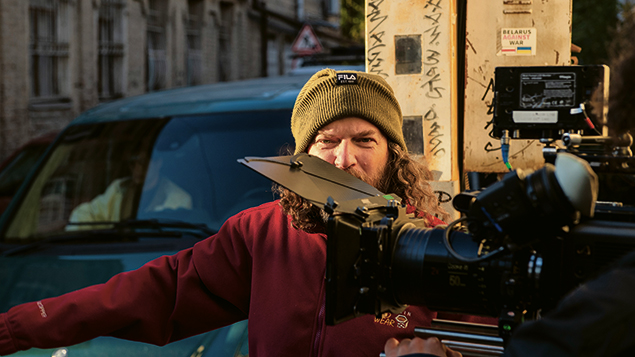
His son made aliyah and joined the IDF. That no doubt would have pleased Mr. Moshe’s Ashkenazi grandmother. “She had a picture of me in my uniform and red beret on her mantle, proof she felt that our people had persevered,” Mr. Moshe said.
“The Fix” is playing in AMC theaters throughout the area.