The inventive ‘Klezmerette’
Daniella Rabbani remakes old music with pride and joy
Start with the video.
It’s brightly colored, fast-moving, entirely and unmistakably New York, starting in Brooklyn and finishing in Washington Square Park, getting there, but of course, by subway.
It centers on a happy, self-confident, fast-dancing woman with long shiny dark hair and sunglasses, who whirls through a bodega and the streets and the train and the park, picking up musicians and tourists, singing a subtitled Yiddish song about her hilariously disreputable family (to be clear, it wouldn’t have been funny in real life), radiating joy.
It’s a song called “Ketzele Baroyges” — it seems to mean “Why Are You So Angry, Kitten,” which seems random, because it doesn’t look like it’s about anger at all, but about freedom and light and motion — and was first sung by the Barry Sisters, the midcentury singing siblings whose real last name was Bagelman.
And the singer is Daniella Rabbani, an actress who started in the Folksbiene before she went on to Broadway, Hollywood, and TV, got married, had two children, became a podcaster with “Mom Curious,” and now is launching her first klezmer CD, called “Klezmerette.”
A word she invented, because it makes perfect sense and there was a hole in the language waiting to be filled by it.
On a Zoom call, Ms. Rabbani told her story.
She’s deeply and multiculturally Jewish. She was born on the Upper West Side and grew up there and then in Great Neck, on Long Island, the granddaughter of a Holocaust survivor on her mother’s side and an Iranian Jew on her father’s. Her parents are Israeli, and Orthodox; they spoke Hebrew at home, and they sent her to a yeshiva. “When you are raised bilingual, you have a leg up when it comes to learning languages,” she said. And when you grow up with such a rich Jewish heritage from so many places, “you have so many ways to express your deep pride in Judaism,” she said.
“I have had a lot of different influences, and I was finding my own expression.”
Ms. Rabbani went to the Tisch School of the Arts at NYU. Tisch, for performing arts students, offers a range of options. She chose the Stella Adler School of Acting. It was named after its creator, Stella Adler, part of a Jewish acting and teaching dynasty that has fueled Yiddish and then New York theater for more than a century. She learned classical acting technique and she was in an atmosphere that was creative, innovative, and somehow also deeply Jewish.
From there she joined the National Yiddish Theatre Folksbiene, and toured with the company. She learned Yiddish from Zalmen Mlotek of Teaneck, the Folksbiene’s artistic director, and she’s toured with him in Warsaw, Budapest, and Vienna. She starred in the Folksbiene’s “Gimpel Tam” in 2008, in its “Golden Land” in 2013, and in its “Amid Falling Walls” in 2023. She’s performed at the Edinburgh Fringe Festival, and at Summer Stage in Central Park. She has been in movies and TV shows, and she does voiceovers. She has a successful career as an actress.
And she sings.
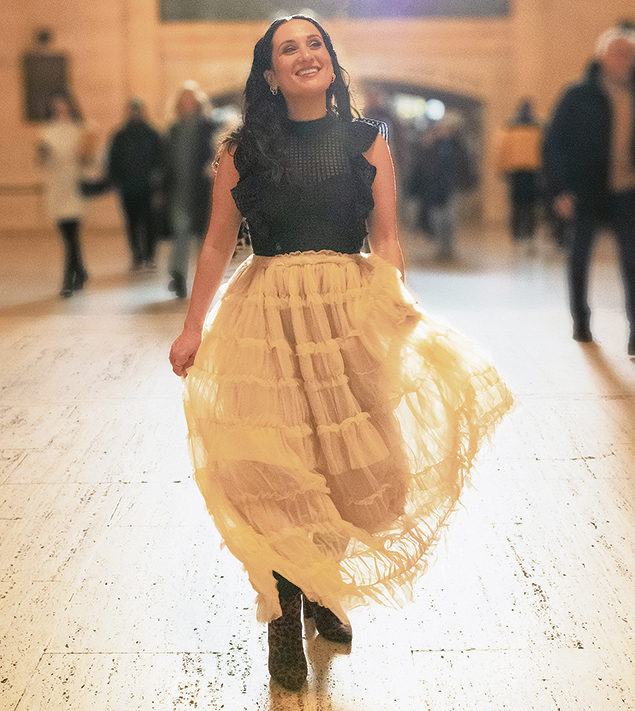
All of this — moving from platform to platform, from one medium to the other, being the same but different — is deeply Jewish, Ms. Rabbani said. “Jews are a storytelling people. We tell the same story over and over again, with enormous fervor and pleasure,” and every time we retell it is slightly different, adjusted to each new time and every new place.
“We have a deep history in Hollywood and on Broadway. I don’t see the difference between those different forms the other people do — especially when it is from the Jewish angle, from the perspective of an artist and an actress and a person — using all the keys on the humanity piano, and that includes a Jewish key. It’s a minor key; a lot of klezmer music is in a minor key.”
Ah. Klezmer.
Ms. Rabbani’s new album has been gestating for about 20 years, she said, although it couldn’t have been born until both it and she were ready.
Now, she said, her children, who are 7 and 9, are old enough so that “I am in a stage of motherhood that allows me a little more independence and self-expression. And I’ve also grown into my artistry as an adult.”
So now it’s time for “Klezmerette” to emerge.
Even the word is a symbol, she said. The word klezmer describes a kind of music, but it also “means musician. So I made up a word for a female musician, and I am carving out a space for myself, with a little more agency.
“I recently learned that the word klezmer comes from two Hebrew words, kley and zemmer,” she said. Kley is a vessel, and zemmer is song, so the word means “vessel of song.” That’s a deeply feminine image. “I really experienced that deeply,” she said. “I feel that as a woman and as a mother, and that this album is a birth of sorts.”
She’s deeply grateful to many of the men in her life, but “I feel the female voice working through me, as a kley zemmer,” she said. She is deeply Jewish but no longer Orthodox, and “I think it’s funny that my children only know female rabbis,” she said. “I feel like this is a feminist reclamation.
“My parents always loved my voice, and honored it, but I wasn’t allowed to sing at school because of kol isha” — the prohibition against men hearing a woman’s voice raised in song. “So this is my adult, motherly expression from that vessel. And the 20 years that it took me — maybe that’s b’sha’ah tovah.” (The phrase means “in a good hour” or at the right time, and it’s usually used when someone says that she’s pregnant.)
“Holy timing,” Ms. Rabbani said.
Which should not be read as meaning that the album is reverent. It is, in part, but it’s also exuberant, joyous, pensive, and simply fun. It has 10 songs, enough for 10 moods.
“It is mostly Yiddish classics,” Ms. Rabbani said. “We have some deep cuts. My producer, Michael Winograd, a virtuoso clarinetist, arranger, and bandleader, has arranged several of the songs.
“Some of them are very well known — “Oyfn Pripetshik,” “Meine Yiddishe Mame” — and Michael arranged them to make them new again, and to reach out to those who don’t know klezmer, so they can start from the beginning.
“I was adamant that we made something fresh and new.
“The first video, ‘Ketzele Baroyges,’ is a cover of a Barry Sisters song that most people don’t know now.” It’s in Yiddish, “but the words have nothing to do with being Jewish.”
Ms. Rabbani talked about the concept of the male gaze — how women’s conversation and self-presentation changes, even if ever so slightly, when there is a man there, watching them.
When Jews are together, they can speak one way. When there are non-Jews, we become aware of the “outside gaze,” she said. But when Jews talked or sang in Yiddish, they could become more natural, and look more inward, toward their own community. There was no outsider gaze.
“What are we talking about?” she asked rhetorically. “We are talking about learning the alphabet. We are talking about raising our children. We are just talking Yid to Yid. We are just people, and that fascinates me.”
Despite her deep immersion in Jewish culture, thought, and life, “I don’t play Jewish” on this album or anywhere else, she said. “I don’t dress period. When I sing, I don’t stop my hips from moving, and I don’t pretend that I am from a different era, or that I am more or less pious than I am.
“I am me.”
The Jewish world has been different since October 7, she said. “It changed the politics, but I think it deepened my confidence that I had something to offer the community. The joy. The pride. I am not Orthodox anymore, but I have had the luxury of being educated in our way and in our people. It is clear that this is useful to the Jewish community, and this is my offering to it.”
When Zalmen Mlotek talked about Daniella Rabbani, he went back to her roots in the Yiddish theater, and in NYU, which is about modern theater.
“Daniella came to us some years ago on the recommendation of Tom Oppenheim, who is the grandson of Stella Adler and the director of the Stella Adler Institute. He told us about this wonderful talent.
“I heard her and I was very excited by her. She is a wonderful spirit, deeply Jewish and deeply connected, and a sparkling presence on the stage. And I’ve worked with her ever since.
What about “Klezmerette”? “I think it’s great. It’s wonderful that people want to record new versions of old songs and make them their own.”
“Klezmerette” comes out on October 15. It will be launched at the Cutting Room in Manhattan; the evening will include a showing of a documentary film about Ms. Rabbani, also called “Klezmerette.” Learn more at daniellarabbani.com or thecuttingroomnyc.com.