‘They want a place to just be Jewish in public’
OU’s Jewish Student Union clubs provide safety — and fun — in high schools
Waverly Greenberg, a sophomore at West Orange High School, recalls that one day last year, the school ordered everyone to remain inside their classrooms due to a possible threat or hazard.
Though no explanation was given for the “shelter in place” order, a classmate told Waverly he had seen a comment on his phone that said, “Jews must be behind this.”
“I looked at his phone to see what he was talking about, but after a quick glance, he snatched it away,” Waverly said. “I demanded that he send me the photo and told him that his comment was extremely disrespectful. How could Jews be blamed for something that no one even knew anything about?”
Waverly’s upsetting experience was hardly unusual.
The Bias Data Dashboard of the New Jersey Office of the Attorney General shows 970 anti-Jewish bias incidents reported in K-12 schools out of a total of 3,744 bias incidents in all New Jersey schools during the first nine months of 2026. Anti-Jewish bias incidents were second only to the 1,628 anti-Black bias incidents in K-12 schools during that period.
Nationwide, the Anti-Defamation League found that in 2023, reported antisemitic incidents in K-12 schools increased by 135 percent and remain near historic highs. That’s unlike college campus incidents, which declined in 2024 and 2025. The majority of reported incidents in K-12 schools involve peer-to-peer behavior, such as antisemitic bullying or students vandalizing classrooms with swastikas.
Fortunately, Waverly, like other Jewish students at approximately 515 public or secular private high schools across the country, have a haven within their own walls, in the form of Jewish Student Union clubs.
The Orthodox Union’s NCSY youth movement now runs 30 active JSU clubs in New Jersey, and several others are being set up. Nearly 900 students attended JSU meetings in New Jersey during the first month of this school year.
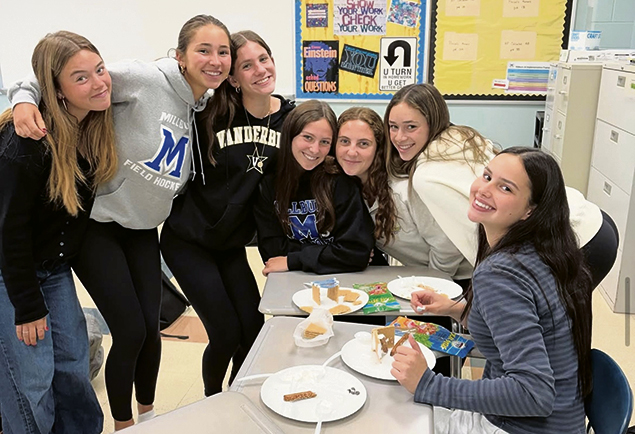
Each school provides space and a faculty advisor who works with a JSU staffer to coordinate the weekly, biweekly, or monthly student-run meetings, typically held at lunchtime.
“JSU has helped me so incredibly much as a Jewish teen in a public school with very few Jewish students,” Waverly said.
“When I moved to West Orange from Demarest in 2024, I didn’t realize how few Jewish students there were. In eighth grade, I think there were only four other Jewish students in my grade, and I knew there were many students who were pro-Palestine. When I went to high school and found out about JSU, I was so happy because I could be with others like me.
“It is a safe place, where I can be open about my religion and express exactly who I am. No one judges you, and everyone allows you to be yourself. JSU is so beneficial for any Jewish teen because it opens the door to new friendships and opportunities to learn more about Judaism.”
Rabbi Derek A. Gormin, NCSY’s managing director and the founding dean of JSU Global Campus, described how JSU clubs are created. They are established only upon request, he said. Each club must be approved by the host school, and sometimes by the local school board as well.
“We have a button on our website called ‘Start a Club’ that kids can click, which brings them to a link where they fill out their information, and we get back to them,” Rabbi Gormin said. “That link was activated maybe once a month or once every other month for years, but after October 7 — without any PR or advertisements — we started getting five or more people a week reaching out.”
He refers, of course, to October 7, 2023, the day thousands of Gazan terrorists unleashed a frenzy of arson, torture, murder, and kidnaping upon Israeli communities along the border. Counterintuitively, this unprecedented attack unleashed a frenzy of antisemitic, anti-Israel sentiment in many parts of the world even before Israel’s military response began.
Many high school students suffered the effects of this backlash.
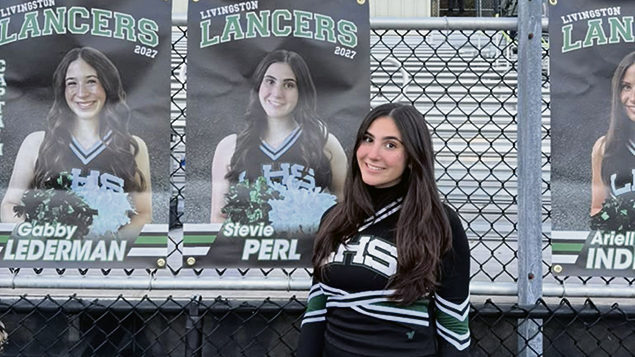
“The events of October 7 personally impacted me as a public school student, as this was the first time in my teenage years that I realized I might have to hide my identity to protect myself,” Livingston High School senior Stevie Perl said.
Stevie is president of the JSU at her school, and she is the student representative to the Livingston Board of Education.
“After witnessing swastikas drawn in bathrooms in the middle school, pro-Palestinian protests on the oval, and an overall sense of melancholy within my community, I became increasingly aware of the antisemitism surrounding me,” she said. “Luckily, I live in a town with a prominent Jewish population, so I have never felt the need to hide my identity. I feel safe in school; it is more what lies beyond high school, in the real world, that concerns both my parents and me.
“Throughout the three years since the events of October 7, JSU has made me feel more confident in my connection to Judaism. It serves as a space every other week where Jewish students can congregate, talk, and eat. JSU is a strong community that makes students feel seen and recognized in a world that often does the opposite.”
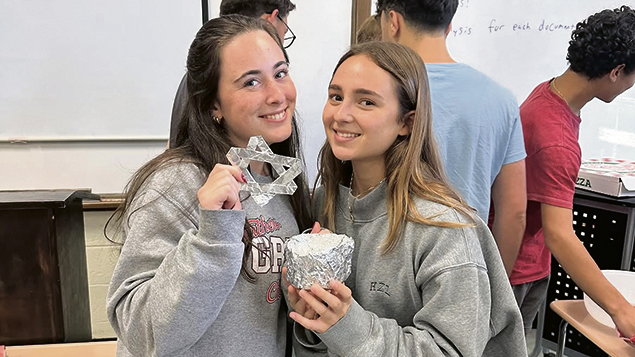
Stevie said around 40 kids, mostly freshmen, attend JSU meetings at Livingston High. They enjoy activities such as Noah’s Mission Unsinkable, tied to the biblical account of Noah’s Ark, in which students competed to craft aluminum-foil floats carrying animal crackers in a bin of water. Outside of school, members meet on Tuesday nights to chill out with ice cream, and there are occasional Shabbaton weekend gatherings.
“Interestingly, kids are not reaching out saying, ‘Help us fight antisemitism,’” Rabbi Gormin said. “They want a place to just be Jewish in public, where they can take their Magen David necklace out of their shirt and wear it in the front proudly.
“We do have programming designed to build the muscle to fight antisemitism and to recognize anti-Jewish bias when it’s sometimes disguised as anti-Israel bias, and we partner with different organizations in that regard, but it’s not the primary theme of our programming. Our primary theme is positive Judaism — ‘prosemitism,’ if you will.
“If you’re proud to be a Jew in high school, then you’re going to continue when you get to university. If you see a rally on campus against the Jewish people, you’ll know that what they’re saying is hateful and wrong, and you’re going to stand up against it.”
Rabbi Gormin emphasized that while it’s under Orthodox auspices, JSU is “maximally inclusive,” so that Jewish students of any or no affiliation will feel comfortable and welcomed. “There are not many programs in the world like that,” he said.
Jason M. Shames, CEO of the Jewish Federation of Northern New Jersey, said the federation started allocating funds to JSU clubs in its catchment area in January 2024 and has continued that support “because teens need a Jewish connection in the years between bar or bat mitzvah and college.
“JSU meets public school students right where they are, in their high schools. It’s a comfortable and safe place to make Jewish friends, have fun, and build connections that can last long after graduation.”
Tyler Lipke, a 16-year-old junior at Fair Lawn High School, said weekly JSU meetings have become a key part of his high school life.
“Jewish Student Union is a community built of teens and advisors who want to build connections, learn about Jewish culture and traditions, and best of all, have fun,” he said. “JSU is for any Jewish student, no matter how observant they are; everyone is welcome and should feel safe. I personally have had so much fun in JSU, and I can’t wait to make more memories and continue my Jewish education.”
On the third anniversary of October 7, many JSUs took a break from fun activities — the previous week, some clubs built edible sukkot from crackers, pretzels, and frosting — to watch “Am Yisrael Chai: Unbreakable Resilience,” a video coproduced by JSU and United Hatzalah, followed by facilitated discussions or text-based study. The video included firsthand survival and rescue accounts of first responders, including teen participants of the NCSY Summer Hatzalah Rescue summer program in Israel.
“One of the pieces that struck in a pretty strong way this year was an aspect of appreciation that there are no more hostages being held in Gaza,” Rabbi Gormin said.
“We introduced the idea, which is very Jewish, that we have the ability to hold conflicting emotions in our hearts at the same time — you can be sad, you can be bothered, you can be upset, and you can also be appreciative. We had a number of programs that touched on that very powerful nuance, and there was a lot of good feedback from students.”
Nearly 400 Jewish teen leaders from across North America are expected to attend JSU’s Presidents Conference in Stamford, Conn., November 1-3. They will receive practical training in building clubs, leading peers, and strengthening Jewish life in their schools.
Lexi Magid, a junior at Livingston High School, said that JSU “has helped me expand on my Jewish friendships. I love to be able to express myself with them and connect with them on levels about Judaism that I cannot with others. I would like other teens and their parents to know that JSU is a safe and fun community to learn more about what’s going on in the Jewish community and life itself.”