‘They’ll put them on Mars!’
Jersey-bred documentary filmmakers release ‘Fiddler on the Moon’
Most folks know that Jews do not really control the film industry in Hollywood.
But when it comes to Garrison, N.Y., well, that’s a completely different story. Garrison is the home of Ironbound Films, founded by two New Jersey boys — Daniel Miller, who grew up in Edison, and Seth Kramer, originally from West Orange — and named after the now primarily Portuguese and Spanish neighborhood in Newark.
Their most recent film, “Fiddler on the Moon: Judaism in Space,” sounds less like a documentary than a Mel Brooks farce. But it was just nominated for a Critics’ Choice Award for best short documentary. They hope this recognition gives them a leg up on an Oscar nod in the same category.
Miller and Kramer, co-directors of the film, and Fiddler’s executive producer, Joseph Strulowitz of West Orange, a childhood friend of Mr. Kramer, appear on my Zoom screen looking not so much Big Shot Film Executives as rabbinical school dropouts.
Mr. Strulowitz, who came up with the idea for “Fiddler,” starts off explaining where the notion came from:
His “fairly religious,” kosher-keeping family — his grandfather was a kosher butcher in Irvington — celebrated holidays at B’nai Shalom.
“That’s how I came to the idea for this film,” he said. “I was a little kid and would often ask my rabbi questions after kiddish. Once I asked him about the concept of the messiah coming back. When the messiah comes back, the dead will rise. My question to the rabbi that morning was, ‘Where will they put everybody?’ The rabbi thought for a second and he said, ‘Well, they’ll put them on Mars.’
“So then I ask follow-up questions. ‘How will that work?’ ‘Can you have a mikvah on Mars?’ ‘Is the water from the heavens?’ And the rabbi, to kind of to shut me up, said, ‘Well, the messiah will deal with that when he comes.’
“Fast forward 45 years. I’m 53. Elon Musk decided that he’s going to build 1,000 Mars rockets. They’re already being tested and flown. He wants to build a city on Mars. So unless Moshiach comes real soon, we’re going to have to figure this stuff out now.
“So I called Seth about two years ago and pitched this crazy idea to him, a kind of retrospective of how Jewish astronauts performed rituals and how they kept it as halachic as possible.
“Seth is someone I’ve known for a long time and I trust was the right guy to do this job along with Daniel, and I’m really glad I reached out to them.”
But Mr. Miller recalls being less enthusiastic, at least initially. “I think when we were first approached with the idea, we thought Joey was a little crazy, sort of like a space cadet, just to go along with the theme,” he said.
“But as we did our research, we discovered that rabbis had been debating the ideas of space travel and space colonization and how Judaism would survive in those circumstances for quite a long time. Even before space travel, they were wondering what will happen if we settle other planets.”
The film quotes the late Rebbe Schneerson, the Lubavitcher rebbe, who said: “Space exploration is absolutely not against the Torah. The more science and technology develop, the more the Torah’s truth becomes clear.”
Astrophysicist and educator Neil DeGrasse Tyson agrees that colonization won’t be a problem for the tribe: “There are Reform Jews,” he said. “Chasidic Jews. So it wouldn’t be weird to have a branch of Jews, the Martians.”
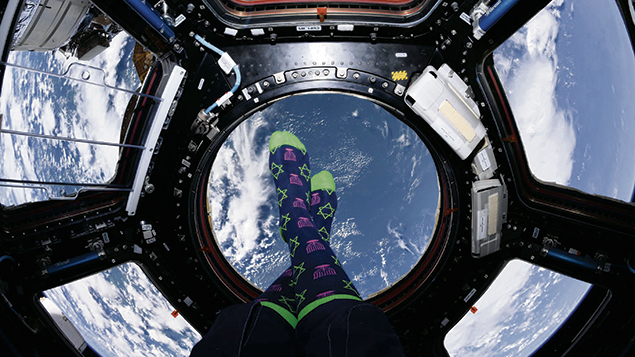
Jewish astronauts Jeffrey Hoffman, Sarah Gillis, Jessica Meir, and others are shown on board (and in Jessica’s case outside the shuttle doing a spacewalk), often with Jewish tchotchkes in hand or on foot. Ms. Meir proudly showed off her Star of David socks, while Ms. Gillis displayed her skill playing the violin.
Conceivably, though, there was the potential mind-blowing headache for astronauts. As their capsule circles the Earth, it runs into a new morning every 20 minutes. Can you imagine — morning prayers, afternoon prayers, evening prayers, morning prayers, afternoon prayers, evening prayers, three times an hour every hour?
Jerusalem, we have a problem.
But that was soon solved when rabbis decided that astronauts had to stay on the time of their city of departure, whether it was Houston or somewhere in Russia.
“‘Fiddler on the Moon’ reflects our company’s sensibilities,” Mr. Miller said. It’s honest. “It’s intellectually rigorous and also has a strong sense of humor.”
He described their backstory. “Seth and I met when we did our first internship together,” he said. They worked there for about a decade before going out on their own.
“I’m not sure we were thinking too clearly,” Mr. Kramer says about the decision. “Founding a documentary production company, you’re taking a big leap. I’m not sure it’s the most rational thing to do. But we had stories we wanted to tell. Ideas we wanted to share with the world.”
They got off to a great start. Their first project was “The Linguists,” which followed two scientists traveling around the world looking for the last speakers of dying languages. That aired on PBS and was nominated for an Emmy.
“The New Recruits” followed, about a group of young business students determined to end world poverty. That, too, aired on PBS and earned an Emmy nod. Clearly, they were on the right track.
But now, Mr. Miller notes, “for the past few years, we’ve been focusing on Jewish themes, returning to our roots.” The two Ironbound Films before “Fiddler” were about the Israeli baseball team, “Israel Swings for the Gold,” and “Heading Home: The Tale of Team Israel.”
They come by that instinct naturally. Mr. Miller, “a born and bred New Jersey Jew,” as he put it, went to Hebrew school at Neve Shalom, a Conservative synagogue in Metuchen, was active in Young Judea, the Zionist youth movement, and spent a gap year after high school in Israel.
Mr. Kramer’s family went to B’nai Jeshurun, a Reform synagogue in Short Hills. “I did have a bar mitzvah, so my parents did give me some Jewish upbringing,” he said. “But I experienced a lot of antisemitism in West Orange, and I think that also gave me a much stronger Jewish identity than I might otherwise have had.
“Film is a great way to get people together,” he added. “And this film, in particular, I think, is helping Jewish audiences look toward the future.”
“Fiddler on the Moon” will screen at the JCC in Manhattan on November 25. Other showings are tentatively scheduled at Jewish film festivals in West Orange and Cherry Hill.