When ‘dough is not just dough anymore’
The Challah Prince teaches braiding — and baked-in connections
While she was on furlough during the pandemic, Stacey Coyne of Airmont in Rockland County became “a personal challah enthusiast,” baking and delivering braided loaves of Shabbat bread to her friends.
Ms. Coyne, now president of the sisterhood of Temple Beth Haverim Shir Shalom in Mahwah, and her friend Nancy Levene, another challah enthusiast and active BHSS member, soon discovered on social media the challah creations of an “adorable Israeli guy.” That’s Idan Chabasov, aka the Challah Prince.
“We became fan girls,” Ms. Coyne recalled. “I had an idea that it would be awesome to have the Challah Prince at BHSS one day, not really believing it could happen.”
Well, sometimes dreams come true. In 2024, the sisterhood had a little extra money in its coffers from a goods-and-services auction. With the enthusiastic assistance of Iris Greenberg, the synagogue’s executive director, they invested those dollars in arranging a challah-braiding demo and workshop led by that adorable Israeli.
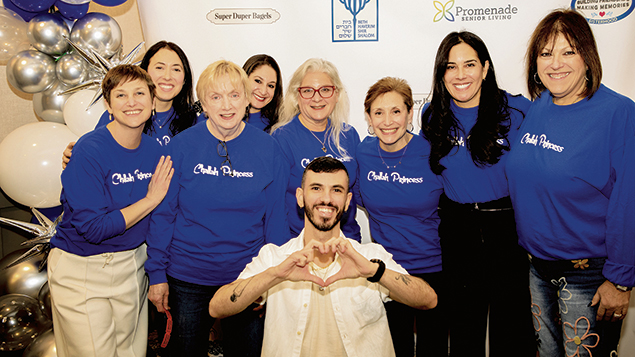
The sold-out event on December 14 at the Crowne Plaza Suffern-Mahwah drew 145 participants, primarily women, leavened with a sprinkling of men and children.
“I’m so lucky to be surrounded by Jewish mothers all the time,” the 40-year-old Challah Prince joked.
The former professional dancer, video producer, and meditation instructor began baking challah in 2017, when he moved to Berlin for seven years and failed to find any decent challah for Friday night gatherings of fellow Israelis.
“I was very involved then in the meditation community in Berlin and I felt something very in common between meditation and working with your hands and body to knead and braid bread,” he said. “I felt like I was going into a deeper state of meditation and just being in the zone. That was amazing for me to discover.
“I realized challah is not just baking and not just bread. Challah is a great instrument for us to communicate something higher and deeper. And especially after October 7, the dough is not just dough anymore. It’s a great tool to lead us to healing as a community and as the Jewish people. The challah is there to make sure we are gathering and reminding ourselves to stay united and be together all the time.
“When we are united, we are stronger, and the challah enables us to do that in such a perfect way.”
Over the last three years, Mr. Chabasov has led about 170 challah-braiding workshops in the United States as well as in Costa Rica, Guatemala, Budapest, Paris, and soon England. In 2022, he was in MetroWest for BBYO; we wrote about it then.
“When Idan gave us the dates he was available, we chose the first night of Chanukah because we felt it would be perfect for our community,” Ms. Greenberg said.
She and Ms. Coyne formed a planning committee — they called themselves “the Challah Princesses” — and spent “months and months” preparing for the big day with Mr. Chabasov’s guidance.
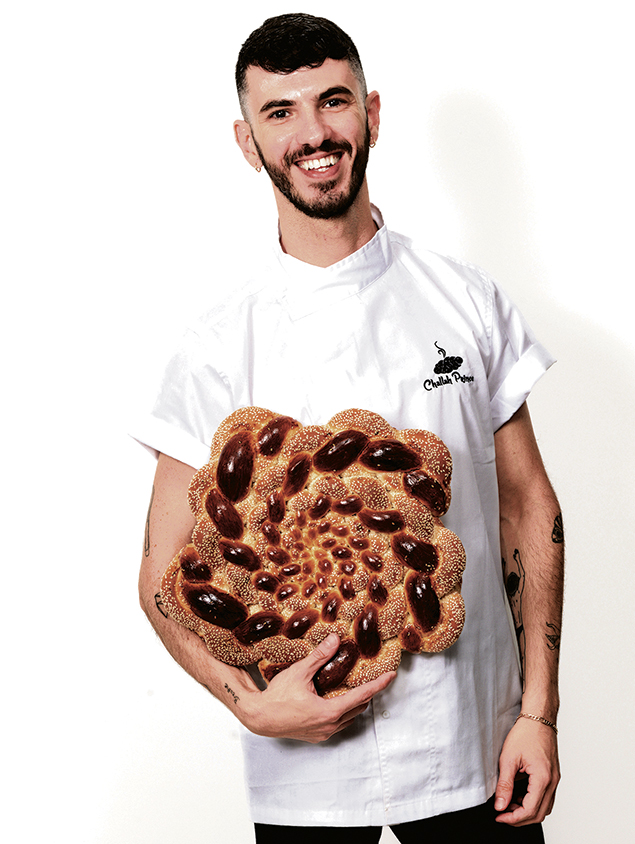
Challah bakes are quite popular in Jewish communities across the United States, but the Challah Prince offers something different: He brings ready-made dough and demonstrates a variety of sophisticated braiding techniques. Participants then take the shaped dough home to bake.
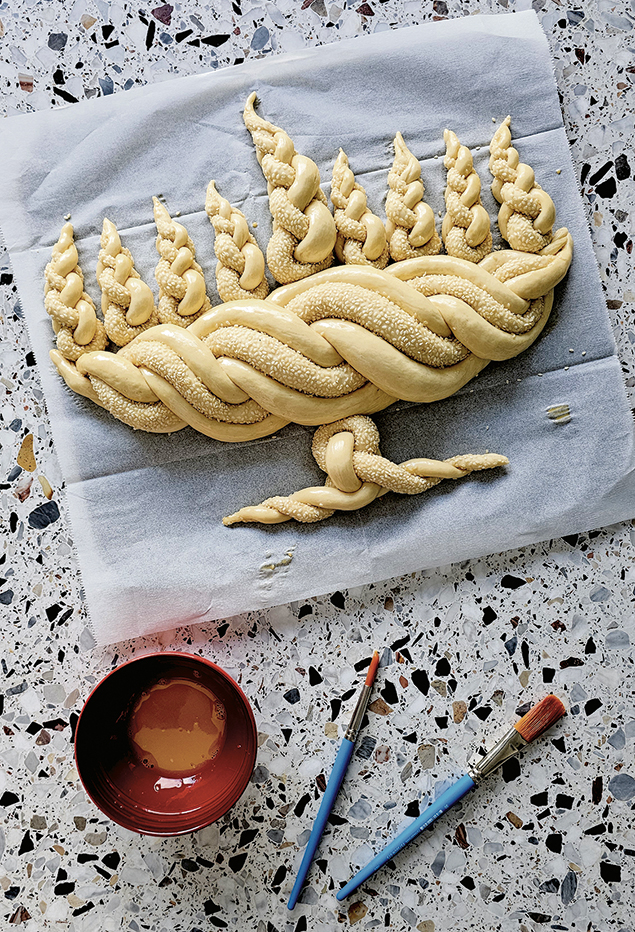
The Challah Princesses assembled a kit for each participant that included a bag for the dough, Mr. Chabasov’s vegan challah recipe, and booklets in which to take notes. They hired two photographers, one of whom projected live overhead video of Mr. Chabasov working his magic so that every attendee could see clearly how he shaped and braided masterpieces such as a six-strand Chanukah flame challah.
“When he flew in on Friday before the event and we met him face to face, we were all giggly and excited,” Ms. Greenberg said. “We felt we’d known him for a million years.”
At 7 a.m. Sunday morning, Ms. Coyne and Ms. Levene drove Mr. Chabasov to Super Duper Bagels in Livingston, a kosher bagel shop whose Israeli owner graciously allowed Mr. Chabasov to use what Ms. Coyne described as “his ginormous floor-model bread mixer” to turn 100 pounds of flour into challah dough.
“Nancy and I then put the dough in giant plastic bags, schlepped them out to my car, and took them to Crowne Plaza, where the rest of the committee was setting up the space. We portioned out the dough into plastic bags labeled for each participant.”
As it turned out, the erev Chanukah mood that day was marred by news of the deadly terror attack at a menorah lighting on Australia’s Bondi Beach. Ms. Greenberg said this tragic backdrop only made the braiding workshop more meaningful.
“So many people who came said they needed this experience on this difficult weekend of the massacre in Australia. The fact that we had something beautiful and wonderful made that Sunday bearable for us.”
Mr. Chabasov said the workshop was therapeutic for him as well as the participants. “The challah is my teacher and therapist,” he said. “Just like I show people the direction in braiding the strands, the challah shows me the direction in life.”
Although the word “challah” now describes the loaf itself, originally it referred to a small piece of dough taken from the batch as a tithe in Temple times. Today, the baker recites a blessing when separating the piece of dough to commemorate this biblical practice and then burns it. (A translation of the bracha: “Blessed are You, Lord our God, King of the Universe, who has sanctified us with His commandments and commanded us to separate challah.”)
Mr. Chabasov recited this blessing when preparing the dough at the bagel bakery and again when leading the braiding demonstration for the group. “It’s so powerful to hear everybody saying ‘amen’ and sending their prayers to the sky,” he said.
He showed the crowd not only how to shape the flame challah but also how to braid with five strands and 11 strands. Several of his specialty loaves were raffled off, including his menorah challah.
“After participants brought the braided dough home and baked it according to Idan’s instructions, they said it was the best challah they’d ever tasted,” Ms. Greenberg said. “They loved the challah, they loved the program, and they loved Idan’s excitement and joy. Several people asked if we’re going to make this an annual event.”
Ms. Coyne invited Mr. Chabasov over for dinner that night and served the fresh-baked challah she’d braided at the workshop. “There’s something so nurturing about homemade bread, and challah is, for many people, a core Jewish memory,” she said. “It’s so accessible to everyone.”
The Challah Prince, who went back to Israel from Berlin five years ago, lives in Harish, about an hour south of Haifa. From his large kitchen, surrounded by views of nature, he gives braiding workshops in person and over Zoom.
“Since biblical times, bread has represented abundance,” he said. “It’s amazing to see how over the years, challah changed shape, but its purpose stayed the same and is just getting stronger.”