Where does the Yiddish theater come from?
Zalmen Mlotek explains it all, with music at Beth Sholom in Livingston
Did you know that the road to big Broadway musicals started in some pubs in 19th-century Romania? With half-drunk patrons banging their tankards on the wooden tables and bellowing songs?
I didn’t. (And I grant that the tankards are possibly an overreach. They might have been drinking from thick glass. I think my imagination’s going all Elizabethan on me.)
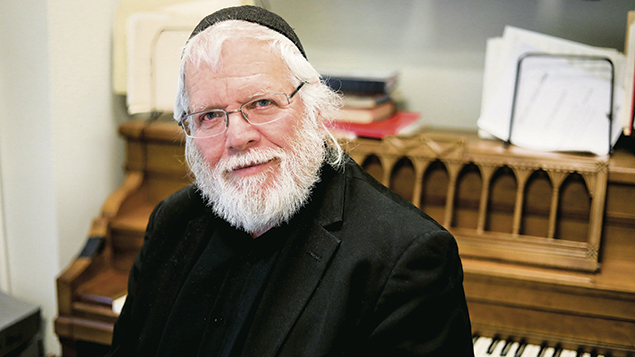
But Zalmen Mlotek of Teaneck did know all about it. Mr. Mlotek, the musicologist and artistic director of the National Yiddish Theatre Folksbiene, is also a historian of Yiddish theater. He has developed a program showcasing that history that he delivers in shuls, JCCs, and other venues. He talks, plays piano, and shows still photos, film clips, and words to songs that allow the audience to sing along — and he’ll bring it all to Temple Beth Sholom in Livingston on Sunday, November 2. (See below.)
“I give a musical history of the American Yiddish theater, with musical examples of various different styles and moments and excerpts from different shows,” Mr. Mlotek said. “Yiddish theater has had such an impact on the theater itself. I talk about the connections between American Yiddish theater and the Gershwins and the Berlins. I give examples of how Cab Calloway and Sophie Tucker used music from the Yiddish theater. They’re all interesting little musical tidbits that somebody interested in musical history would find fascinating.”
Where do the Romanian taverns come in?
“I start in Europe, where the Yiddish theater began,” he said. “I talk about how Yiddish theater came about. Why there was a need for it, out of the desire to hear stories.”
It began with the Purim spiel, Mr. Mlotek said. That, of course, is the play that tells the story of the holiday; it’s often funny, broad, at some times in some places coarse, or at least lowbrow. Think Punch and Judy, just about a Bible story, and in Yiddish.
The desire for drama also led to reenactments of the Joseph story. “It’s such a dramatic story, with the recognition and reconciliation between the brothers,” Mr. Mlotek said. “To this day, if you go to Brooklyn, to a chasidic shtiebel, there can be a thousand people at a fabrengen” — a big gathering, with lots of men, lots of energy, lots of singing, lots of storytelling, and often lots of drinking — “and they do these Purim spiels.”
Okay, but why Romania? “That’s because that’s where Abraham Goldfaden was.”
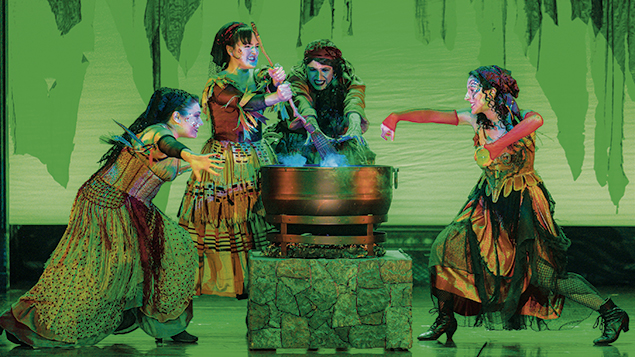
Goldfaden, who was born in what is now Ukraine in 1840 — it was just part of the Russian Empire then — was “a writer and a composer, and he became a producer,” Mr. Mlotek said. “There were lots of performances and opportunities for him. He’d go to a tavern where there would be singing and storytelling in Yiddish, and he’d begin to tell his stories. He’d do a kind of stand-up, and from there they’d turn into shows, and his shows became the fodder for eastern European Jewry. Every major Jewish city — Moscow, Warsaw, London — would produce an opera by Goldfaden.” Just a few years ago, the Folksbiene presented a Goldfaden opera called “The Sorceress.” (It was great fun.)
Goldfaden did a lot of work in the Romanian city called Iași, which is not far from Bucharest, Mr. Mlotek said. “To this day, there is a state-sponsored Yiddish theater in Bucharest. You can count on one hand the number of state-sponsored Yiddish theaters there are — one in Israel, one in Bucharest, and one in Warsaw — and when I say that the one in Bucharest is state-sponsored, I mean totally state-sponsored. Of course funds have dwindled through the years, but there still is a season of Yiddish theater. And we” — the Folksbiene — “still go there every year.”
Abraham Goldfaden eventually made his way to New York. When he died there in 1908, his funeral drew an estimated 75,000 mourners (foreshadowing Sholom Aleichem’s even bigger funeral, eight years later.) “That can give you an indication of how popular his work was on Second Avenue,” the Manhattan home of Yiddish theater, “in those days,” Mr. Mlotek said.
In his talk, he moves from Goldfaden to “the immigration of Jews to America, and what happened with all those Russian-born composers, whether it was Alexander Olshanetsky or Joseph Rumshinsky or Sholom Secunda, Abraham Ellstein, or Irving Berlin, who came from the Pale of Settlement and created culture here.
“Berlin’s early works had Jewish themes, even though he was totally assimilated. These people were the composers, and basically four or five of them did all the scores. Remember, there were a dozen Yiddish theaters from the 1880s to the 1930s, so they had to keep churning out material all the time.”
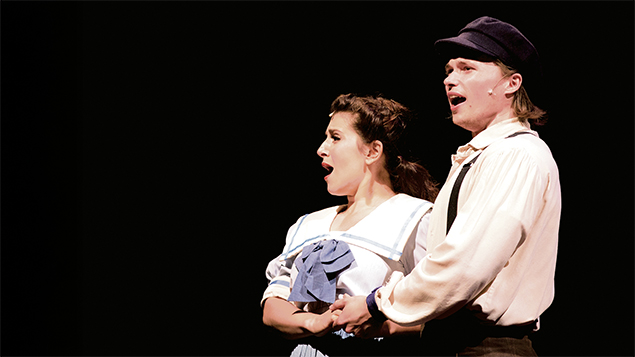
The Yiddish theater wasn’t only musicals, and it wasn’t all lighthearted fun or sudsy melodrama. “The first show the Folksbiene ever did was Ibsen’s ‘A Doll’s House’ in Yiddish,” Mr. Mlotek said.
“And here we are, 110 years later. The Folksbiene was founded in 1915, to present more socially relevant work. Much of the Second Avenue theater was soap opera. Pure schmaltz. It was what people needed and wanted. They didn’t have television.”
But there was serious theater, performed by serious actors, many of them taught very seriously by the famous (and very serious) actress and acting teacher Stella Adler, the daughter of a famous Jewish acting family.
Mr. Mlotek ends his talk with a discussion of the Yiddish-language version of “Fiddler on the Roof” that the Folksbiene has been presenting, first at its downtown theater at the Museum of Jewish Heritage and then around the country and the world.
“People ask me what’s going to be the next ‘Fiddler,’ but there isn’t another piece in the American musical theater canon that did what ‘Fiddler’ does and continues to do,” Mr. Mlotek said. “It’s because of the uniqueness of the story and the music, the way it was staged and that it was first produced in the 1960s, just 20 years after the end of the Holocaust, with many survivors still alive.
“There was a need for it. People were ready for something positively Jewish on Broadway. And look at it now, 60 years later.” The need remains, Mr. Mlotek said.
Who: Zalmen Mlotek
What: Talks about the American Yiddish theater (and looks back at its roots)
Where: At Temple Beth Shalom in Livingston
When: On Sunday, November 2, at 7 p.m.
How much: $36 per person
To learn more or for tickets: Go to tbsnj.org or call (973) 992-3600