

‘Dedication’
Pianist confronts his family’s past in one-man play at Kean
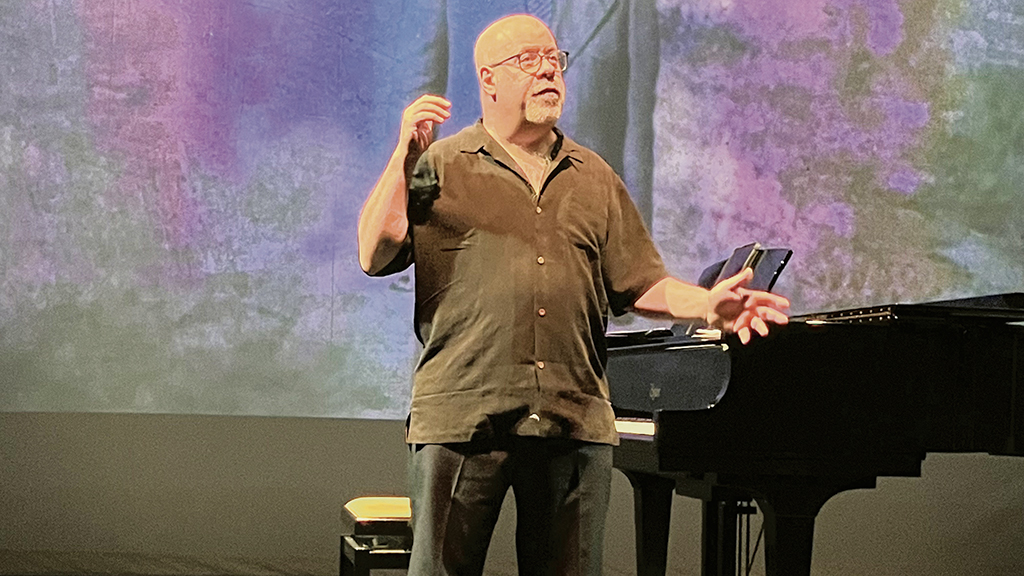
“How do you cope when the most important event in your life occurred before you were born?”
That’s the question that has both haunted and guided Roger Peltzman, a pianist and piano teacher whose career, to his own surprise — not to mention to the astonishment of the people around him — grew out of his family’s Holocaust trauma, and his where-did-that-come-from? close connection to the murdered piano-genius uncle he of course never met.
Oh, and he’s also very funny.
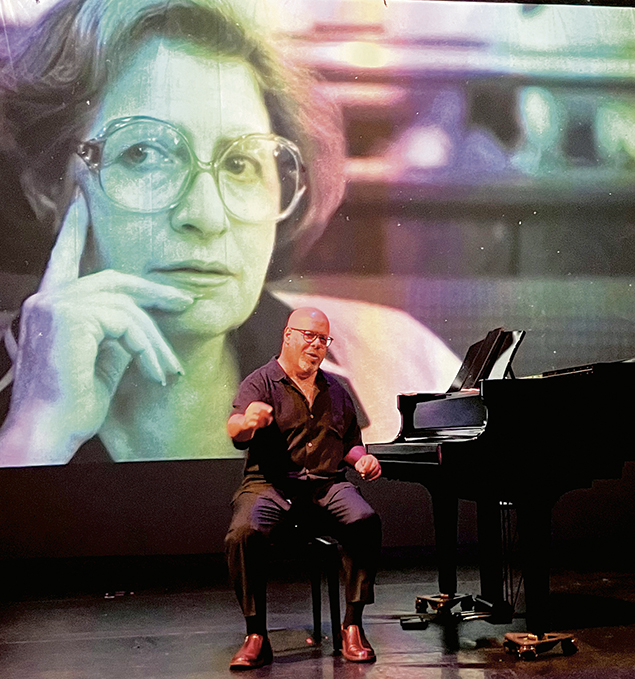
He’s put his family’s nightmare and his own life, in consonance and response to it, onstage in a one-man presentation, called “Dedication,” that will play at the Kean Stage at Kean University in Union on Sunday, March 8. (See below.)
The show is about two things, the past and the present, about “my family’s experiences in Belgium during the war, hiding from the Nazis, and also about second-generation trauma,” Mr. Peltzman said. “And it’s also about a third thing, how music bridges the two, the past and the present.”
The past reaches into the present through the ethereal presence of Mr. Peltzman’s uncle, Norbert Stern, an acclaimed young pianist whose future would have been full of opportunities to create and explore beauty had the Nazis not murdered him in Auschwitz when he was 21.
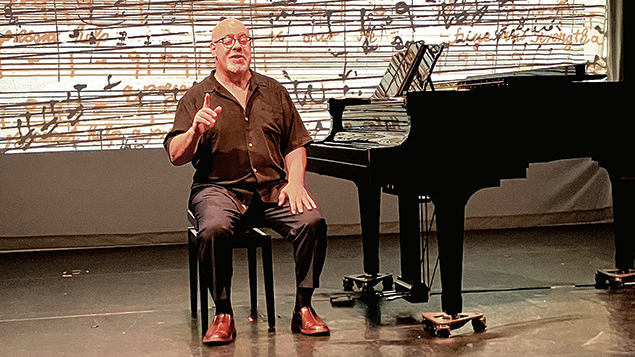
“I have a sort of strange dialogue with him, where I intuit things from him,” Mr. Peltzman, who was born in the United States well after his uncle was gassed in Poland, said.
How did that happen? Mr. Peltzman is also an actor and playwright, so it’s a story; it’s the story he tells in “Dedication.”
He grew up in Blauvelt, a small town in Rockland County.
It was not a town full of Jews. “There were like three Jews in Blauvelt,” he said. And there certainly were no Holocaust survivors or refugees there — except for his mother, Beatrice Stern.
His grandparents were from Warsaw, but they moved to Berlin in the 1920s. “My grandfather was a perfumer, and my grandmother was a chemist.” She was a what? “She went to school for chemistry. And her whole family was in the soaps and perfume business.
“They moved to Brussels in 1933, when Hitler came to power. I found a letter where my grandfather tells the Belgiun government that he’d invented a cream that’s better than Nivea, and he would bring a fortune in business to Belgium. He was a really cocky kind of guy.”
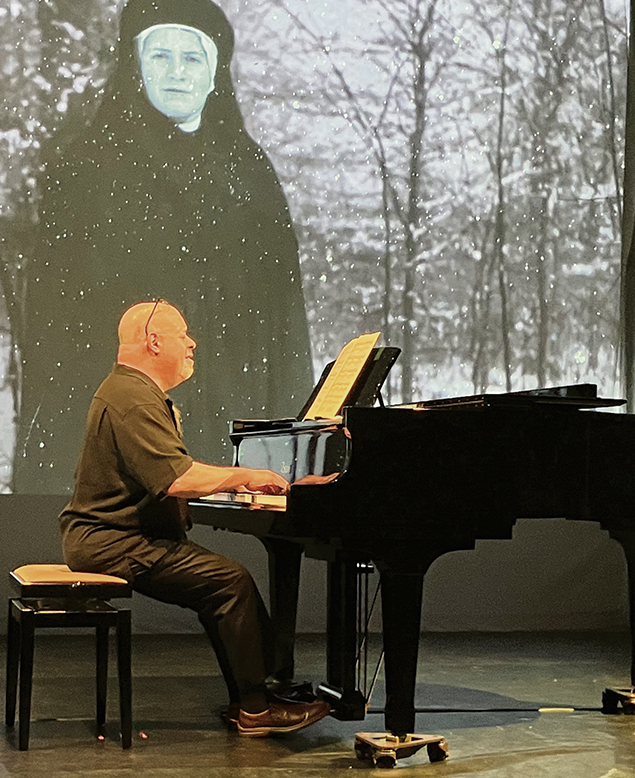
And his ploy worked. The family moved to Belgium, “and my mother’s brother, Norbert, became a great concert pianist. He was at the Brussels Conservatory of Music.
“And then in 1940 the Germans invaded Belgium, and by 1942 they were sending Jews to the camps, so the family went into hiding. They hid for two years. And then we’re not exactly sure what happened, but somebody denounced them. Turned them in.
“My mother, who was 17, had a plan hatched in case something like that happened. The second the SS started banging down the door, she grabbed her coat and slippers and ran toward the bathroom. Her mother said, ‘Where are you going?’ And she said, ‘They’re not going to take me.’ She climbed through the bathroom window and out onto a roof.
“They grabbed the rest of her family, her parents and her brother, and they ended up in Auschwitz.
“But my mother was out the window.”
She hid for days; a friend’s family refused to give her shelter but sent her away with five francs and dry clothes. She called Norbert’s teacher, “a famous violinist who taught chamber music, and said, ‘I need help.’ He said, ‘Call back in three days.’ She was like, ‘What am I going to do for three days?’ So she took a tram to her best friend’s house — her friend was Catholic. She was stopped by a German soldier, and she flirted with him to hide that she didn’t have an ID. And then she got herself to her friend’s house, and told her mother that she had nowhere to go, and the friend’s mother said, ‘Beatrice, my house is your house.’
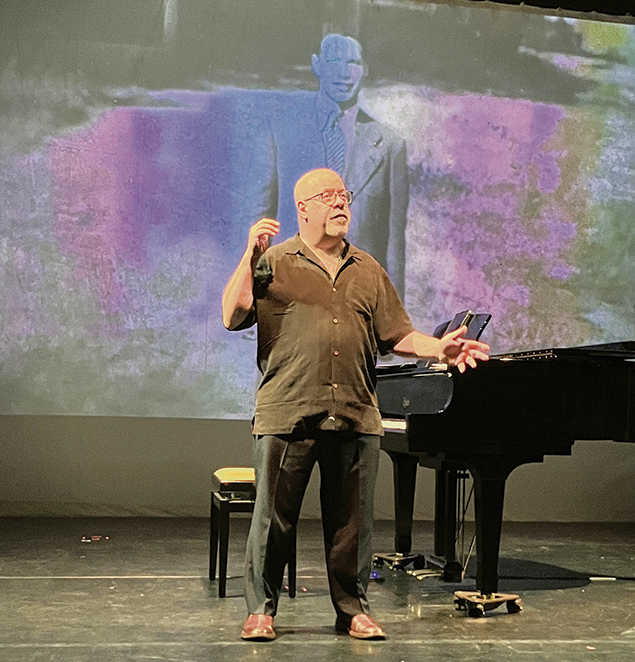
“And three days later, they smuggled my mother out of Brussels disguised as a nun.” He has a photo of her in the habit.
Eventually, she met Nils Peltzman, a pharmacist and the son of a pharmacist, on the Upper West Side. They got married and moved to Blauvelt, where his mother “tells me how the world hates Jews.” He saw no evidence of it in Rockland County, so it was confusing.
His mother, like many Europeans, spoke four languages, but didn’t teach any to her kids. She wanted to assimilate. She hadn’t been able to finish high school in Belgium, but she went back to school in New York, and eventually became a social worker, specializing in geriatric patients. “She was an extraordinary person,” he said.
“I was a kind of lazy kid,” he continued. “I wasn’t a particularly good student. I used to play piano a little. I played blues, and decided that I should get a little bit better at it, which was kind of pathetic, because I was not good at it.
“So I auditioned for piano lessons at Binghamton” — that’s Binghamton University, or SUNY Binghamton as it was then — “and I played classical piano, just to see if I could get my fingers to play better.
“And all of a sudden, I fell in love with classical music. All of a sudden, I found the meaning of my life.
“I stayed in college for three extra years.”
The myth is that classical musicians start playing when they are far younger than Mr. Peltzman was. “That myth is true,” he said. “But I just willed it to happen.”
He went to graduate school at the Manhattan School of Music, and then he worked “in the recording business, making rock and roll. “And then I moved in with my future wife, who had a baby grand, and I started playing little by little, and then more and more. And I started teaching, which I hadn’t wanted to do when I was younger.
“I didn’t think about my family much, because they were dead, and I was an ordinary American. But years later, I went to the Third Street Music School, with a teacher of teachers, Edmund Arkus, who took me under his wing. He’s a very spiritual guy, and he really believed that Norbert was present in my life.
“So I start to look for Norbert, and I get interested in my grandparents for the first time in my life, and I’m trying to find information, and I can’t. And then, all of a sudden, I get a phone call from an 85-year-old woman in Brussels. Norbert used to sneak out of hiding to practice on her family’s Steinway.
“She wanted to know if my mother was still alive. But she had died about six months earlier. So I went to Brussels, I went to her house, and I played the piano that Norbert had played.
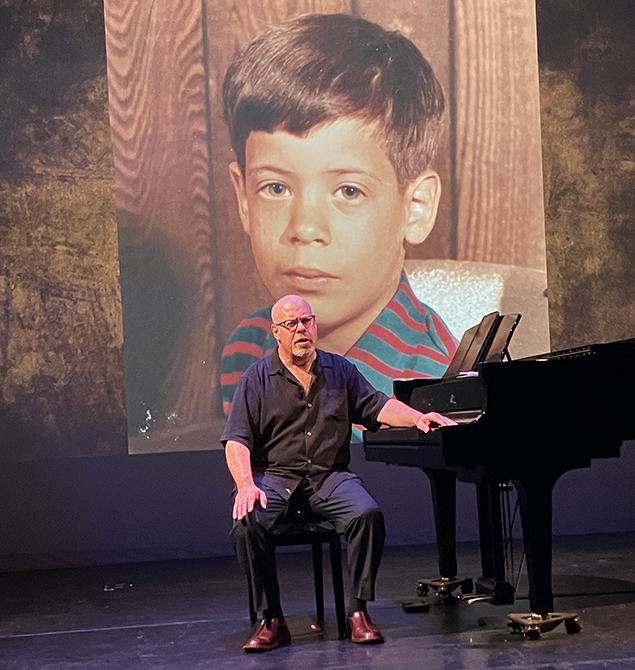
“It was really special. It really felt as if a little piece of him entered me.
“And then she told me that it was her father who had brought my mother to the convent. She had the same picture of my mother as a nun that I had. I asked her where my family had hidden. My mother couldn’t remember, probably because of PTSD. The woman took me to the house.”
For some time now, Mr. Peltzman has been communicating with Norbert Stern. Mr. Stern specialized in Chopin, and now so does his nephew, Mr. Peltzman.
He’s played “Dedication” around the country and around the world. “I’ve done it in Edinburgh, London, Brussels, Berlin, and I’ll do it at the Museum of Jewish Heritage a week after this show.
He plays piano, he tells stories, he shows photos. Some of his stories are heartbreaking, and others are funny. His goals are to channel his uncle, to play Chopin, to give a human face to the nightmare of antisemitism and the losses to the human race that hatred causes, and to show that life and love survive and grow when the horror is over, even as its memory remains. (And to repeat, he’s also funny.)
“Dedication” points in all those directions. It bridges the past and the present, which implies a bridge to the future. It hints at those bridges in its one-word title.
The play is written in dedication to his family, and most particularly to his uncle, Norbert Stern. It’s about the dedication that Norbert brought to his music, and that Mr. Peltzman brings to Norbert’s music, his legacy, and his own music. It looks backward and forward. In the end, it’s a dedication to life.
Who: Roger Peltzman
What: Presents his one-man play, “Dedication”
Where: At Wilkins Theatre at Kean University in Union
When: On Sunday, March 8, at 7 p.m.
How much: Tickets range from $28 to $42.
For information and tickets: Go to keanstage.com/dedication, call (908) 737-7469, or email ticket@kean.edu