

Writing, rewriting, and truth-telling
Author Debbie Slevin touches on pain, secrets, and forgiveness
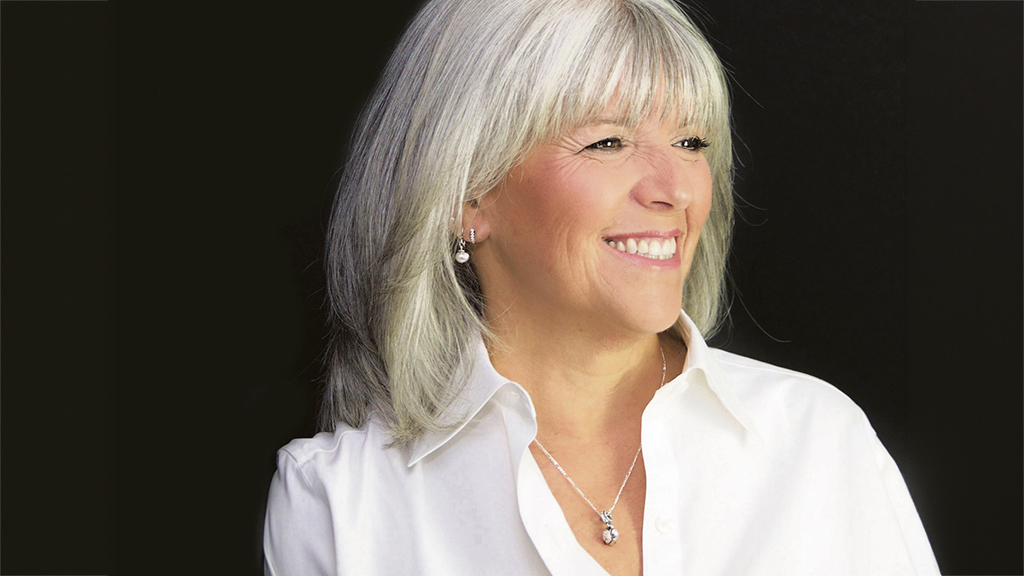
The creative process can work in mysterious ways.
We’ve all read about writers who say that when they start a book, they’re not exactly sure where it will end. They create characters, put them in a situation, and then let them loose. Of course, there also are writers who know exactly where their carefully plotted stories will go. Both can produce great art (or slop, for that matter).
When Debbie Slevin started to write “A Good Man,” her first novel, soon after September 11, it was going to be about the nightmare of that day and the tragedies and stories of heroism that followed it.
But it turned into something else.
Ms. Slevin lives on the Upper East Side now, but she’s a born-and-bred Jersey girl; she grew up in Demarest and then brought her three children up there before moving to Fort Lee, then to Edgewater, and finally decamping to the other side of the river. She’s a writer and theater producer; she also wrote for the Jewish Standard years ago. In 2016 we interviewed her about her nonfiction book, “Unpregnant Pause: Where Are the Babies?” which looked into why so many of her friends, like her, were old enough to be grandparents but weren’t.
(She and her husband, Jeff, did become proud grandparents before the book was published.)
The genesis of “A Good Man” was in a story someone told her soon after September 11. Ms. Slevin was a member of the Northern Valley Regional High School District then — see? deep Jersey roots — “when a colleague told a story about a friend whose husband died on 9/11,” she said. “He was an abuser. She felt such conflict, between feeling freed from the relationship and having to be a publicly grieving widow. She was really caught and squeezed in that dilemma. How do you process it?
“I thought that it was the most painful, poignant dilemma, and the basis of the book I wanted to write. But I determined that it wasn’t my story to tell, so I decided to fictionalize it.”
The story germinated in her head, getting nowhere near a keyboard or a screen, for a few years. “I started writing maybe 15 years ago,” Ms. Slevin said. “I wrote it and I sent it out and I got an agent right away.
“And then she came back to me and said, ‘I cannot possibly place this book. Nobody wants to read a book portraying a 9/11 victim as an abuser.’”
That made sense to Ms. Slevin. She put the book away. And then, with the 25th anniversary of the terrorist attack approaching, “I decided to take it out again.”
But she rewrote it. Much had changed for her. The friends who had read her initial manuscript had told her that they wanted to know more about the characters, so when she began to work on the book again, her emphasis shifted “to the women themselves,” she said. It’s hard to identify with September 11 victims. The idea of facing the choice between jumping to death or burning to death that so many of those victims faced, and without a miraculous savior to swoop them up and out and away, is something most people’s minds shy away from. But “more people can identify with the idea of the conflict between being a public and a private person.”
And as she rewrote, Ms. Slevin realized that underneath the 9/11 story was the story of her own childhood. She did not share anything about September 11 with her characters — except, of course, for living locally, hearing stories of local escape and tragedy, and experiencing it from that remove — but she did share the stories they were hiding.
Stories of abuse.
The book increasingly centered on the story of “the friendship between these two women” — two very different women — “and how they helped each other survive,” Ms. Slevin said.
“As I wrote, I realized that I was writing about the trauma of my childhood. About growing up in an abusive home, where nobody wanted to know about it.
“We were a respectable Jewish family. We lived in a nice community. We belonged to a nice synagogue — Temple Beth El in Closter, where I started in nursery school.
“Nobody knew about what was going on with my family of origin. My mother had two friends who were very supportive and they did know, but nobody intervened to help.
“My father was so charming on the surface. Nobody knew that he was a hitter. And my mother was a little crazy.
“I was never touched,” she continued. For her, the abuse was not physical but emotional, and it was overwhelming. “My father hit my older brother, and my mother. I remember the last time he did it. My brother already was a wrestler in high school, and he turned around and immobilized my father, and he said, ‘This is the last time that you will ever touch me.’
“And he never touched him again.
“I don’t think that he ever hit my mother again after that either. I think that he was a little afraid. We had frequent visits from the police.
“My parents finally got divorced, during my last year of college,” Ms. Slevin said. “They were in the middle of a huge, verbally violent confrontation. I came into the room, and I said, ‘Why don’t you guys get a divorce already?’ They had thought they were staying together for the children. The next day, my father went to a lawyer, my mother lawyered up, and they began the divorce proceedings.
Ms. Slevin remembers the police officer who visited her house. “It was Officer DeLuzio,” she said. “Things would calm down when he came over.
“I went to high school with his son, at Northern Valley. When we reconnected at our 40th reunion, his son was a priest of the Paulist order. He was Father James. I rekindled our friendship; I had warm feelings for him because his father was a place of safety for me.” When she needed the name of a kindly priest in her book, he was Father Jim.
Why did the book become more personal 15 years after she first started writing it? “I think I wasn’t ready at first,” Ms. Slevin said. “My parents were still alive then.” They are not now. “I wasn’t ready to write about that kind of abuse and understand where it came from. Now I can, from a different perspective.”
Neither of the book’s main characters is Jewish. “That’s because I started it back then,” Ms. Slevin said. “If I started it now, it would be different.”
The book has Jewish secondary characters, One is a voice of sanity, Edith Eckenthal, “a Jewish grandmother.” She’s based on Ms. Slevin’s own grandmother, but unlike Ms. Slevin’s grandmother, Edith is a Holocaust survivor. “She’s very wise about how to live life, like my grandmother, but I wanted her to be a survivor because I wanted to talk about survival,” Ms. Slevin said.
And a good friend of one of the two protagonists also is Jewish, a woman whose husband, a lawyer — not an abuser — died in the Twin Towers, and whose support and clear-sighted kindness helps propel the plot toward a happy ending.
Another theme in Ms. Slevin’s writing, and in her life, is her insistence that instead of running away or staying away — a very reasonable response — she goes back and fixes. That explains her moving back to the town where she had grown up, in a chaotic, scary, occasionally dangerous household, and bringing up her own children there with love and compassion, modeling a happy marriage instead of the hateful one she’d known as a child.
It also explains her going back and fixing her novel, surfacing the themes that she wanted to address head-on.
And the book is deeply Jewish, Ms. Slevin said, because she is so Jewish. “How can a Jewish writer not write about Jewish themes?” she asked. “Forgiveness is important to me.”
The book is written in the first person; the “I” is Elizabeth, who is married to Anderson, an imploded rock star. In the early version of the book, Elizabeth does not forgive Anderson “for his weaknesses and his addiction,” which leads to serious physical and emotional abuse, but in the published version she does. “At the very end, Elizabeth says, ‘I think that the place I have to start from is forgiveness,’” Ms. Slevin said.
“For me, it was about realizing that I had to start with forgiveness for my parents. They did the best they could with the tools they had.”
Learn more about Debbie Slevin on her website, debbieslevin.com. Her book, “A Good Man: A story of heroism, friendship, and survival” is available on Amazon, Barnes & Noble, and other bookstores.