

Dancing because we remember
What happens when Simchat Torah and your birthday both are October 7?
The Jewish calendar has a way of making you realize that history is never quite as far away as you think.
Yom Kippur fell on October 7, 1954, and the phone in our apartment rang incessantly. We were observant, so the phone could keep on ringing and nobody would’ve picked it up.
A neighbor came up, asked that I come down to their apartment, and when I did they handed me the phone. It was my Uncle Gustave, the oldest of my mother’s five siblings — mom was the youngest. My Uncle Alfred, sibling #4, a renowned chazan, had suffered a massive heart attack while davening Kol Nidrei at Temple Ohabei Shalom in Brookline, Massachusetts, as 1,200 people sat in the pews in stunned silence.
“Don’t say anything to your mother,” he said. “Tell your father, and he’ll know how to tell her.” Dad walked into the bedroom. “Alfred is sick,” he said.
Mom began to scream. “He’s dead,” she screamed. “I know that he’s dead!”
I had no idea how she could possibly know that he had died, but it didn’t matter. We walked almost five miles to where her sisters — siblings 2 and 3 — lived in Boro Park, and I sat on a couch listening to the three of them crying in disbelief. Uncle Alfred was 42 years old and left a wife and two sons, 6 and 10 years old.
For the last 80 years — from 1946 through 2025 — October 7 has fallen somewhere between Rosh Hashanah and the end of Simchat Torah 57 times, and on 50 of those 80 occasions, October 7 actually fell on one of the major festival days themselves.
October 7 and the Jewish holidays have been meeting each other on the calendar for generations, but the October 7 that none of us will ever forget is October 7, 2023.
It was 22 Tishrei, Shemini Atzeret, in the diaspora but in Israel it was also Simchat Torah.
Simchat Torah — the day we were supposed to dance with the Torah, celebrate, and immediately begin again.
With the exceptions of October 7, 1954, and October 7, 2023, I’ve had a wonderful relationship with the date. October 7 is my birthday, and this past week was a milestone year.
Normally, when somebody asks, “When’s your birthday?” I say, “October 7,” and it’s nice to be able to say that. It’s autumn, the weather usually is beautiful, the foliage is beginning to change, making a stunningly brilliant portrait of the landscape. And because my birthday often falls around the Jewish holidays, I get a built-in celebration, which is something most people don’t get with their birthdays.
There’s singing, there’s food, there are family gatherings, there is dancing, and in shul there’s always somebody who thinks that when you’re celebrating somebody’s birthday you must drink a l’chaim.
But since October 7, 2023, my birthday stopped being just my birthday anymore.
October 7 became a date that belonged to an entire people. It became a date associated with unimaginable murder, with families shattered, with hostages taken, with communities destroyed, with a trauma that probably will stay with the world forever. And the bitter irony is that it happened on Simchat Torah.
Simcha, joy — I can’t be the only person asking himself how to celebrate joy after October 7.
What do you do when the date of your birth becomes a date of mourning? Do you celebrate your birthday? My answer is yes, we celebrate — but we celebrate differently.
October 7 couldn’t destroy the fact that Simchat Torah is about finishing something and immediately beginning again.
We reach the end of the Torah with V’Zzot haberachah, and as we recite the final words, without even taking a breath, we roll the Torah back to the beginning. To Bereishit — In the beginning.
We do this every year, because Judaism refuses to allow an ending to be the final word. We finish, and we begin again. We mourn, and we live. We cry, and eventually, we laugh. We remember, and then we get up and we dance. That’s not denial, that’s Jewish resilience.
There is also something almost comical about having a birthday on Simchat Torah, because Simchat Torah is not exactly a quiet holiday. People are singing, jumping, spinning around, hugging, and yelling. Somebody is trying to figure out who has the kids, and somewhere in the background there is always a person, okay, maybe lots of people, who have had one l’chaim too many.
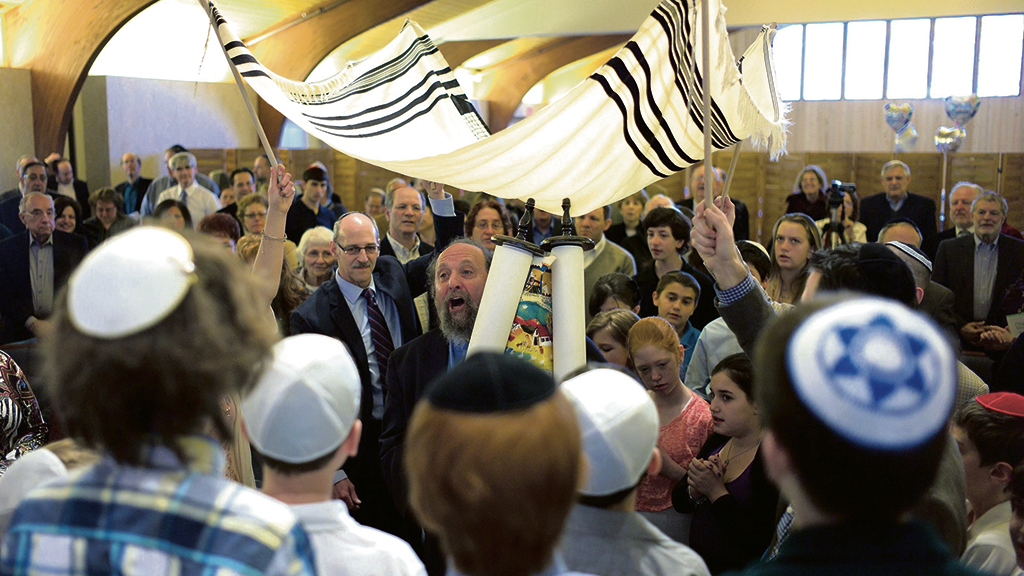
We don’t just study the Torah, we dance with it. We don’t just honor it, we hold it close.
The massacre on October 7 was beyond devastating, and part of that devastation was because the attack wasn’t simply on people.
The attack happened at a moment when Jews were publicly expressing Jewish joy. People were praying, celebrating, dancing, with a joy that was palpable throughout the shul, and suddenly the day of joy became a day of unimaginable grief.
The fact that in 57 out of the last 80 years October 7 has landed in the neighborhood of our holidays is astounding.
Sometimes it was Sukkot, sometimes Yom Kippur, sometimes the days leading into the holidays, sometimes Shemini Atzeret, and sometimes Simchat Torah. The calendar kept bringing this date back into the story of Tishrei, and then, in 2023, it happened — October 7 became 22 Tishrei. It was Shemini Atzeret, as well as Simchat Torah in Israel.
We know what happened on October 7, 2023, and there’s nothing that we can do to change that, but we can work on what October 7 means going forward.
Regarding my birthday, it means that October 7 is, and will always be, a reminder of how precious life is.
When I was younger, my birthday was all about how old I was, what presents I was getting, who was coming to my birthday party, and that I hoped that the cake was all chocolate, but now the questions I ask on my birthday are quite different.
Who am I grateful to have here? Who can I call? Who can I hug? Who do I need to tell that I love them. What have I done with the year I’ve been given?
We’re allowed to be happy, we’re allowed to celebrate birthdays, we’re allowed to laugh, we’re allowed to have weddings, to have children, to sing, to eat cake, to dance, and we don’t have to apologize for any of it, because if October 7 taught us anything, it is that life is precious.
The answer to murder can’t be to stop living, the answer to hatred can’t be to stop loving, and the answer to terror can’t be to stop celebrating everything that makes life worthwhile.
So when we celebrate Simchat Torah, we shouldn’t dance because we’ve forgotten, we should dance because we remember. We dance for those who can’t, we dance carrying their memory with us, we dance even though we know that there are empty chairs and broken hearts, and we dance because Jewish joy comes from thousands of years of knowing what it means to suffer and still choose life.
I never want my birthday to belong to those who brought death and destruction. I refuse to allow them to own the date. And because October 7 was the day I was born, I have a choice.
I can let October 7 become only a day of death, or I can insist that it remain a day that also contains life, and not by forgetting, but by adding birthdays, weddings, children, grandchildren, acts of chesed (goodwill and kindness), laughter, music, dance, and life. And that brings me back to Simchat Torah.
We finish the Torah and immediately we start it again. We don’t stand at the end and say “Well, that’s it.” We say “Bereishit.” We repeat let’s begin, again and again and again, because that’s what Jews have done throughout history.
After exile, after persecution, after destruction, after the Holocaust. after wars, and after October 7, we begin again, because the past matters so much that we refuse to let it determine whether there will be a future.
I don’t know what the calendar is trying to tell us, but I know what I want my birthday to tell me. I want it to tell me that life is stronger than death, that memory is stronger than forgetting, that love is stronger than hatred, and that joy is not a betrayal of those we lost.
So yes, I will celebrate my birthday, I will eat the cake, I will accept the l’chaim (many l’chaims!), I may complain that I’m getting older, but I’ll pretend that I’m not, I’ll hug my family, and when Simchat Torah comes, I will dance. Maybe not exactly the way I danced before October 7, 2023. Maybe with a little more sadness, a few more names in my heart, and with a little more gratitude, but I will dance, because October 7 is my birthday.
I want the date to carry a message about Jewish life, about memory, about hope, and a message about refusing to let the darkest day become the last word. So when we take the Torah in our arms and begin to dance, remember everyone who should be here dancing with us, because I want us to dance for them; for the families, the children, the parents, the grandparents, the soldiers, the first responders, the hostages and their families, for everyone whose life was changed forever, and for ourselves, because we’re still here.
The date that became a symbol of death is also the date of my birth. The day that became a day of mourning was also a day on which Jewish people were supposed to celebrate, and the day that tried to stop the dancing will not be allowed to stop the dancing forever.
The responses have to be “We will live, we will love, we will build, we will teach, we will celebrate, and we will dance,” and that’s the promise we should carry from this Simchat Torah into every year that follows.
The Jewish story has never been only about what happened to us, it’s always been about what we did afterward; we took a breath, we started again, and then — we danced.
“Od nirkod.” “We will dance again.” That became a slogan associated with survivors of the Nova music festival and then an Israeli response after October 7, 2023, meaning that despite the massacre, they would eventually return to dancing and living. Not because we have forgotten, but because we remember. Not because the pain is gone, but because life remains. Not because October 7 didn’t happen, but because October 7 will not have the last word.
Od nirkod. We will dance again, and when we do, we will carry everyone who is missing with us, and, somehow, despite everything — happy birthday to me.
Cantor/Rabbi Lenny Mandel of West Orange is the chazan and spiritual leader of Congregation B’nai Israel in Emerson.