

Going to Treblinka
Allan Chernoff writes about taking his family to see his mother’s story
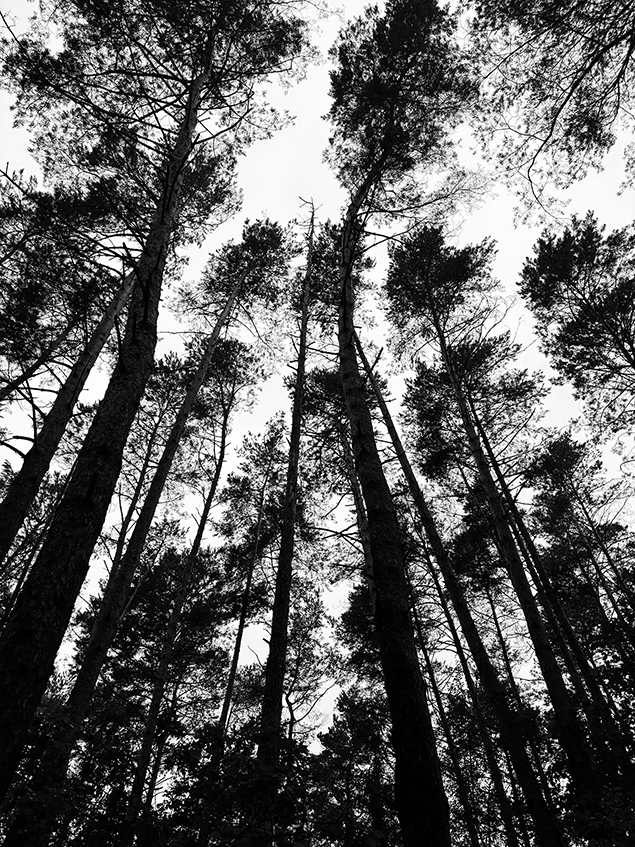
The trauma of my family history weighed on me as we drove toward a cursed tract of land deep in the Polish province of Masovia, 70 miles northeast of Warsaw. On either side of the road, pine tree trunks soared 80 feet before their branches, thick with dark green needles, spread toward the sky, as if screaming to the heavens of the atrocities committed here.
Traveling 4,500 miles to visit the Treblinka death camp may seem a strange choice for a family vacation. But for me, it was essential. This was the moment I had been planning for years, to share my deepest trauma with my wife, Robin, and our twin daughters, Betsy and Elana, at the very locations where my maternal ancestors had been slaughtered — Treblinka, Auschwitz, and the ghetto of my mother’s hometown, Tomaszów Mazowiecki in central Poland.
Thirty-two years ago, I traveled here with my parents and sister after convincing my mother to show us where her happy childhood had imploded into a nightmare. Now that she was no longer alive, it was incumbent upon me to bear witness with my children, to show them where their ancestors’ painful history had transpired, a mission that had gained new urgency amid the renewed spike in antisemitism and widespread allegations that the descendants of Jews who survived the Holocaust are now committing the most heinous crime of crimes, genocide.
It is peaceful in Treblinka, an ideal place for a lovely day in the woods, were it not for the fact that this is the site of the most efficient mass murder factory in history, a death camp where the Nazis killed 925,000 Jews over the course of just 15 months, a much faster pace than at Auschwitz. Sure enough, though, we do come across local Poles enjoying a bike ride as their tires roll above the ashes of Nazi victims.
Visitors like us, with a more serious intent, walk along a long path of rectangular cement blocks marking the rail line that transported victims of the Nazis to their deaths, including most of Tomaszów’s Jews, who were entirely unaware of what awaited them. A sudden curve in the road reveals the former killing field, dotted with 17,000 stone memorials, a cemetery for the hundreds of thousands without a grave.
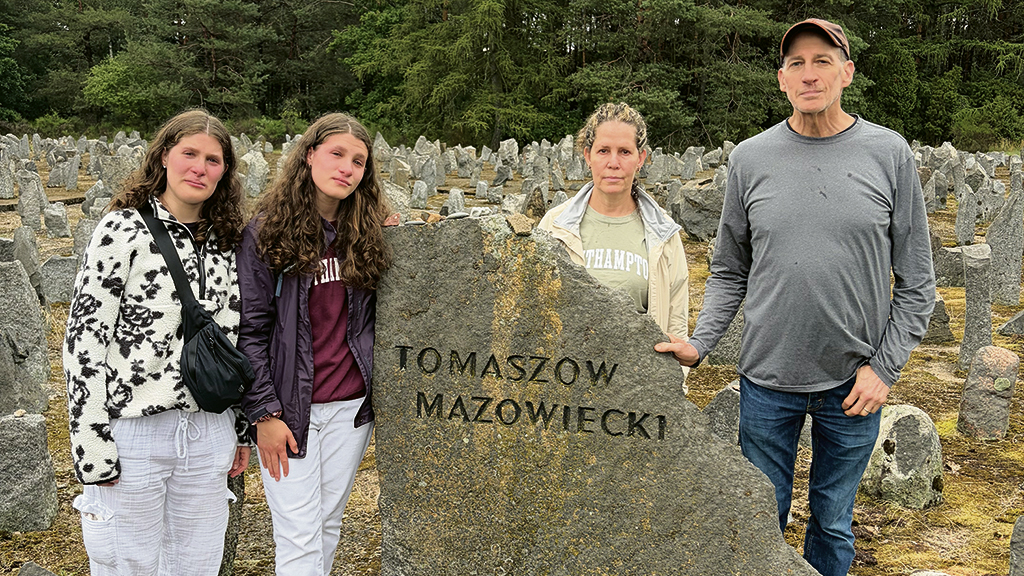
My mother, Rena Margulies Chernoff, was not an emotional person. As a child imprisoned by the Nazis, she quickly learned to be stoic, because if you cried you could be shot on the spot. But in Treblinka, three decades ago, she wept as I had never seen before, embracing the stone engraved with the name of her hometown, sobbing for her grandparents, aunts, uncles, and cousins, all of whom were murdered here. It seemed she had repressed her mourning until that moment.
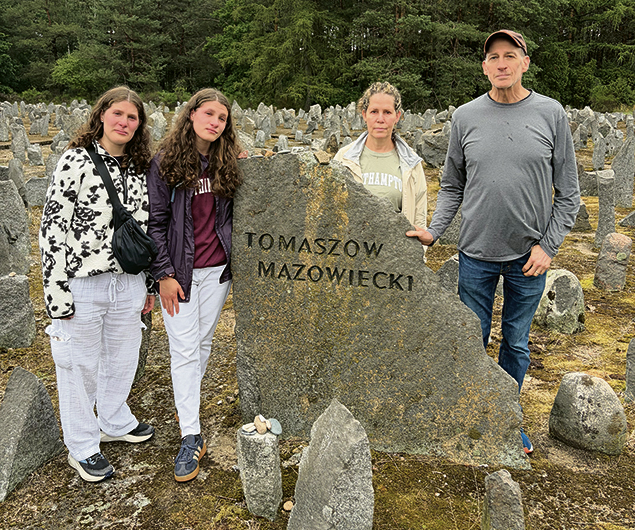
As we reach the Tomaszów Mazowiecki memorial, surrounded by thousands of stones, I discuss the tragedy that befell our family here. We stand in silent contemplation of the murder of our ancestors, including my great-grandparents, Raizel and Hersh Tenenbaum, and hundreds of thousands of other innocent souls. Then, as I recite the El Maleh Rachamim memorial prayer, my 23-year-old daughters break down in sobs, mirroring their grandmother’s pain. “It was the first time I felt a deep connection to the family that I never had a chance to meet,” said my daughter Elana, who grew up knowing her grandmother, but only a few other relatives from that side of the family. “Being in that place, with the name ‘Tomaszow Mazowiecki’ carved into that large stone, made their loss feel very real.”
I’ve never cried for my poor ancestors who were tortured, starved, and killed. Rather, their tragic history deeply colors my view of humanity, making me ever-conscious of man’s potential for evil. What weighs on me as the child of an Auschwitz survivor is the responsibility of preserving historical memory. It is not enough for me to simply pass down family traditions, culture, and beliefs to my daughters. I have the additional burden of transmitting the family trauma.
Sharing a history of trauma, though, should not create new trauma. This is the approach my mother took with me, avoiding discussion of her Holocaust experiences until I was a teenager. And I, not wanting her to suffer by reliving her trauma, didn’t ask many questions as a child, though the number tattooed on her forearm, A-15647, reminded me every day that she was a Holocaust survivor. It was a mutual conspiracy we engaged in to protect each other. My daughters, well past the age where they need such protection, and separated from the Holocaust by an additional generation, were ready to face the horrors of Treblinka and Auschwitz.
I envisioned this trip to the Nazi death camps as a critical element of their education, a rite of passage to fully embracing their heritage. As their bat mitzvah was an entrance into the growing maturation of a teenager, this was a bookend experience, a final coda to adolescence that would sear into their memories a recognition of who they are as grandchildren of a Holocaust survivor, and deepen their knowledge, enabling them to carry history forward, educate others, and, one day, share the story with their own children. (Yes, a very tall order for a family vacation!)
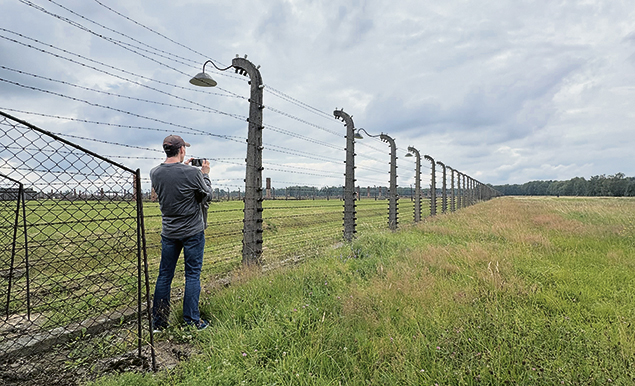
In 1994, I walked with my mom through the deserted Auschwitz II-Birkenau camp, where half a century earlier she had been a starving 11-year-old prisoner standing behind the electrified barbed wire. It was so serene that sunny day that we could hear birds chirping, an incongruous experience, given the horrors that had occurred at this hell on earth.
Today, Auschwitz, unlike Treblinka, is no longer a quiet place for contemplation. Visitors from around the globe jam the gates, two million last year, most of whom have no personal connection to the concentration and death camp.
In the main Auschwitz I camp, we see the famous exhibits that present horrifying details of the Nazis’ systematic murder factory, including Crematorium I, the sole remaining gas chamber at the Auschwitz-Birkenau complex. A new exhibit shows the shovels of slave laborers, like my Great-Aunt Eva, who worked at the nearby Vistula River. Another display case houses a huge metal vat in which prisoners carried the once-daily soup of rotted potatoes, turnips, kohlrabi, and cabbage to the barracks. If my mother was lucky, the person serving would dip the ladle deep enough to catch a few pieces of vegetable for her bowl.
So that my daughters could see concrete evidence of their grandmother’s presence in the camp, I had requested access to the archives to allow us to view the Nazis’ meticulous records. Wojciech Płosa, head of archives for the Auschwitz-Birkenau State Museum, welcomed us into his office. He had pulled several camp record books. First, he showed us an alphabetical list of prisoners in beautiful handwriting listing my grandmother, Hela (Helen), followed by my mom, Renia, along with their prisoner numbers (though my mom’s number was entered incorrectly). My grandfather Avram Chaim and Uncle Romek are in a list of prisoners who received blood tests to determine they did not have typhus. A separate hospital registry indicates Romek was suffering from “grippe” — the flu. He was just nine years old when he was murdered in a Birkenau gas chamber on Rosh Hashanah, the Jewish New Year, 1944.
As we depart, our guide, Anna, informs us that this section of the camp served as a brothel for the Nazis, where officers could have their way with selected Jewish prisoners.
We take a lunch break, sitting silently in the Auschwitz cafeteria. A worker is using a pizza shovel to insert a new pie into a large oven in the kitchen. It reminds me of the crematoria oven.
In Birkenau, the only remaining wooden barracks are those along the camp’s first row, the Men’s B-II-a sector, where Avram Chaim and Romek were held. These barracks have been restored to prevent their collapse. But the interior is the same — the three-tiered wooden bunks on which prisoners were crammed together like sardines, the brick oven running through the middle of the barrack that provided minimal heat. I point to the reinforced wooden walls, telling the girls how the original barracks had gaps between the slats where wind would howl, freezing my mom and the other prisoners.
We walk the entire perimeter of Birkenau, past hundreds of brick chimney stacks, each the remains of a former barrack. At the far end of the camp, we enter the building where, after arriving from the Blizyn slave labor camp, my mom showered, received the sackcloth dress she would wear for six months, and was tattooed.
When we stop at the ruins of one of the destroyed Birkenau crematoria to say a memorial prayer for Uncle Romek, my daughters are stone-faced.
There is so much to absorb at Auschwitz-Birkenau. Much of it, including the fact that people were processed like cattle, is incomprehensible. “It’s amazing that people were able to survive,” my daughter Betsy said afterward. “It made me realize the mental strength that Grandma had to survive and continue with life.”
In Tomaszów, we see my mom’s former homes — her apartment on Antoniego Street, the town’s grand boulevard, and the far more modest apartments where she was repeatedly forced to move as the Nazis cornered the town’s Jews into a ghetto.
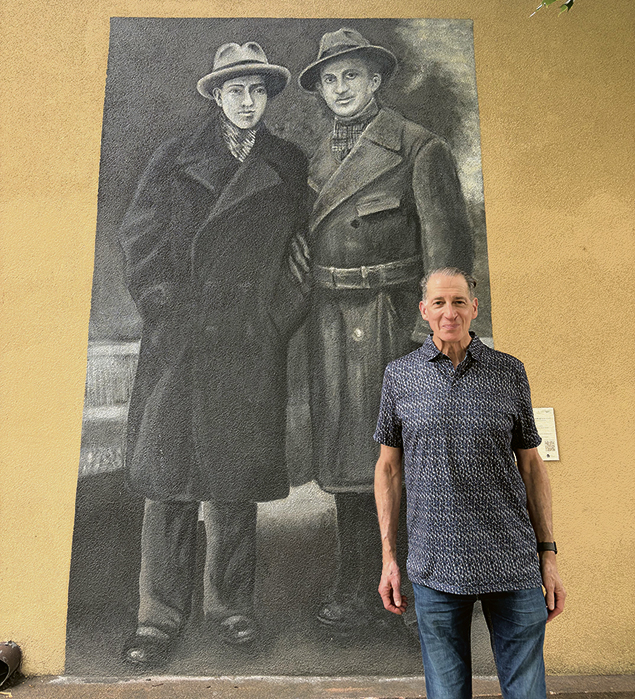
The ghosts of Jewish Tomaszów haunt these streets. An empty lot occupies the site of the Groys Shul, the Great Synagogue that stood on Handlowa Street before the local Hitler Youth burned it to the ground. A nondescript five-story apartment building stands where my great-grandparents’ home was located. The small prayer rooms, shtiebels, that dotted the street are all gone. Here was my grandfather’s tailor shop. There was the Bornstein textile factory, and here was the Jewish-owned Odeon movie theater and casino. Gone too are the Jewish orchestra and theater troupes; the Yiddish newspapers, Di Shtime and Tomaszówer Wochenblat; and Z.T.G.S., the Jewish sports organization.
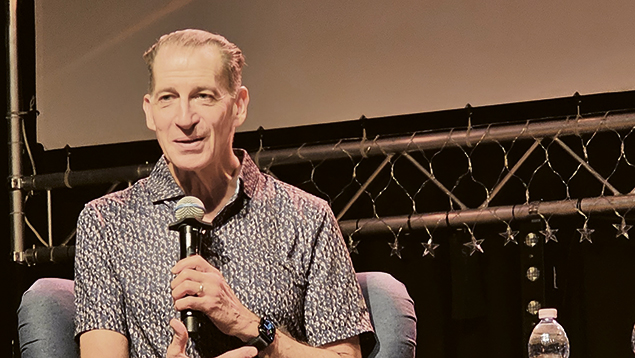
That afternoon, we attend the screening of a documentary about the disappearance of Tomaszów’s Jewish community, for which a Polish filmmaker interviewed me. Following the screening, I speak and then answer questions from the audience. Their comments reveal a naivete about the reception Holocaust survivors received when they returned to Poland, hoping to reunite with loved ones. “Why didn’t the Jews stay in Tomaszów after the war?” ask several audience members, apparently unaware of their town’s antisemitic past. I couldn’t sugarcoat my answer. “Following my mother’s recuperation at Auschwitz, she, her mother, her cousin, and aunt took a train from Krakow back to Tomaszów,” I began. “On the train, Poles stared at them and said, ‘Jews. Too bad Hitler didn’t kill them all.’ Then, they shoved my grandmother and great-aunt off the train, one stop before Tomaszów.”
Much attention has been given to the embers of a “Jewish revival” in Poland’s major cities, particularly Kraków, which hosts an annual Jewish Culture Festival. But there is no revival in the many towns like Tomaszów that once had thriving Jewish communities.
Tomaszów was home to about 14,000 Jews before World War II, one-third of its population. Jews were an integral part of Tomaszów’s economy, culture, and politics. They even had local representatives to the Polish Sejm, the lower house of the Polish parliament. Today, there are no Jews in Tomaszów, no signs of Jewish life. Swastikas desecrate some gravestones in the Jewish cemetery.
My daughters knew that the Jews of Poland were decimated during the Holocaust. But to see, with their own eyes, that the hometown of their grandmother is truly extinct of Jews brought a sober recognition of the terrible arc of their family history and their responsibility to carry forward their ancestors’ memory.
Allan Chernoff of South Orange is author, with his mother, of “The Tailors of Tomaszow: A Memoir of Polish Jews.” A former senior correspondent for CNN, Allan is a speaker for the Museum of Jewish Heritage and the New Jersey Commission on Holocaust Education.