

I say shtreimel and you say shtroymel
Or sometimes a hat is more than just a hat

“The Cat In The Hat,” “Caps for Sale: A Tale of a Peddler, Some Monkeys and Their Monkey Business,” and “Hats Are Not for Cats!” are just a few of the names of books about hats. And there’s a brilliant short story by one of the most famous Yiddish writers and humorists, Sholem Aleichem: “On Account of a Hat.”
Although the Sholem Aleichem story has been interpreted in many ways and has myriad implications, it’s basically about a man (sort of a dullard) trying to get home in time for Passover, and a mix-up with a hat. He falls asleep on a bench in the train station, gets jarred awake, realizes that his hat fell off, and feels around under the bench until he comes up with a hat and puts it on his head. But it’s not his hat. It belongs instead to an official of the state, with a red band and peak.
When the man gets to the ticket booth, the people see the red band and the peak and they make way for him. “Where to, Your Excellency?”
We all wear different hats during our time here on Earth, but I’m being literal writing about the large fur hats worn by chasidim: the shtreimel, or is that shtraymel, or maybe shtroymel. Your pronunciation may depend on where your family is from, and I’d bet that there are a bunch of you who never knew that the shtreimel even had a name, but most likely it’s the way you heard its name spoken. (We ask fathers of bar or bat mitzvah children their Hebrew name and some say Yankel or Yossel. When I correct them, saying that’s Ya’akov or Yoseph, they are adamant that I am incorrect.)
I call it a shtreimel because when I asked my father what the fur hat my zeide wore (a lot of you may call your grandfather zayde) he said, “it’s a shtreimel.”
My zeide’s shtreimel is about 125 years old, and as in most cases still today, it was a gift from the father of the bride to be, and was to be worn under the chupah (the wedding canopy).
Today’s shtreimels are mostly made from the tails of a sable, marten, fox, or fitch, and depending on the quality of the fur, the craftsman, and surprisingly, even where it’s made, the prices can run from a couple of thousand to eight, nine or even 10 thousand dollars.
To paraphrase one of Tevye’s lines in the song Tradition: “…you might ask, how did this tradition get started? I’ll tell you…,” the historical answers and the folklore have been passed down from generation to generation.
The chasidim of the 18th century modeled the shtreimel after the fur-trimmed hats that Eastern European noblemen wore, but over time different chasidic sects made style changes that became distinctive to them.
Many years ago, Rabbi Mark Kiel told me the folkloric tale (as opposed to tail) that I love.
I don’t remember if it was the king of Poland or the czar of Russia who ordered that Jewish men were to attach the tails of fur-bearing animals to the back of their hats. The purpose was, first, to show that they were Jews, and second, to humiliate them by making them wear a Davy Crockett hat with a raccoon tail hanging down the back.
But the Jews lifted the tail so that instead of allowing it to hang down their backs, it was sewn around the hat, making it beautiful. Hence, the shtreimel.
Chasidim wear their shtreimels on Shabbat, Holy Days (including the intermediary days of Pesach and Sukkot) and it is considered a mark of distinction and honor by the chasidic community.
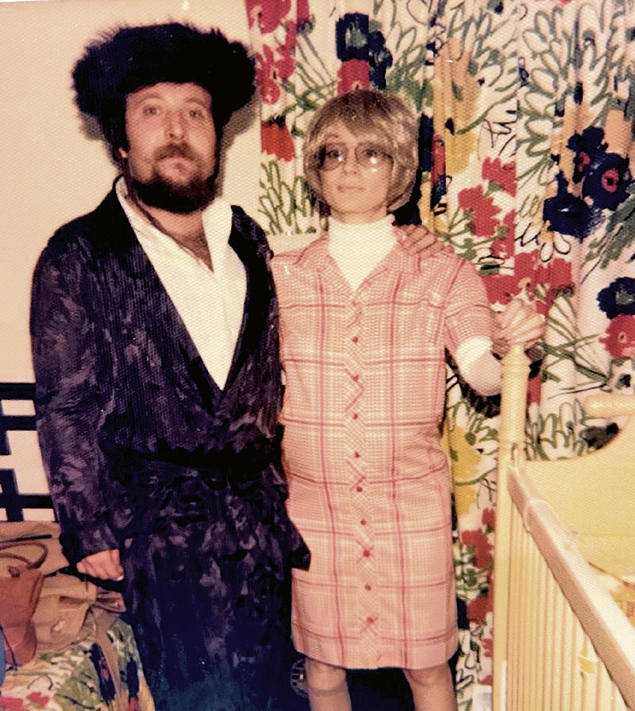
About 50 years ago friends of ours had a costume party. Shelly — who was pregnant — and I went to the party dressed as a chasidic couple.
Shelly’s dress was much shorter than any Orthodox woman would ever wear, and her wig wasn’t de rigueur either, but no one there would have conceived of coming to a costume party dressed like that. I wore a bekishe (the long silk coat), a white shirt, and my zeide’s shtreimel. That’s right, I still have it, and I will pass it on to our son. It’s part of where we came from, but more than that, it’s why we are what we are.
My zeide’s shtreimel is very small compared to the gigantic one the chasidim wear now.
I’m sure that you’re wondering how I know that.
Come around the Turtleback Zoo in West Orange during Chol HaMoed (the intermediary days) Pesach and Sukkot. There will be many chasidim families there, and many of the men will be in full chasidic garb, including a shtreimel.
So, whether I say shtreimel or you say shtroymel, I say Yoseph or you say Yossel, shtreimel, shtroymel, Yoseph, Yossel, it’s only about a hat!
Cantor/Rabbi Lenny Mandel, who left the wilds of Manhattan almost 50 years ago and lives in West Orange, has been the chazan at Congregation B’nai Israel in Emerson for the past quarter century.