

‘Names Not Numbers’
Golda Och Academy students interview Shoah survivors
How do you teach about the Holocaust?
You don’t want to traumatize children. You don’t want to make children — particularly, in this case, Jewish children — afraid that something like what happened to 1.5 million children like them, give or take — as if it’s possible to be approximate about a number like that, with every single life a complete universe — will happen to them.
You also don’t want to pretend that it didn’t happen. Okay, you might want to pretend that it didn’t happen, but you know that you can’t.
You also don’t want to expose kids to the Shoah in ways that make them callous to it, as a form of self-protection.
You want to teach it in an age-appropriate way. You have to know when first to introduce it, gently, and when to show more and more of its horrors.
The task demands creativity, intuition, and close attention.
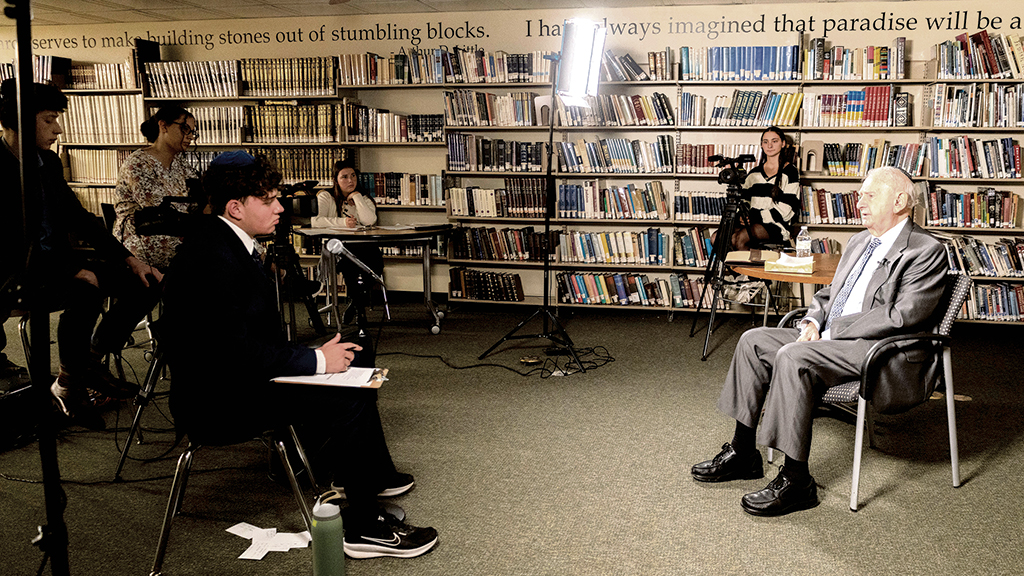
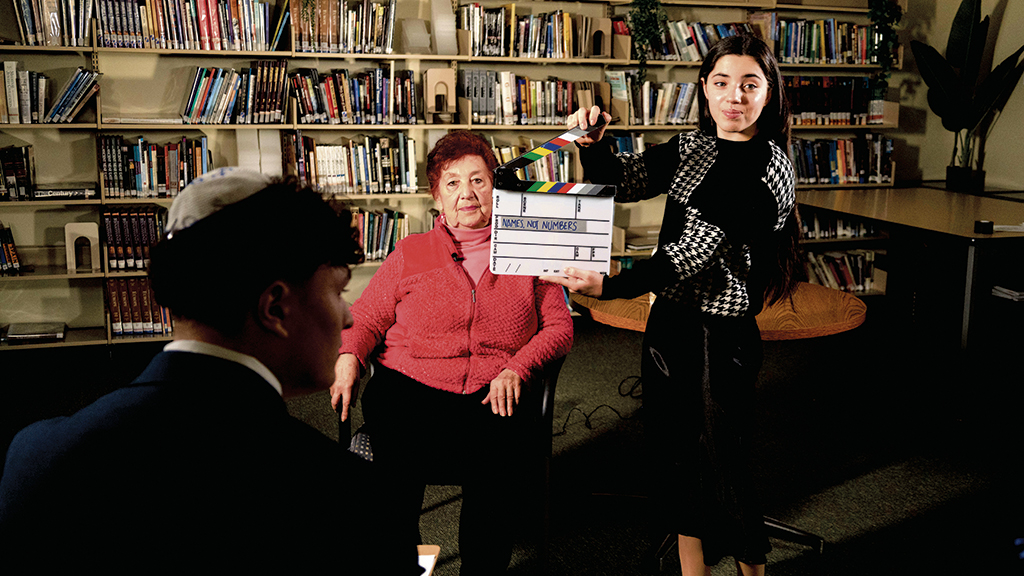
That was the impetus for Names Not Numbers, a Holocaust education program that helps students meet survivors, ask them questions, listen to their answers, film the interviewers, and then — and with the help of professional filmmakers — turn that footage into a movie that preserves the survivors’ stories and presents them to the world. It also teaches collaboration, flexibility, and a way to find some hope in horror.
On May 12, the Golda Och Academy in West Orange will present the premiere of “Names Not Numbers: A Movie in the Making,” as the films created through the Holocaust education project Names Not Numbers are called.
GOA is not the only local day school to work with Names Not Numbers. In fact, the idea for the program came to Erin Sternthal, the school’s Holocaust education coordinator, when she was at a similar program at the Moriah School in Englewood. “It was about 10 years ago, and a friend invited me to her daughter’s school to see it,” Ms. Sternthal said. “I was in tears from the opening credits, and I knew that we had to have this program too.
“So I went to the then head of school, Adam Shapiro, and I said that this program is incredible. We need to have it here. He said okay. This was in May. I said, ‘What do you think? Start it a year from now?’ And he said, ‘Why wait? Let’s start it now!’”
Names Not Numbers — online at namesnotnumbers.org — was started by educator Tova Fish-Rosenberg of Yeshiva University. Its unusual approach does not confine Holocaust education to the classroom, to be gleaned only from books and films, but to use the arts and crafts of filmmaking, interviewing, and oral history to make it interactive.
At GOA, the program began as an “application-only program for grades 10 to 12,” Ms. Sternthal said. “Eventually, we decided that we wanted to give more students the opportunity to participate in the program, and get the additional Holocaust education courses that are interwoven in it.” Now, it’s part of every 10th-grader’s schedule.
Holocaust education at GOA begins formally in second grade with the Butterfly Project, which “uses age-appropriate oral history and art lessons as part of a worldwide effort to paint and display ceramic butterflies” to honor the children murdered by the Nazis and their collaborators, Ms. Sternthal said. From third grade on, speakers and programs mark Kristallnacht, International Holocaust Remembrance Day, and Yom HaShoah in age-appropriate ways, and coursework addresses the Holocaust in increasing detail as students grow older.
Now, GOA’s 10th-grade curriculum includes Holocaust education. “We have an opening session in the fall where the students hear from a journalist. For several years, it’s been Alan Chernoff of South Orange. Mr. Chernoff, a Peabody- and other-award-winning journalist who worked for CNN for decades, is also both the parent of a GOA alumna and the son of a Holocaust survivor; he and his mother wrote a book about her experiences, called “The Tailors of Tomaszow: A Memoir of Polish Jews.” All this makes him uniquely positioned to teach GOA students about how to interview Holocaust survivors.
The students also hear from Names Not Numbers’ Tova Fish-Rosenberg, and “they watch an edited clip of survivor testimony from another school, so they can see what they’ll be doing in their own interviews.”
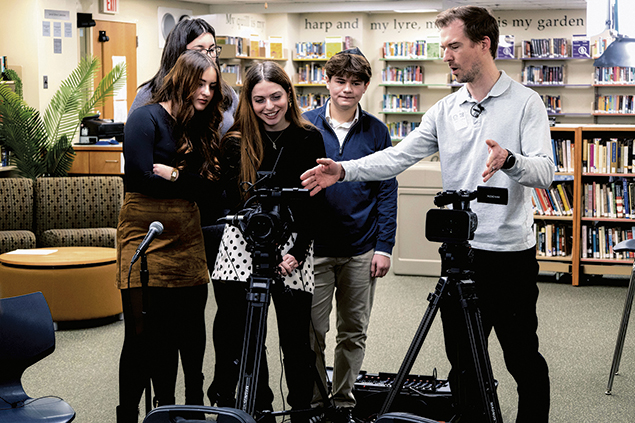
These sessions, like everything else from Names Not Numbers, is filmed.
And then there’s “Interview Week,” as the school calls it, when survivors come to tell their experiences.
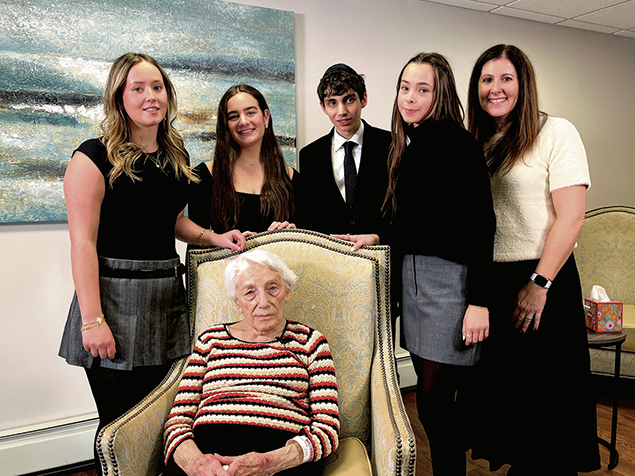
Ms. Sternthal finds the survivors, who come from throughout the metropolitan area. “We have not yet repeated a survivor,” she said. “Some are local, but some come from Long Island or Westchester. Some come from two hours away. They come because they still feel that this is their duty. It is their obligation. It is their purpose. It is remarkable, the lengths they’ll go to in order to do this.”
Some of the students are descendants of survivors; if any of those survivors want to participate, “they have first priority,” Ms. Sternthal said. “We have had students interview their grandparents. This year, we had a student who interviewed her great-aunt, and a student interviewed her great-grandmother, who was 105.” Soon after the screening, Helen Frenkel died.
The grade is divided into groups of five or six students — this year, there are 27 10th- graders — and each is assigned a survivor. The students are given a biography of the survivor with whom they will work, “and their job is to create interview questions, working as a group.” They ask about four segments of the survivor’s life — before the war, during the war, liberation, and after the war.
“Once the students have created their interview questions, they are ready for interview week,” Ms. Sternthal said. That’s when the survivors come to the West Orange campus, one at a time. “We have film equipment on loan for a week, and a professional filmmaker teaches the students filming techniques, and how to use the camera equipment.
“Students do the entire interview. We rotate them through the stations, so everyone has a chance to do everything. One student is the interviewer, one works the camera equipment, one works the sound equipment, another monitors the DVD burner, and the fifth usually takes notes.” And then they switch, until everyone’s gotten to do everything.
“After the survivors leave, we interview the students and they give their testimony about the process. At the end of the week, we have a session called Emunah, which is led by Rabbi Meirav Kallush,” the school’s director of Israel education. “It’s an opportunity for the students to reflect on what they’ve learned during the week and to talk about some of the tough questions that can arise. Questions like why bad things happen to good people, and about where God was during the Holocaust. It’s time to pull all this together.”
Then, moving back from the theological and the theoretical to the practical, “we teach them to edit the film,” Ms. Sternthal said. “Each interview is recorded for about two hours. They have to edit it down to 20 minutes. And then we send that to our professional filmmaker, who puts them all together into one film, which is roughly about 1 hour and 20 minutes.”
The process allows students to discover a great many things about themselves and the world. The project involves a great deal of collaboration, and the subject can provoke much self-examination about faith and doubt and community. It also introduces students to skills, ranging from careful listening to operating a camera or sound equipment, that they might choose to develop.
“I always say to the students that this is a gift,” Ms. Sternthal said. “You might not realize it today. You might not realize it tomorrow. But at some point in your life you will recognize that you had the opportunity to do something very few people your age will get to do. And when the students go to Poland in 12th grade, they carry these stories with them, and they remember.”
There’s one more step left to the project. The film premieres to an audience that includes survivors and their families and students and their families, along with other community members. “It allows people not only to bear witness to the survivors, but it also allows us to celebrate them,” Ms. Sternthal said. “At the end, we call up each of the groups, who present the survivors with a gift.”
The premiere, set for Tuesday, May 12, at 7:15 p.m., at Temple Beth Sholom in Livingston, is open to the public, but registration is necessary. Go to goldaochacademy.org/nnn to register or for more information.