

Harmony in action
Agudath Israel’s Cantor Joel Caplan ends four-decade role
In celebration
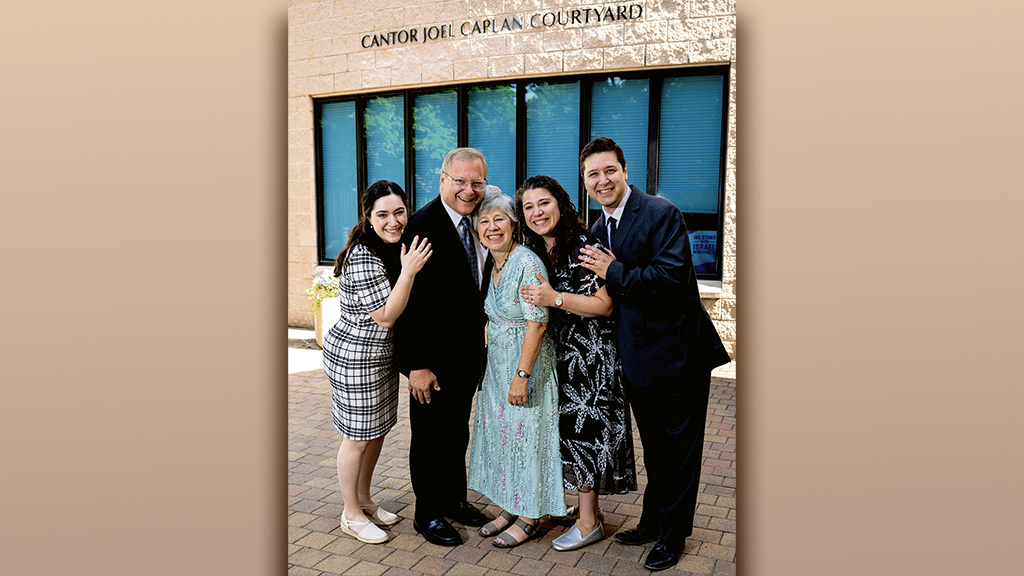
A weekend celebration of Cantor Caplan’s retirement was held at the synagogue on June 13-14. At Shabbat services, the focus was on the cantor’s wife, Nancy, who retired a few years ago from her position teaching youngsters and adults in the shul’s education department; she continues to teach Torah reading to young people on Shabbat. On Sunday, with some 500 celebrants in attendance, a stream of congregants and guests — including family members and visiting cantors and choral groups he’s been involved with — paid tribute to the cantor in speeches and song and presentations.
Joel Caplan describes his love of Jewish music — performing, teaching, and leading choirs — with the enthusiasm of someone new to the profession. In fact, on June 30, he retired, after spending 40 years — his entire career — at Congregation Agudath Israel in Caldwell.
When asked about his energy, the cantor chuckled, acknowledging that neither time nor age has dimmed the passion that has been with him since his teens. “I’ve been lucky, extremely lucky,” he said.
The conversation took place by phone, as Cantor Caplan drove from Chicago, where his flight from New Jersey had landed, to Iowa City to visit his 95-year-old mother. He has been making that journey every five weeks, grateful for the chance to see her in the community where he grew up.
His whole family was musical. His mother, Ellen, a former high school librarian and still a “pillar of the Jewish community,” is a flutist. His father, Richard, a dermatologist who ran the continuing medical education program at the University of Iowa and started its department of medical humanities and bioethics, was a skilled pianist and clarinetist.
Cantor Caplan, the second eldest of four sons, learned to daven while in high school. The congregation he attended, with 200 families, was not large enough to hire a full-time cantor but hired graduate students. They helped educate him. He listened to cantorial records, along with swing and orchestral and choir music. But the possibility of making a career as a singer of the liturgy didn’t dawn on him until, on a visit to the much larger Des Moines community, he saw his first professional cantor, Pinchas Spiro.
Reminiscing as he drove across Iowa, Cantor Caplan vividly recalled his early realization that this could be his career. “By the time I was 16 or 17, I was able to do the High Holiday services,” he said. Asked if he was afraid to perform for the congregation, he exclaimed, “No!” — seemingly puzzled by the question.
He came to New York to study at the Conservative movement’s H.L. Miller Cantorial School at the Jewish Theological Seminary. That was where, in 1982, Rabbi Alan Silverstein — then the fairly new religious leader at Agudath Israel and a major leader of the Conservative/Masorti movement — heard him. “He sought me out and suggested I come out to Caldwell on certain weekends and holidays.”
In summer 1984, as he was about to graduate, Cantor Caplan was invited to become CAI’s full-time cantor. “It was a good shidduch, with good, menschy people and a good, gifted, menschlich rabbi,” he said.
His then fiancée, Nancy Gorodetzer, had been accompanying him to Caldwell. They got married on July 1, right after his appointment.
Jewish music is not the only kind the cantor loves. His list extended to “Broadway and big band and bluegrass and Beethoven, and even some types that don’t begin with B. Not rap or hip-hop — sorry; I like melodies.” He also plays numerous instruments, including clarinet, piano, guitar, accordion, harp, and French horn.
The cantor’s high energy has been much in demand throughout his tenure. In addition to his primary role at Shabbat and holiday services, he trained bar and bat mitzvah students — about 45 a year — has presided at myriad lifecycle events, and organizes and conducts singing groups, for both kids and adults. He has also created many dozens of original musical arrangements.
From the beginning, shared song has been important. “I sang in choirs in high school, university, and beyond,” he said. “At 20, I joined a choir in Jerusalem, and that led to my serving as a High Holiday ba’al Shacharit for the Conservative congregation on Agron Street. At age 24, I joined a Jewish choir in New York — the Zamir Chorale, directed by Matthew Lazar,” the leading force behind the Jewish choral movement in North America, best known as founder and director of the Zamir Choral Foundation.
At CAI, he has directed choirs across the age spectrum. “For years, I directed choir music aimed at an audience that would sit quietly and listen: concert pieces, plus shul music that I’ve called ‘Listen-To-Us’ pieces,” he said. “But over the last 20 years, I’ve concentrated on writing and directing a cappella shul music that’s meant for the Jews in the pews to sing along with the choir.”
Beyond CAI, he and Cantor Rikki Lippitz, then of Oheb Shalom Congregation in South Orange, founded the inter-congregational Kol Dodi Jewish Community Chorale; performed with and led the NJ Cantors Concert Ensemble; and performed, recorded, and toured the world with the renowned Zamir Chorale of Boston.
Working with the next generation, he established and led the North Jersey branch of HaZamir International Jewish Teen Choir, the network of 35 choruses for high-schoolers across America and Israel. He conducted the teen singers and headed their participation in the annual gathering of the entire cohort in Manhattan, culminating in a joint performance at Lincoln Center or Carnegie Hall. “What they sing is not baby stuff,” he said. “It’s very sophisticated.”
HaZamir also offered a means for family connection for the cantor. “I wanted to do something that my kids could be part of too — like fathers who coach baseball,” he said. “They are all very fine singers.” All three of the Caplans’ children, Ilan, Simona, and Tamar, went on to join — and to lead — a cappella groups at their colleges. (All are married with children, seven in total.)
Cantor Caplan’s love of teaching took him back to the Miller school at JTS, where he has taught for the past 32 years and will continue to do so.
He draws particular pride from a number of graduates: Rabbi Cantor Shoshi Levin Goldberg, who grew up at CAI, is now director of the Miller School. “As a teen she sang in my HaZamir choir, and she was a JTS student of mine before becoming my JTS boss,” he said. “I’m also very proud of Cantor Josh Ehrlich, who also sang in my HaZamir teen choir and studied with me at JTS, before becoming my successor at CAI. Lots of naches!”
Others who grew up at CAI and went on to become cantors are Mira Davis, assistant cantor at Park Avenue Synagogue in Manhattan, Steven Walvick, at the East Northport Jewish Center in New York — both JTS alumni — and Hinda Eisen Labovitz, at Ohr Kodesh in Chevy Chase, Md.
The harmony he felt with his colleagues was central to his tenure at CAI, Cantor Caplan said. From the start, he worked closely with Rabbi Silverstein and with CAI’s directors of education, first Susan Yammer and then Susan Werk, who arrived in 1990. Rabbi Silverstein, Cantor Caplan, and Ms. Werk often were referred to as “the Troika.”
 Ms. Werk still is CAI’s education director. Rabbi Silverstein, who stepped down in 2021, is rabbi emeritus; he handed over CAI’s reins to Ari Lucas, who had been associate rabbi since 2018. By all accounts, Rabbi Lucas has stepped smoothly into his role as part of the three-member leadership team.
Asked what gave the Troika such long-lasting success, Cantor Caplan said simply, “Respect for each other and each other’s talents.” He used the Hebrew word for “turf,” t’chum. “Spiritual questions we left to Rabbi Silverstein; education issues, Susan handled; music matters they left to me.”
“Joel was always a mensch in his dealings with professional staff and lay leaders alike,” Rabbi Silverstein said. “We never had conflict. Why? We deferred to him in his arena of liturgical expertise and he deferred to us in our defined domains.” Together, they “grew our community from 325 to 850 households. He truly has been a community builder par excellence.”
Asked about Cantor Caplan’s selection in the ’80s, Rabbi Silverstein said they “wanted someone who could beautifully lead davening and read Torah, but someone who was also passionate about training people of all ages to join in as Torah readers and as ba’alei tefillah. Joel uniquely fit our aspirations; he has now trained two generations in these sacred tasks.”
“Joel is unique in the diversity of his commitment to torat Yisrael, am Yisrael, and medinat Yisrael” — the wisdom, people, and country of Israel. “He has always been energetic in building friendships and a sense of community at CAI” — notably through his annual mishloach manot program, organizing volunteers to assemble and deliver Purim baskets to more than 1,000 homes.
Ms. Werk agreed that her teamwork with Cantor Caplan was “built on mutual respect and admiration. Together, we are silly and serious, joyful and sad, empathetic, and focused…. Together, we share a passion for bringing our congregants closer to their own path to Judaism. He is my colleague, teacher, puppet partner, and office mate, but, more importantly, my dear and treasured friend. His creativity, willingness to learn from everyone, and ability to bring out excellence in me and in his colleagues are remarkable.”
Rabbi Lucas described Cantor Caplan as “a mensch of the highest order…a teacher, friend, colleague, and more. He is beloved by the congregation — and by me.
“When I came to CAI, I quickly learned he touches every aspect of the life of this synagogue — prayer, education, community events. He’s equally capable and comfortable in…singing silly songs in front of a group of three-year-olds, teaching b’nai mitzvah students one-on-one, leading an adult choir, visiting a congregant in the hospital, or leading High Holy Day services for thousands.”
Rabbi Lucas said, “I’ve learned from him a number of new liturgical pieces, not often featured in Conservative congregations, that enrich our weekly and holiday prayers. In a time when many other congregations are looking to shorten or abridge the liturgy, Cantor Caplan stands for a full and robust traditional approach. He has uncompromising standards coupled with uncompromising support for those who wish to learn.”
Longtime CAI member Rabbi Paula Mack Drill has been friends with Cantor Caplan since he came to the congregation. She has also been a student of his, and a colleague, since becoming CAI’s rabbi-in-residence in 2024. He is, she said, “synonymous with our community. His loving care is evident in every action he takes. He is hilarious in a deeply intelligent way and able to lighten any moment if necessary.” But he is also very serious about his mission “to empower the community by teaching us how to lead and read and sing, all with careful attention to tradition.”
Nikki Rachelson of West Caldwell, 96, her husband, Dr. Morton Rachelson, and their two small daughters joined CAI in 1957. Until Cantor Caplan’s arrival in 1982, she said, the rabbi and a few members would serve as shlichei tzibur. “Right from the start,” she said, they liked Caplan “a lot; he made the services definitely more spiritual — and more pleasant to the ear — and he was magical with children.”
Ms. Rachelson is particularly grateful for Cantor Caplan’s practice of bikur cholim, visiting the sick. “He visited me and my husband when we were ill, and his visits were always uplifting,” she said. “The day before my husband died, in 2018, Joel came and recited the Vidui. It was so beautiful and very comforting.”
Her family’s relationship with Cantor Caplan remains strong. Ms. Rachelson is still a CAI member, as is her daughter, Margie Samuels, her husband, and their daughter, Rebecca Nelson. Cantor Caplan officiated at Ms. Nelson’s wedding — playing his signature chuppah instrument, a small harp — during the processional — and at her two daughters’ baby namings and bat mitzvah services.
Ms. Samuels recalled that she was “surprised and delighted at the range of what Cantor Caplan did for our haimische community. He brought so much ruach to the holidays and he made b’nai mitzvah lessons fun.”
Arthur Franklin of West Caldwell, a CAI congregant his entire life and a shul leader, is a member of one of the congregation’s multigenerational families: His grandparents, who joined in 1938, and his parents were members and active leaders, and he and his sister are congregants who raised their children in the shul.
From the time Cantor Caplan arrived, Mr. Franklin said, “he was a major presence in their Jewish life. “When our son, David, was beginning his bar mitzvah training, the cantor urged me to observe the lessons. It was a ‘wow’ moment, a realization of the little miracles that take place with such a patient, dedicated, and caring teacher and religious leader.”
Mr. Franklin and the cantor worked together for years on CAI’s participation in the West Essex Memorial Day parade. “Joel throws himself 100 percent into the synagogue’s representation in the parade as a civic duty and way of paying tribute to those being memorialized and to veterans, particularly CAI members,” Mr. Franklin said. He also often plays Taps at memorial services for veterans.
The cantor, said Gayle Wieseneck of West Orange, a longtime member of Agudath Israel who was 15 when he arrived, “has been a significant part of so many of our life-cycle events,” including officiating at her 1990 wedding. The Caplans, “as friends and beloved members of the community, show up — no matter what — at simchas and during difficult times of loss.”
As CAI president from 2020 to 2022, she was witness to Cantor Caplan’s “herculean” efforts in the face of the pandemic. “What Joel did was remarkable,” she said. “He would go in a mask — alone or with a few others — to daven as services were streamed. He adapted to these strange ways of worship in a way that made the services and holidays meaningful for all of us.” This “says everything about who he is as a religious leader, one fully devoted to Judaism and our community.”
Murray and Randi Spiegel of Roseland, CAI members since 1986, produce CAI’s annual winter concert series. They both have sung in many ensembles under the cantor’s direction, including Kol Dodi and the CAI High Holiday Choir and Shabbat Neshamah Singers. “Cantor Caplan has been a mentor to so many of us,” they wrote in an email. “He encourages us to be better singers, is patient when we’re learning new music, and works with us for a great blended sound.”
The Caplans will stay in Caldwell after he retires. “Why not?” the cantor asked. “It’s a wonderful community with wonderful people.” They look forward to doing things together and spending time — especially Shabbatot — visiting with their children and grandchildren.
Like Rabbi Silverstein, Caplan plans to spend time at the synagogue, where he will have “a cubicle.” Staying put at home, he said, “would drive me berserk.” He has plenty of work planned. For example, he has 40 years of his choir arrangements that he wants to put into a form he can share, and between 150 and 200 handwritten pieces he composed for piano and cello that he would like to get into replicable form. He also wants to polish his piano playing and to play for hospital patients, continuing that central commitment to caring for those in need.
“I know I sound glib about all this, but I’ve never done it before,” he said. “I’ve been reading about retirement and how it can take three years to find a new balance.”
It’s clear that in searching for that balance, Cantor Caplan’s passion for community and music and Judaism will continue to occupy a hefty weight on the scales.
Love notes for Cantor Caplan
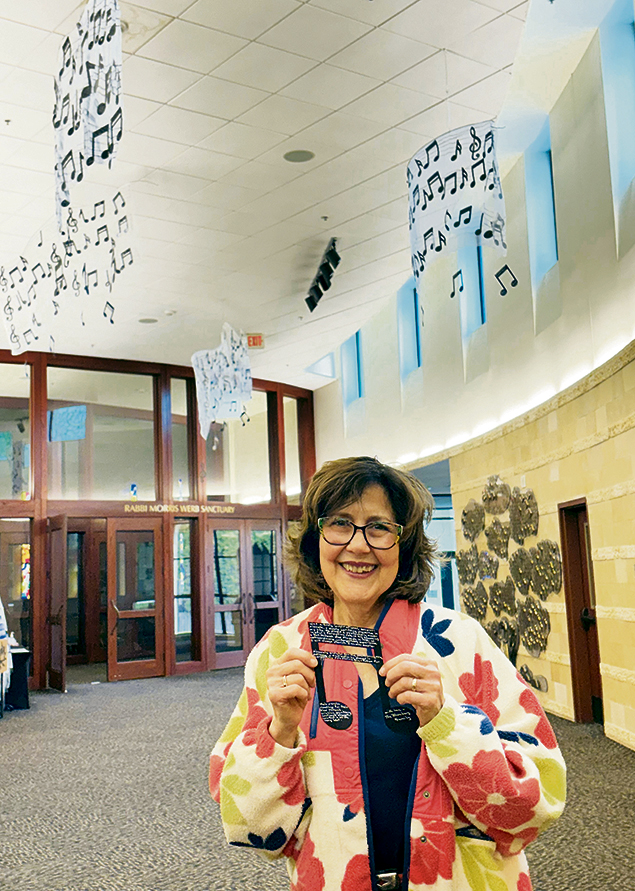
Agudath Israel congregants had a particularly noteworthy way to pay tribute to Cantor Caplan and his wife, Nancy — thanks to the creative vision of longtime CAI member Anne Burg of West Caldwell.
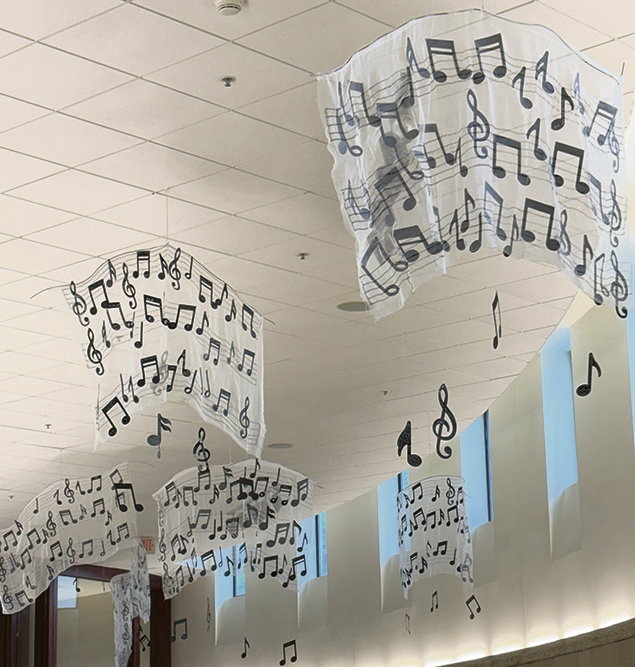
To honor the couple, Ms. Burg, an artist, retired teacher, and West Caldwell resident, has assembled “Love Notes,” an art installation. Aided by a team of fellow CAI members, she provided musical notes and clefs cut from black cardstock on which congregants were invited to write, using white-ink marker, their blessings and messages to the Caplans.
Ms. Burg also held a few sessions with CAI religious school students and ECC children so that even the youngest congregants had the opportunity to write — or draw — their feelings.
“Cantor Caplan and Nancy have had such a profound and positive impact on the lives of so many,” Ms. Burg said. “I wanted to create an opportunity for the entire congregation to express their gratitude in an art installation that would honor this remarkable couple.”
The messages cover the gamut — from memories of being a bar or bat mitzvah student under the cantor’s tutelage, to thankfulness for his officiating at life-cycle events and bikur holim visits, to gratitude for Nancy’s teaching and guidance. Most expressed deep appreciation for the cantor’s musical talents, which enhanced myriad religious services and community and holiday events.
Ms. Burg and her team attached more than 500 of these “love notes” to musical “staffs” she fashioned and then hoisted the installation to the heights of the synagogue’s entrance atrium, creating a visual chorus singing the Caplans’ praises and offering a symphony of wishes and blessings.