

‘The Bridge’ over troubled waters
October 7 survivors, rock ’n’ roll camp, and an old Jersey boy’s documentary
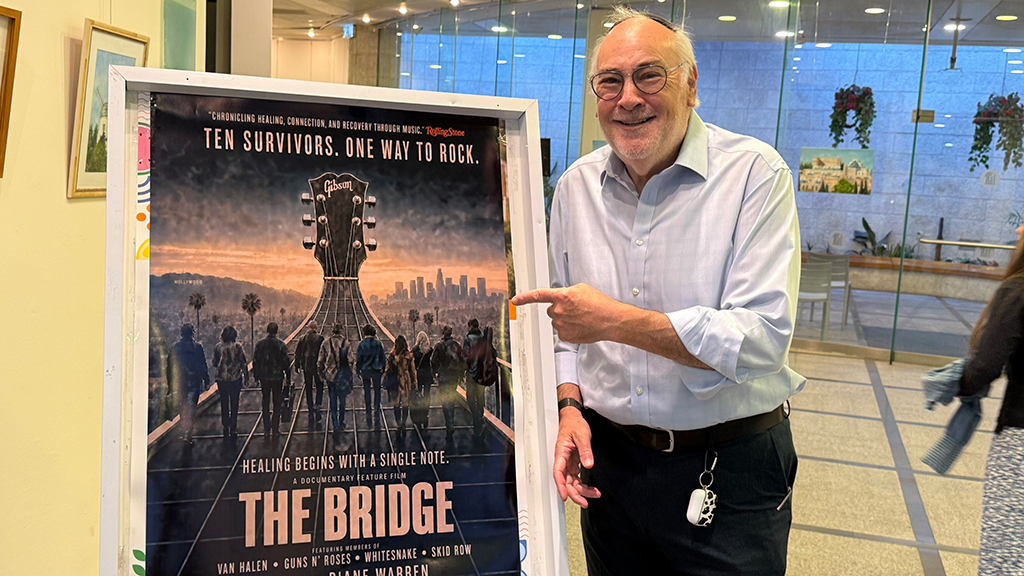
Ostensibly, we’re Zooming to discuss David Fishof’s film project, “The Bridge.” The documentary is a moving testament to the power of music to heal even the heartbreak of October 7. But, instead, unbidden, Mr. Fishof starts the conversation about his North Star, his dad, Mark Fishof. And about growing up in Hackensack, reading the Jewish Standard every Shabbas.
David’s father “was a cantor in Hackensack at Temple Beth-El for 32 years,” he said. “I used to joke he was Orthodox, the temple was Conservative, and the congregation Reform.” (It’s Chabad now.)
Cantor Fishof also was a mohel, and each week he ran a one-inch-by-one-inch ad in the Standard promoting his services. “He wrote articles in the Jewish Standard, too, about how he survived Auschwitz and Buchenwald,” Mr. Fishof said.
“He would tell stories about lighting Chanukah candles in Auschwitz and how he got down on the floor and picked up cigarette butts he traded to the Nazis for flour so he could bake matzah at the plane factory he was working at in Buchenwald.
“I hope you are recording this. Are you recording all this?” David Fishof asked as he told his father’s story.
Mark Fishkof was blond, blue-eyed, and able to pass. He escaped a transit camp, made his way to Budapest, and as a 17-year-old got a job as a printer. He’d stay late at night and print false passports that Mr. Fishof says “saved many people’s lives, including that of the Rebbe of Bubov.
“When I was 10 years old, the Bubover rebbe said to me in Yiddish, ‘My entire life I made people Jews. Your father made me a Christian.’”
Like his dad, Mr. Fishof has been frum all his life, and, like his dad, he also started his business life with ads in Jewish media. “I came up with the idea to write a Jewish gossip column and I convinced the Jewish Press to run it,” he said. “In return, I said, ‘Don’t pay me. Just put an ad in that says: ‘If your synagogue is looking for entertainment, call me.’”

And they did. From these humble beginnings, his business grew to include the Catskills, “booking comedians like Freddie Roman, Henny Youngman, Jan Murray. From there I transferred to the sports business. I went on to represent Phil Simms for his entire career, and the whole offensive line for the New York Giants. In 1986, I represented eight members of the team.”
In an unlikely brand extension, he arranged a series of tours for many pop stars, including the Monkees, Roger Daltry, and Ringo Starr. Mr. Fishof is generally credited with helping revive Mr. Starr’s career by suggesting and putting together a series of all-star bands that played around the world with the former Beatle.
Mr. Starr, in turn, became the only Beatle to go to a Fishof Shabbat dinner and use his hands to drum along on the table as the family sang. (On tour, Mr. Starr also went to a Shabbat morning service in Sweden with Mr. Fishof.)
The next step in Mr. Fishof’s career was both evolutionary and revolutionary. If he could help revive the careers of professional musicians, could he not help the tens of thousands of would-be rockers? The answer: Yes. That led to the birth of his Rock ’n’ Roll Fantasy Camps, long weekends in different cities around the United States, where would-be rockers are trained by all-star musicians. It was also the vehicle at the center of “The Bridge.”
The idea for “The Bridge” germinated after a visit to his son in Israel during Chanukah in 2023. Mr. Fishof’s successful businesses have allowed him to acquire a goodly amount of real estate — homes in New York City, Los Angeles, and Israel — and influential friends. One, a former Israel consul general in Los Angeles, helped arrange a private tour of the area impacted by the October 7 invasion. “I wanted to see what happened,” Mr. Fishof said. “I wanted to see the devastation.”
He was given a private car and a personal tour by a local mayor, who, three hours in, said she had to leave to attend the funeral of Yotam Haim, one of three hostages killed by friendly fire in what was supposed to be an effort to rescue them.
When Mr. Fishof heard that Yotam was a drummer, he said, “I want to go to the funeral. I’m in the music business. Both Yotam’s father and brother were drummers. They set up his drum kit in front of his grave, and the brother, Tuval, did a 20-minute drum solo.
“Then he took the sticks and threw them in the grave.”
It moved Mr. Fishof. He’d already arranged all the details for his next (and fully booked) camp, scheduled for March 24 of that year — 2024 — including bringing in several musicians from Van Halen. But he decided then and there that he’d hire more rockers and bring 10 survivors to Los Angeles, free of charge.
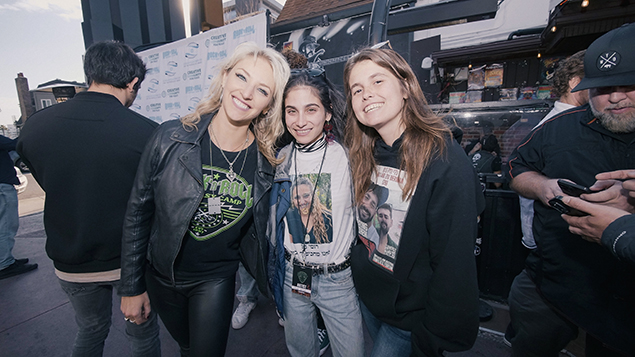
But not just any survivors.
He made clear: “I don’t want folk singers. I want to find musicians who like the Rolling Stones, the Beatles, who know rock music.”
“The Bridge” is so named because it’s about crossing a bridge to healing; the camp is one such bridge. It was named by its producer, Kevin Bright; the director is Brad Allgood.
The film begins with scenes from October 7. They are difficult to watch, but a necessary reminder to a world that seems to remember the war that followed it but not the tragedy from which the war grew.
After lengthy auditions, as “The Bridge” shows us, 10 winners were selected. They included Sagi Arad, an attorney who fought off a large group of invaders as part of Kibbutz Magen’s rapid response team; Bar Rudaeff, whose father Lior’s body was taken to Gaza and not released for about two years; and Raz Shifer, a survivor of the Nova Music Festival who had two of her close friends taken hostage.
It all seems so simple, but it wasn’t. The cost to Mr. Fishof was about $100,000 out of pocket, even after donations he was able to raise. But money was the least of his problems.
“Number one, I couldn’t tell anyone what I was doing,” he said. “I couldn’t tell the press because there was so much rage in Los Angeles, at UCLA, because there would be protests at the rock camp.
“I also couldn’t tell my customers, who were paying $7,000 to come to the Rock ’n’ Roll Fantasy Camp. It’s expensive, and I didn’t know their reaction because 90 percent of them are not Jewish.

“But my biggest issue was the rock stars. I can throw somebody [who causes a problem] out of camp, but I need these rock stars to jam with the people. If I told their managers or if I told them, they might have said, ‘You know, David, I’m not doing this camp. I don’t want to get involved.”
So he didn’t tell anyone, but the first morning of the camp, when everyone was gathered, he changed his mind. He introduced the 10 Israelis and spoke about what they’d been through. “The people gave them a standing ovation.”
The reception helped ease his mind about another potential problem. He’d been warned: “You’re going to need a lot of therapists there because these people are in a bad way.” He had some standing by, but they proved unnecessary.
“There was one line that didn’t make the movie, but I wish it had,” he said. “When they asked one guy about therapists, he said ‘My best therapy is my guitar.’”
It was heartwarming to watch the Israelis slowly open up and bloom. The film shows the two highlights of the camp, performances at two of L.A.’s most storied venues, the Whisky @ Go Go and the Viper Room.
I asked Mr. Fishof what he wanted his film to accomplish. “I hope not only to get Jews to see it because October 7 was the most devastating time in our lives since the Holocaust. But I hope to get non-Jews to see this film. While you can’t change an antisemite, I want people who may not know what really happened to see it. It’s about music and it’s positive.
“It’s my father. That’s where the story really starts from.”
Mr. Fishof has lived what appears to be a blessed high-octane life. Yet in a world of rock and sports where it’s easy to lose your way, he has maintained his faith.
“After everything my father went through, he stayed religious,” he said. “How could I not?”
“The Bridge” will be screened at the Marlene Meyerson JCC in Manhattan on October 7, and then at the Telyas Chabad Jewish Center in Hunterdon on October 13. Mr. Fishof will be at the Hunterdon showing. He hopes the film will have a theatrical release later in the year.