

Because they chose to
Temple Sholom of West Essex sees surge in adult b’nai mitzvah participation
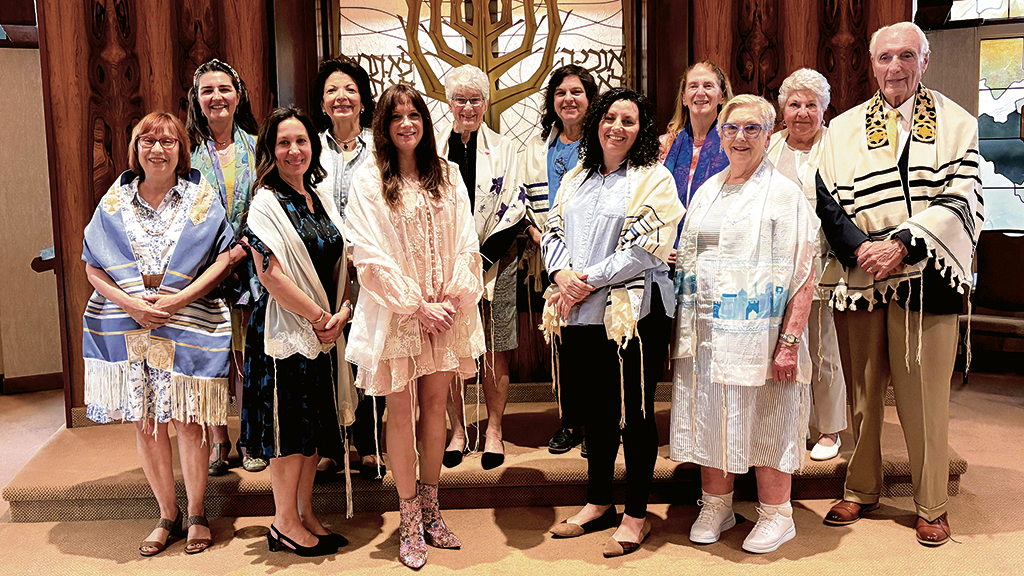
Andrea Stone never expected to be standing at the bimah at 42, chanting from the Torah. As a child, she was told there wasn’t enough time to prepare for a bat mitzvah. Decades later, as she guides her own children toward that milestone, she decided it was finally time to claim it for herself.
She won’t be alone.
On May 30, Temple Sholom of West Essex celebrated its largest adult b’nai mitzvah class to date, with 12 participants — 11 of them women — marking a powerful resurgence in a program that had once been in decline.
At Temple Sholom, a milestone traditionally associated with 12- and 13-year-olds is being reclaimed by adults seeking something deeper: connection, meaning, and, for many, a second chance.
The last time the synagogue saw comparable enrollment was in 2003, when 11 adults completed the program. Clergy and educators credit the revival to a more intentional, cohort-based approach that fosters both commitment and community.
The trend reflects a broader national movement, as more adults turn to Jewish learning and ritual to affirm or rediscover their identity.
Adult b’nai mitzvahs are a fairly new concept — they didn’t take off until the 1970s. Rabbi Albert Axelrad of Brandeis University officiated at the first adult bar and bat mitzvahs and encouraged the practice in all denominations of Judaism.
While becoming a bar or bat mitzvah is automatic under Jewish law when a child turns 13 — in the Orthodox and parts of the Conservative worlds, it’s when a girl turns 12 — the ceremony itself—leading services, reading from the Torah, and delivering a d’var Torah—has become a meaningful way to mark that responsibility publicly.
For adults, however, the journey can carry a different weight.
“One thing that differentiates the 13-year-olds from adults is that they are a self-selecting group,” Temple Sholom’s Rabbi Lawrence Groffman said. “They are receptive because they chose to be there. The discussions are in-depth because they are eager participants.”
The synagogue’s Cantor Stephanie Wright emphasized that the transformation happens along the journey. “Over time, many adults feel a deeper connection to their Jewish roots and a stronger sense of identity and belonging,” she said.
When Ms. Stone was in fourth grade, her mother suggested she prepare for a bat mitzvah, but the rabbi at the time said there wasn’t enough time for her to get ready. The opportunity slipped away. It wasn’t until college, when she met more Jewish women and began to explore her identity more deeply, that Judaism took on greater meaning in her life. Now, as the mother of two children, ages 8 and 11, she found herself returning to that unfinished chapter.
“When I started my children on their path to b’nai mitzvah, and the class was offered for adults, I couldn’t help but go through it with them,” she said. “It was Jewish guilt. If I expected them to do it, I should as well when it was offered to me.”
What began as a sense of obligation quickly became something more personal. The experience has allowed her to take a more active role in her daughter’s Jewish education and to engage more deeply at home.
Her family has taken notice. “They find it interesting that I’m doing this at 42,” she said. “My mother is impressed.”
The process has not been without its challenges. Ms. Stone said the most difficult part has been public speaking — reading from the Torah and delivering her d’var Torah. “I don’t like to be the center of attention,” she said.
But over the past eight months, the learning has reshaped how she understands core aspects of Jewish life — especially prayer. “I grew up thinking prayer was about asking for things,” she said. “But we were taught by the rabbi that ‘God is not a vending machine.’”
Instead, she now sees prayer as an act of gratitude. “A big part of Judaism is being grateful,” Ms. Stone said. “It’s a smart way to live. I try to live more in the moment now and be more grateful.”
Reflecting on the journey, she added: “I’m learning how many times you can rise from the ashes.”
While she began developing a sense of Jewish pride in college, Ms. Stone said she now feels she has both a family and a community at Temple Sholom, where that identity can fully take root.
She was going to bypass a party, but friends and family talked her into a small celebration at her favorite restaurant, which they said was a “big deal.”
At Temple Sholom, the current class began meeting weekly in October, committing to two hours of study each Sunday. The program combines Hebrew instruction with broader exploration of Jewish texts, rituals, and traditions. Education Director Cara Moroze leads the Hebrew component, helping students decode the language through consonant-vowel recognition, liturgical vocabulary, and traditional melodies. “The Hebrew part isn’t the lion’s share,” Ms. Moroze said. “It’s part of a much bigger picture.”
For many participants, the most meaningful moment comes when unfamiliar symbols begin to make sense — when they can read Hebrew words they once recognized only in transliteration. “That’s when confidence builds,” Ms. Moroze said. “And with it, a real sense of accomplishment.”
“Teaching adults is especially meaningful because they genuinely want to be there,” Cantor Wright added. “Their motivation comes from a personal desire to learn and grow.”
As students progress, the experience deepens. “Once they understand the text, it’s no longer rote,” Ms. Moroze said. “They feel pride in leading the congregation and knowing what these ancient words mean.”
Cantor Wright said that what stands out most this year is not just individual stories but the collective dynamic. “Each person brings something unique,” she said. “The shared learning experience and hearing their different perspectives and insights is incredibly meaningful.”
Rabbi Groffman said that the surge in interest reflects a convergence of factors: increased outreach, word-of-mouth recruitment, and a growing desire among adults for meaningful communal experiences. “Adults are a self-selecting group,” he said. “They choose to be there, and that makes the discussions deeper and more engaged.”
The post-pandemic period and broader shifts in Jewish identity following global events may also be contributing to renewed interest in communal and spiritual life, he added.
Still, Cantor Wright noted that the process is not without its challenges. “Learning as an adult can be more demanding,” she said. “It requires commitment and consistency, especially when it comes to retaining new material.”
For Arlene and Bob O’Connell, both in their 80s, the experience is both deeply personal and long overdue.
Arlene was part of the synagogue’s first adult b’nai mitzvah class in 1978. She grew up in the 1950s, and she had not been offered the opportunity then. Now, nearly five decades later, she has returned to the bimah — this time alongside her husband.
Bob’s path has been more unexpected. Raised Catholic, he later discovered through family history and genealogy that his mother was Jewish. Though he had long been active in the synagogue and raised his children as Jews, in his 80s he decided to mark the milestone formally. “I never felt comfortable as a Catholic,” he said. “Judaism felt logical.”
For Bob, the ceremony represents closure. “I feel like I’m closing the loop,” he said.
Arlene joined the class to support him—and to reconnect with her own Hebrew studies. The couple studies together, discusses text, and shares in the preparation.
“It brings me closer to my husband,” Arlene said. “It reaffirms I married the right man.” As a couple, they feel very special “being able to talk through the scripture together,” Bob said.
For the ceremony, Bob wore their grandson Kyle’s tallit, needlepointed by Arlene; Kyle wore at his bar mitzvah 21 years ago. He also wore their grandson Joshua’s kippah, which Joshua wore at his bar mitzvah. Arlene wore their granddaughter Jilyan’s tallit, worn at her bat mitzvah.
To celebrate their becoming b’nai mitzvah, the couple shared a party with Joshua, who graduated from Seton Hall Prep on the same day.
For synagogue leaders, the success of the 2026 cohort raises an important question: is this a one-time spike or the beginning of sustained growth?
There are signs of momentum. Participants have formed strong bonds, and many have expressed interest in continuing their studies together. Rabbi Groffman is already exploring ways to build on that energy with future classes and ongoing learning opportunities.
On May 30, the 12 adults stepped onto the bimah, not because they had to, but because they chose to.