

Dreams rising from drudgery
Temple Sinai dedicates artist’s work honoring women of Terezin
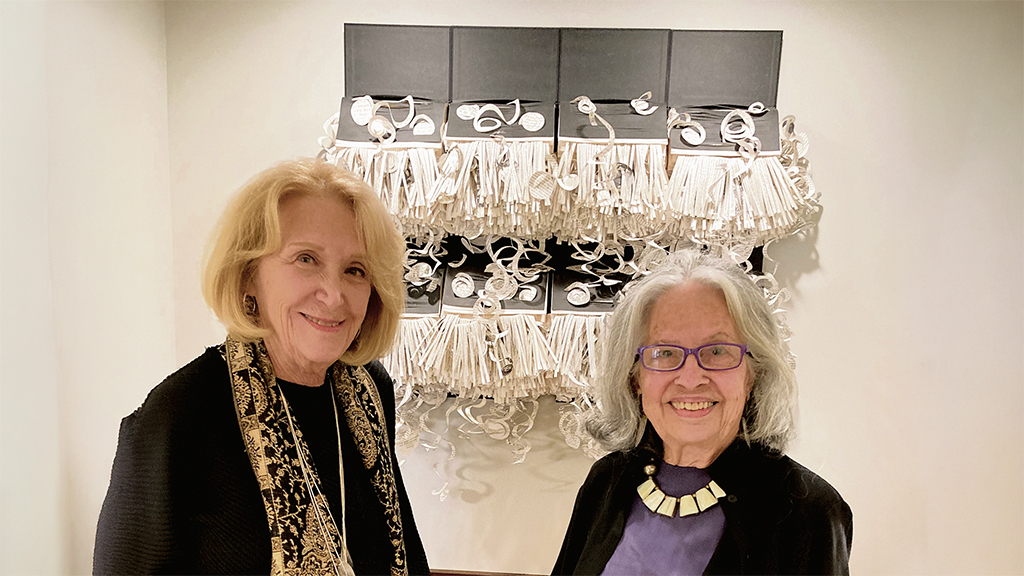
Terezin was a terrible place.
It was a concentration camp and a ghetto, alternately called Theresienstadt, in what then was Czechoslovakia. It was unusual because it was a kind of show camp, meant to display to the world the lie that Jews were doing fine. Just fine! Nothing to see there, folks.
Art and music and culture were part of life there, because that was part of the show. It’s where the book of piercingly sad children’s poetry and drawings called “I Never Saw Another Butterfly” and the opera “Brundibar” come from. It was a perversion of art, but because people are people and some have nearly ineradicable sparks of life in them, it also was real art.
Also, because people are people, some of the women imprisoned in Terezin, the half-starved women who worked in the kitchen, peeling endless potatoes, dreamed about life outside the camp. Those dreams included food. Those women talked to each other, describing food, sharing recipes, and giving breath to hope. One of those women, Mina Pachter, managed to write some of it down. Mina died of starvation in 1944, at Terezin, but the book made its way to Israel, then to New York, where her daughter, Anny Stern, eventually got it. Ms. Stern gave it to the writer and food historian Cara De Silva — who despite the implications of her name was an Ashkenazi Jew — and it was published in 1996, under the title “In Memory’s Kitchen: A Legacy from the Women of Terezin.”
Irmari Nacht of Englewood is an artist whose work has been displayed in many museums around the region and the country, including at Rutgers and the Yale Art Museum; she’s won many awards and and fellowships Ms. Nacht works, among other media, with books, cutting them, exploding them, playing with the truth that they’re physical objects made of words, and that the words are physical, ink on a page, and also metaphoric non-objects that whirl in our imaginations, kicking up dust storms of letters.
A few years ago, “I found 13 copies of a book,” Ms. Nacht said. “That’s how this started. I was very intrigued with their black endpapers. As I worked on them, I realized that the book was about the Holocaust.” Of course, it was “In Memory’s Kitchen.”
“I decided to use eight of the books. I always read them, and when I did I realized that it was about the starving women of Terezin, who recorded the recipes of the past to help them dream of a future.
“The physicality of the book fascinated me.”
To make the piece of art that those eight copies of the same book became, “I worked on all eight of them simultaneously, making the same cuts on each page,” she said. “But because this is the work of a hand, not a machine, each book looks a little different.
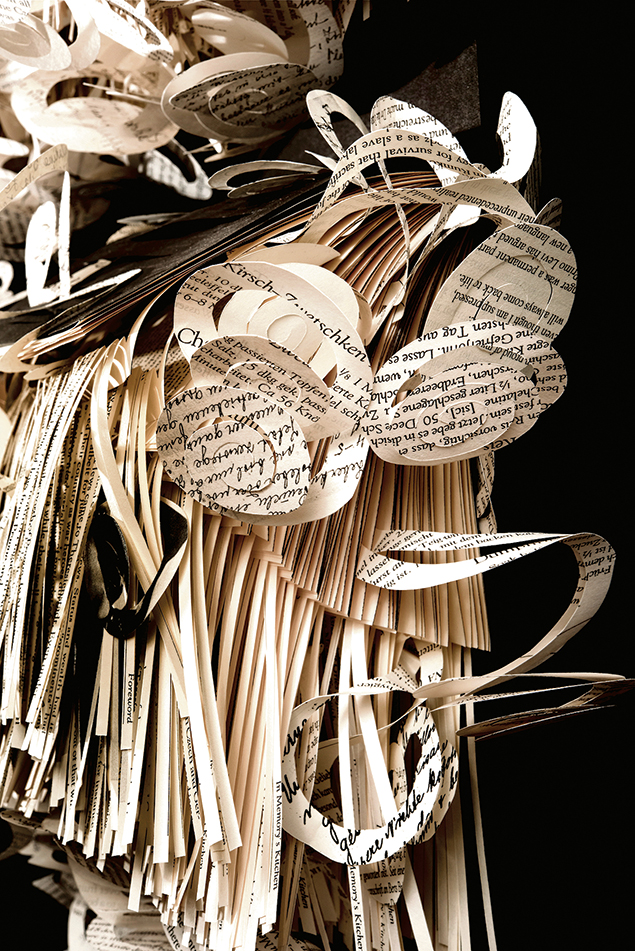
“The words of the books are visible, but you can’t read them,” she continued. “The black endpapers seem to me to be like the stark emptiness of life in the camp. The swirls and slices and stripes symbolize the barriers and bars to freedom, and the swirls also represent the endless job of peeling potatoes. The book talks a lot about slicing potatoes, cutting weeds into salads, watering it all down.
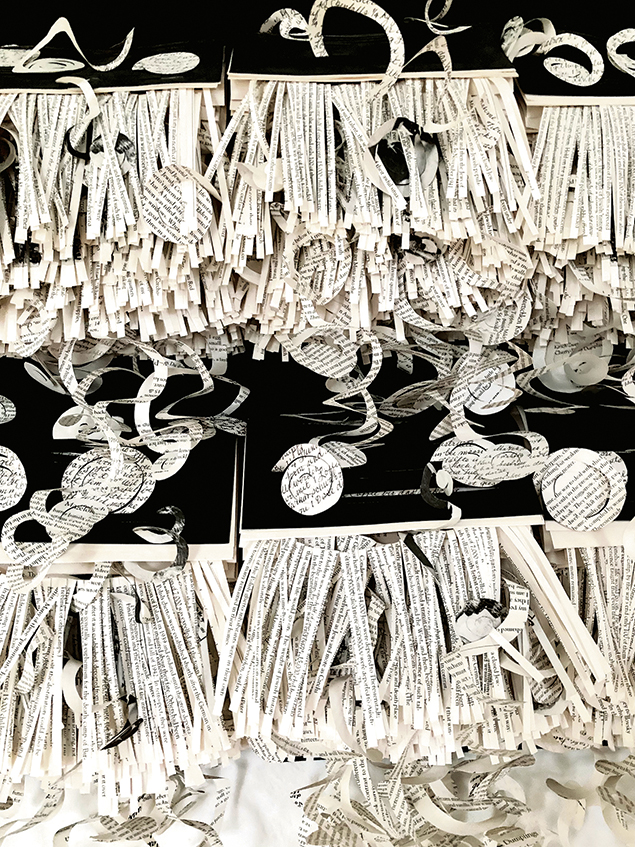
“It was also monotonous for me, making all these repetitive cuts, but I could stop doing it whenever I wanted to, whenever it got to be too much. The prisoners couldn’t do that. So making this work was very emotional.”
The artwork those books became, called “Books110Terezin,” is on permanent display at Temple Sinai in Tenafly; it will be dedicated on Sunday, November 9, at the synagogue, which also, and not coincidentally, is Kristallnacht. That night of terror in 1938, when the Nazis displayed their intentions and showed what true evil looks like, bears some resemblance to Ms. Nacht’s work, in that it takes an ordinary physical object — in this case, glass — and transforms it into something else. But Ms. Nacht’s work turns books, which themselves can be or at least contain magic, into objects of memory. Her work also touches on recycling, turning books into physical art instead of throwing them way.
The opening will be the start of a year of programming about women in the Holocaust. It will include art from the synagogue’s children, based on “I Never Saw Another Butterfly,” and food inspired by “In Memory’s Kitchen.” Because the recipes in the book were drawn from starving women’s memories, they are more dreamlike than accurate. They’ve been translated into cookable, bakeable food, and that’s what’ll be at Temple Sinai on Sunday
Ms. Nacht is also writing a book about Terezin. “I have been working on it since January, and I live and breathe this book,” she said. She’s discovered all kinds of connections to Terezin and “Books110Terezin” — relatives of people who had survived the camp or died there; relatives of people who wrote down remembered recipes in other concentration camps; people who made art or played music based on the music created and played in Terezin.
“The project may take another year, or maybe more,” Ms. Nacht said. “I may never be done. But right now I am about 200 pages in — I think that it might be around 300 pages. It’s continuously recycling. I go on the internet — I go down the rabbi hole of the internet — and I never know what I may find.”
Shelly Wimpfheimer of Fort Lee is the executive director of the Community Chest of Eastern Bergen County.
“It was a complete and utter accident” that got her involved with Ms. Nacht’s work, Dr. Wimpfheimer said. The two women often met professionally; the worked on many projects in the local nonprofit world together. “So I was at Irmari’s house for some unrelated thing, and I walked through the living room, and I looked up and saw this piece of art on the wall and I couldn’t stop looking at it.
“It was compelling, even though I didn’t know anything about it,” she continued. “So I asked her, ‘What is that?’ and she told me the story of the women of Theresienstadt. I was just very taken with the story. Like so many of us, we’d lost many people in the Holocaust.
I was struck by the strength of the women who survived, and with their determination to keep as close a semblance of normality as was possible under the most unbelievably life circumstances.”
Dr. Wimpfheimer also thought about one of her husband’s aunt, who had been in five concentration camps, survived them all, but ended up in the United States with a lot of scar tissue from the horrors she’d seen.
“So I was driving home from Englewood to Fort Lee — which isn’t very far — and I decided that I wanted to do something with this piece of art. I wanted to share it with other people, and to keep the memory of the women who had created it alive. I don’t remember reading or learning so much about women in the Holocaust.
“So I got home and walked to my apartment, and I told husband, Justin, that we are buying this piece of art and giving it do Temple Sinai. He said, ‘Just like that?’ and I said, ‘Yes. Just like that. I said, ‘Here’s the deal. We will teach women about the Holocaust.”
Dr. Wimpfheimer has created a committee to program around the art. Now, when people walk through the synagogue’s lobby, they stay, look, and learn.
“I’m so glad to have this permanent tribute to the survivors to the Holocaust,” she said.
What: “Books110Terezin” reception
Where: At Temple Sinai of Bergen County in Tenafly
When: On Sunday, November 9, at 4 p.m.
Who’s invited: The community
To learn more: Go to templesinaibc.org