

Hatred at the stadium
Rabbi Shmuley Boteach describes his afternoon at a World Cup game
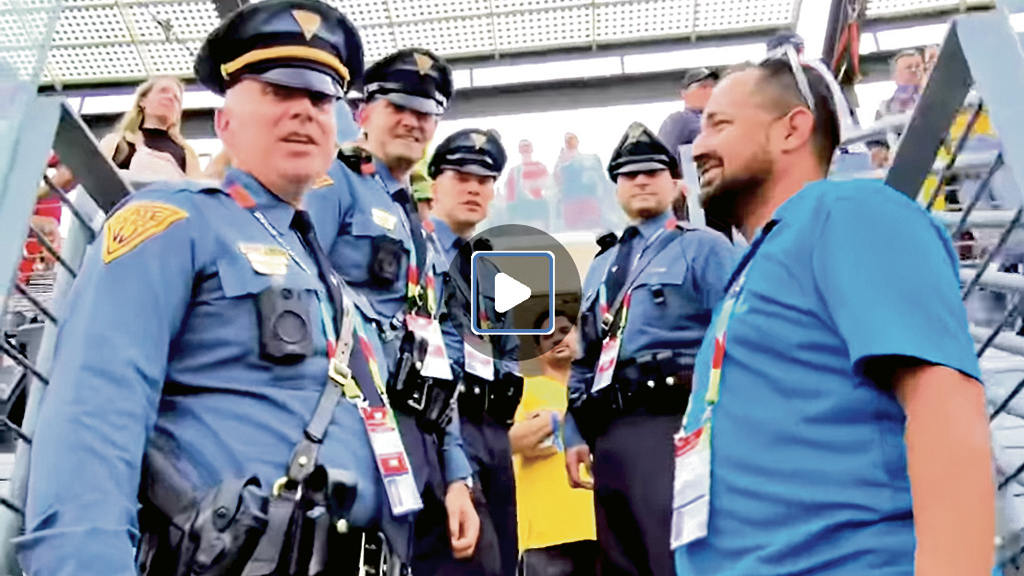
All he wanted to do was see a World Cup game.
Rabbi Shmuley Boteach of Englewood, whose career as a very public Jew, he says, has made him “the most famous rabbi in the country,” is not a big soccer fan. But he went to MetLife Stadium in the Meadowlands — temporarily renamed the New York/New Jersey Stadium — to see the game between Brazil and Norway that began at 5 on Sunday.
(The name’s been changed because FIFA — the Fédération Internationale de Football Association, to be French and formal — the organization that organizes the World Cup, has demanded that all commercial naming be dropped for its games. As for the series-long replacement, for the stadium that’s in Rutherford, New Jersey, “They are so embarrassed about New Jersey,” Rabbi Boteach said. “When you go to the stadium, you see that New York is in big, giant letters, but you need binoculars to see the words New Jersey.”)
He has no knowledge of soccer, and no real interest in it, Rabbi Boteach said, but “I like the internationalism of it. I was fortunate, in my years at Oxford” — those years started in 1988, when he arrived in the U.K. as a Chabad shaliach and created the L’Chaim Society at the storied university — “to live in a truly international city.”
He’d hoped to find a group of soccer fans from all over at the stadium, and in fact he did. “I think that about 20 percent of them were American,” he said. Many others were from Brazil, some were from Norway, and others came from even farther away. “New Jersey is a great state, but you don’t often bump into people from Sicily or Vietnam or Norway or from whatever, and I love doing it.
“In this time of incredibly hatred, it is a nice feeling when the world comes together, even if it is to watch people kicking a dumb ball.”
He went hoping to be surrounded by people from all over, and he was. “I went on my own, and I sat next to a Latina-American woman from Queens who explained the game to me,” he said.
He was visually striking. He’s no longer a member of the Chabad world officially but he’s closely affiliated with it. That’s not clear from his clothing, however. He always covers his head, but it’s not always with a kippah. Much as he wants to wear one to show his identity even from a distance, he also loves hats — he has a huge, ever-growing collection of them, he said — and so he often covers his kippah with a hat. Deciding whether to wear a kippah or a hat is always a struggle for him, he said.
On Sunday, he wore a brightly colored cap over a kippah. He wore visible tzitzit, as he always does. He also wore sandals, shorts, and a brightly colored and patterned short-sleeved T-shirt. No one item of clothing particularly went with any other, and that was by choice. “I love color, and I love mixing color,” he said. “When you are a chasidic Jew, all you get is black and white, but I love crazy colors.”
He also wore Brazil’s colors under his eyes. “The woman sitting next to me was from Brazil, and she said, ‘They’ll kill you if they think you’re there for Norway, so I will put this stuff under your eyes,’” he said. So she did.
“These people have no experience with Jews,” he said. They were friendly and welcoming. They knew he was Jewish because “I bought a kosher hot dog, at twice the price of a non-kosher one.
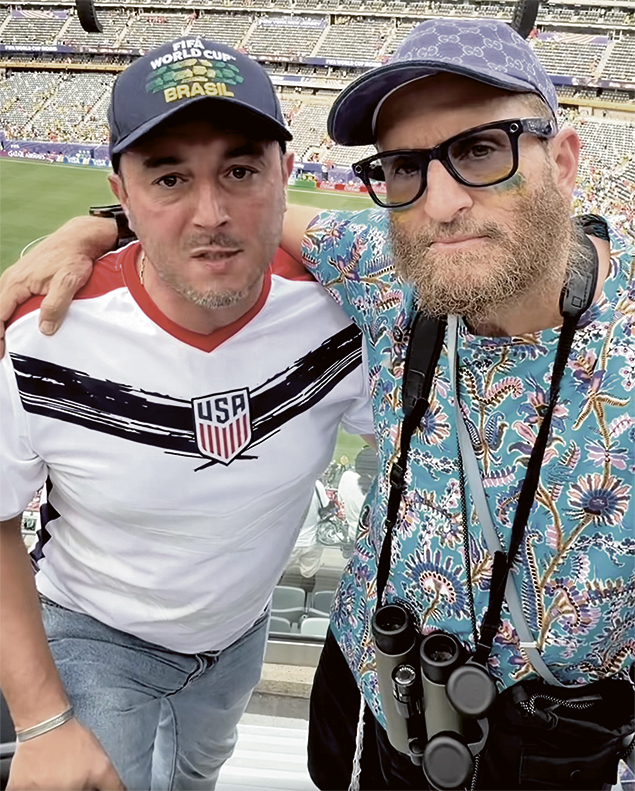
“I heard Hebrew right in the row behind me. It was a few Israelis, but they were keeping their metaphoric heads down. I said hello to them.”
Everything was going well. “That why the attack was so jarring,” he said. “I didn’t expect it.
“Suddenly, in the last quarter of the game, I started hearing ‘Rabbi Shmuley, eff you,’” — in reporting it, Rabbi Boteach said ‘eff,’ but the men screaming at him were not so delicate. They used the full word.
“It was the worst language. They clearly recognized me.”
He was one of approximately 80,663 fans in the stadium — that’s its capacity for soccer, and officials claim that it has out each of the World Cup games it’s hosted this summer . He was sitting way up high, in the cheap seats, because it’s one thing to want to experience a game, and it’s another to pay massive sums to do so, he said. So it’s unlikely that someone spotted him accidentally and happened to be in a group of his detractors. Instead, he said, “There are so many websites that monitor me.” Anti-Israel groups detest him, and they keep tabs on him, he said. That’s how “there suddenly can be a group of 30 guys with a giant Palestinian flag and other, smaller ones, screaming my name.”
The game was ending, Norway, surprisingly, was winning, and “a lot of people were moving by then, leaving the stadium,” Rabbi Boteach said. “The Israelis behind me skedaddled.
“And the people sitting with me were so nice, and all of a sudden they see me as an object of hatred. They must have been thinking, ‘This guy, who seemed nice — he’s an actual murderer.’
“At first I tried to make light of it and hoped they’d go away. But they got louder and louder and louder and louder and louder.
“Then it became menacing. The crowd began to grow.”
He faces online hatred all the time, Rabbi Boteach said. “I wake up every day to hundreds of messages that I should die, that I should be gassed, pictures of me as a cookie about to be baked in an oven.”
This time, though, he was being accused of being a baby killer.
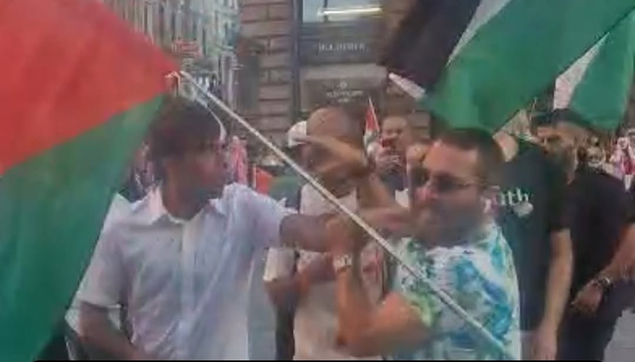
“That’s when I started to get worried,” he said. That’s a highly specific accusation. “More and more people are exiting the game, which basically is over. I see that everyone around me has left, except a couple of Australians. So I decide to go get help.
“I start walking away from my seat to get away from these guys. There is only one barrier between me and them, and they could push me down. So I see, maybe eight or 10 New Jersey state troopers.
“And then a miracle happened. So very proud Jews, who all spoke English with accents — one was Israeli, one was from Monaco, one was from Brazil, and none of them were born here — came, when I was describing the incident to the police, and said, ‘Did you see what they did to Rabbi Shmuley? No Jew deserves this.’”
The police took it seriously. “Sometimes I fear that they are trained to de-escalate, which for us Jews means ignore it, because it just doesn’t go away.” But this time, perhaps because of the vehemence of the Jews who supported him, “the police took it seriously,” Rabbi Boteach said. The anti-Zionists who had screamed at him slinked back into the crowd. “The police asked me if I wanted them to escort me out, but I said no, let me stay and compose myself.”
He thought back to an incident in Toledo and another in Vienna. Neither the Spanish nor the Austrian police took the threats against him seriously; in fact, they accused him of fomenting trouble and courting violence, Rabbi Boteach said. So he’s had experience in similar situations.
He’s also “faced a similar attack that went viral,” in Miami, “for which I am being sued,” he said. “That case is ongoing” — the next court date is August 24. “I vow to fight any attempt to silence attacks on Jews in the United States.”
Back in the stadium, Rabbi Boteach realized that if the police escorted him out, that would be filmed and the video would be disseminated widely. “That would be two bad messages,” he said. “One would be that Rabbi Shmuley did something wrong and is being escorted out. The other is that Rabbi Shmuley is so scared that he has to be escorted out.
“I think that I have endured 25 to 30 public violent attacks against me since October 7,” he continued. “I think that the only reason I am alive is because I show them that I am fearless. I show them that I will not retreat. I believe that makes a statement.”
Meanwhile, the Jews who had rallied to his support refused to leave him. “They really cared about me,” he said. “I interviewed them. I thanked them for having my back.”
They walked him down a few levels, from the nosebleed section where they’d all been sitting, and then he blended back into the crowd.
Looking back at his day at the World Cup game, “any interest in soccer that I have felt since then — and I never was interested in it — has diminished significantly as a result of this experience,” Rabbi Boteach said.