

Sing it in Ladino
Sarah Aroeste talks about the language of her family
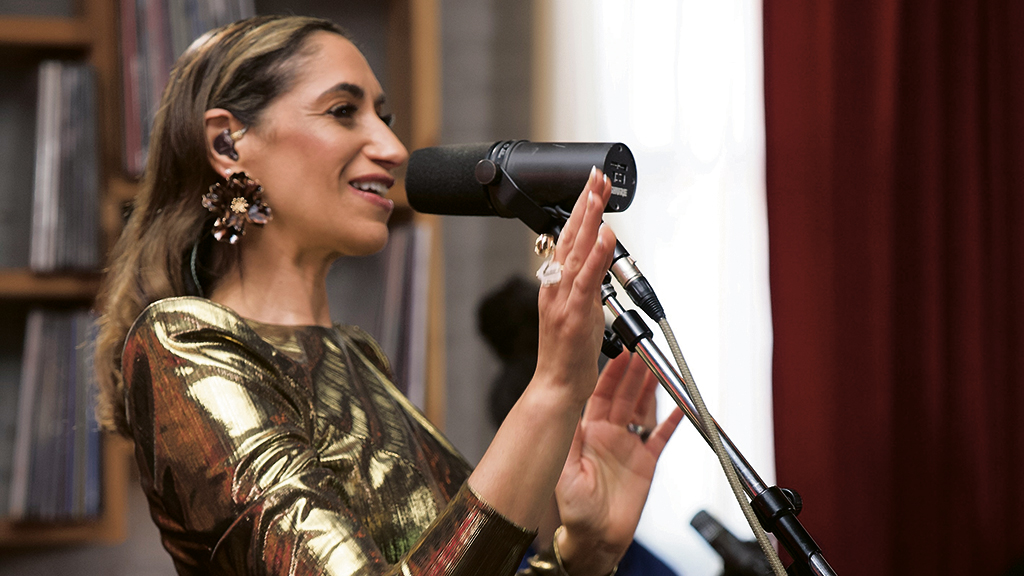
Think of Ladino as a kind of unmelting snowball, rolling from country to country, picking up more words, more quirks, more resilience — more color — as it goes. Often it rests, then it takes off again.
Ladino, the language of Sephardi Jews, began in Spain, with the Romance language that is now called Old Castilian. When the Jews were expelled in 1492, they took their language, which always had been flavored by liturgical Hebrew and less formal Aramaic, with them, and allowed it to change and grow as they went through Portugal and France and Italy and Greece and the Balkans and Turkey. Some of them stayed at many of those destinations. Eventually, centuries later, affected by the waves of war that swept across Europe, some moved to the United States, and others went to what was then Palestine and now is Israel.
It’s a fascinating and beautiful language. It’s not particularly flourishing; most of its speakers are elderly.
Of course it echoes the story of Yiddish, which developed around the same time, give or take a few centuries, and now similarly and steadfastly refuses to die, but it does not mirror it; there are far too many specificities and eccentricities to each of those rich hybrid Jewish languages.
Sarah Aroeste did not grow up speaking Ladino — like Yiddish speakers, Ladino speakers did not teach the language to their children when they got to this country, because they wanted to become real Americans as quickly and completely as possible — but she was surrounded in the culture as she grew up.
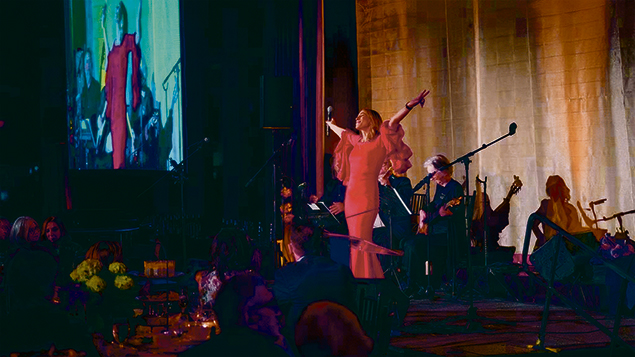
“I am a Jersey girl, born and bred,” Ms. Aroeste said. She grew up in Princeton; her father died when she was young, but her mother lives there still. “I haven’t lived there in 30 years, but you can’t take the Jersey out of me.”
She grew up in a Jewish community, as a member of the Princeton Jewish Center, “but I remember very clearly that even as a young child I knew that our family was different from most others. I knew that there were only a handful of other Sephardic families, and we were always excited when we could point them out.”
Her background is mixed — her father was Ashkenazi. “I mean no disrespect to my father when I talk about my family as Sephardi,” she said. “I grew up with my mother’s family.”
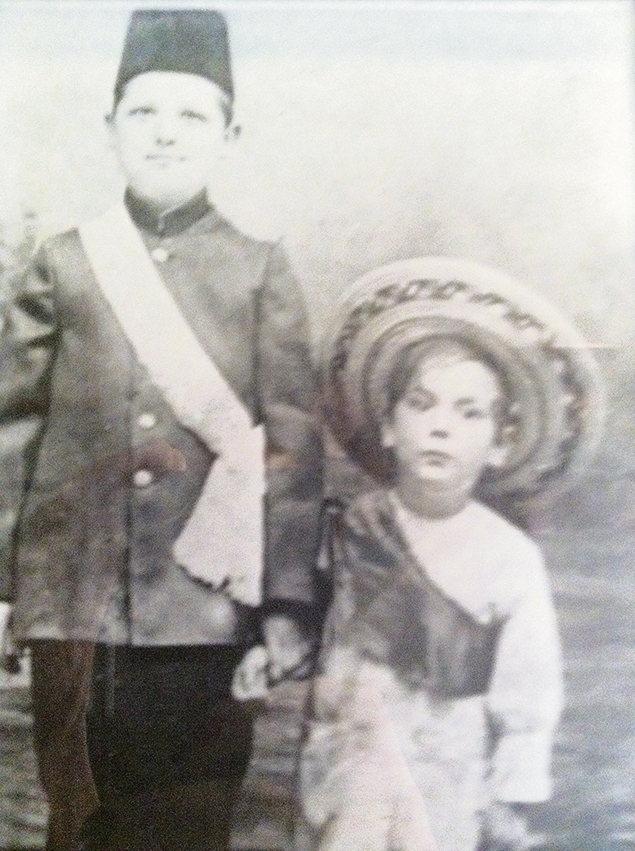
That family was headed by her grandfather, Julian Aroeste, who was born when the Ottoman Empire still governed southeastern Europe. The place where he was born is now part of Northern Macedonia; because of the complicated history of that part of the world, it’s Northern Macedonia because Macedonia is part of Greece. North Macedonians are Slavs. But they all live in the same fairly small corner of Europe.
“The best way that I can describe my heritage is the way my grandfather described it when he came to America in 1912, during the Balkan wars,” Ms. Aroeste said. “That’s when there was an influx of Ottoman Jews to modern-day Israel or South America or the United States. His papers said that he was born in Greece but that he was a Turk and spoke Spanish. They meant Ladino.
“To me, that really encapsulates what it meant to be an Ottoman Jew. They didn’t have stable borders. And that’s how I think of myself. We were from the Balkans, and we had an Ottoman identity, and Ladino was our language.”

Despite her Sephardic background — and despite having chosen to sing the Hebrew and Ladino version of Ein Keloheinu at her bat mitzvath — Ms. Aroeste didn’t feel as connected to that background “until I was in college, when I took it on as my own.”
Her college was Yale, where “I was a very, very serious student of classical voice,” she said. “I thought that I was going to become an opera singer, and I ended up for a stint in Tel Aviv, at the Israel Vocal Arts Institute, where, by serendipity, I was paired with a very famous opera singer and coach from the Metropolitan Opera named Nico Castell,” who died in 2015; he was from Venezuela, and his birth name was Naftali Chaim Castel Kalinhoff.
Perhaps unsurprisingly, given his background, “he was also an expert in Ladino music,” Ms Aroeste said. “He was an incredible singer and coach. We discovered our shared Sephardic heritage during our opera coaching work together, and sort of secretly he’d teach me some of the classical Ladino repertoire. I just fell in love with it, to the point that when I came back to America and continued studying with him, I did a series of opera recitals, and I inserted a small section of classical Ladino music inside these recitals.
“And I kid you not, without fail, audience members would come up to me afterward and tell me that the Ladino portion was their favorite.
“That made me wonder why that was. It could have been that it was unfamiliar to them, so their ears perked up. Or did I actually sing the music differently than I sang the Mozart, because it was so personal to me? I suspect that the answer is somewhere between those two.

“But the upshot was that I agreed with them. It was my favorite part too. And a few years later, I left the opera world to focus exclusively on Ladino music.”
Ms. Aroeste has become an ambassador for Sephardic culture. She sings in Ladino; she composes music, with lyrics in Ladino; she writes children’s books, in English but about Sephardic culture. (One of them, “Anyada Buena! Shanah Tovah!” is particularly appropriate for this time of year.) Her commitment to Ladino culture leads her not only to immerse herself in it, but to advance it.
She has just recorded a new album, “Orijinal (en bivo),” set to be released in late October. “It came out of the desire to acknowledge that I have been doing this for a long time,” she said. “For 25 years. There are some newer people on the scene who are doing beautiful work, and we are creating a community of Ladino artists.
“I live in the Berkshires now, my children are getting older” — the younger one is 10 and the older, about to turn 13, is preparing for her bat mitzvah — “and I have a big birthday coming up. All this came together and I wanted to do something to mark all of them.
“This album, ‘Orijinal,’ is because I am very proud that my contribution to Ladino culture has been through my songwriting. I am not just an interpreter of Ladino music. There is nothing wrong with that! We need both. We need people to preserve what is considered the traditional repertoire, and we need people to continue to create in this language, in this culture, or else it will die out.
“So I chose my favorite songs from my 25 years of songwriting in Ladino and I re-recorded them in a live setting. That’s why it’s called ‘Orijinal en bivo’ — en bivo means live. I had wonderful musicians, and we recorded all the songs in one day, in a studio in Queens.
“I really wanted to celebrate with this album. This is not about ego. I wanted to celebrate the possibilities of Ladino creativity and longevity and life. Some of the songs I picked were recorded so many years ago. I changed some lyrics. Some of the songs had little bits of other languages in them, but I wanted this album to be purely in Ladino. And I made some other changes, and I reimagined some of the songs.
“I’m really proud of this album for showing that Ladino is still very much alive.”
That brings up the question about how to learn about Ladino culture. Is there a YIVO equivalent, doing the kind of valiant, smart, effective work to keep Ladino alive that YIVO does for Yiddish?
Yes, Ms. Aroeste said. The organizations are smaller — and there is not one main group — but they exist. She mentioned the newly formed American Ladino League; there’s the Ladino/Hebrew Akademia de Ladino. “And I hate to say it, but covid, which was such a tragedy on so many levels, was good for Ladino learners.” When people were stuck at home with not much to do, they were free to follow their interests, as long as they could do it from home. The result is a platform where people can meet and talk to each other, only in Ladino. “It’s had 10,000 members,” Ms. Aroeste said.
Her website, saraharoeste.com, includes information about her upcoming albums and her already released work, as well as her books, other writing, and information about Ladino resources. Of course she’s included links to everything.
Ladino continues to live; in Ms. Aroeste’s care, it flourishes.