

Sweet 6-7
Finally, a free ride and other perks
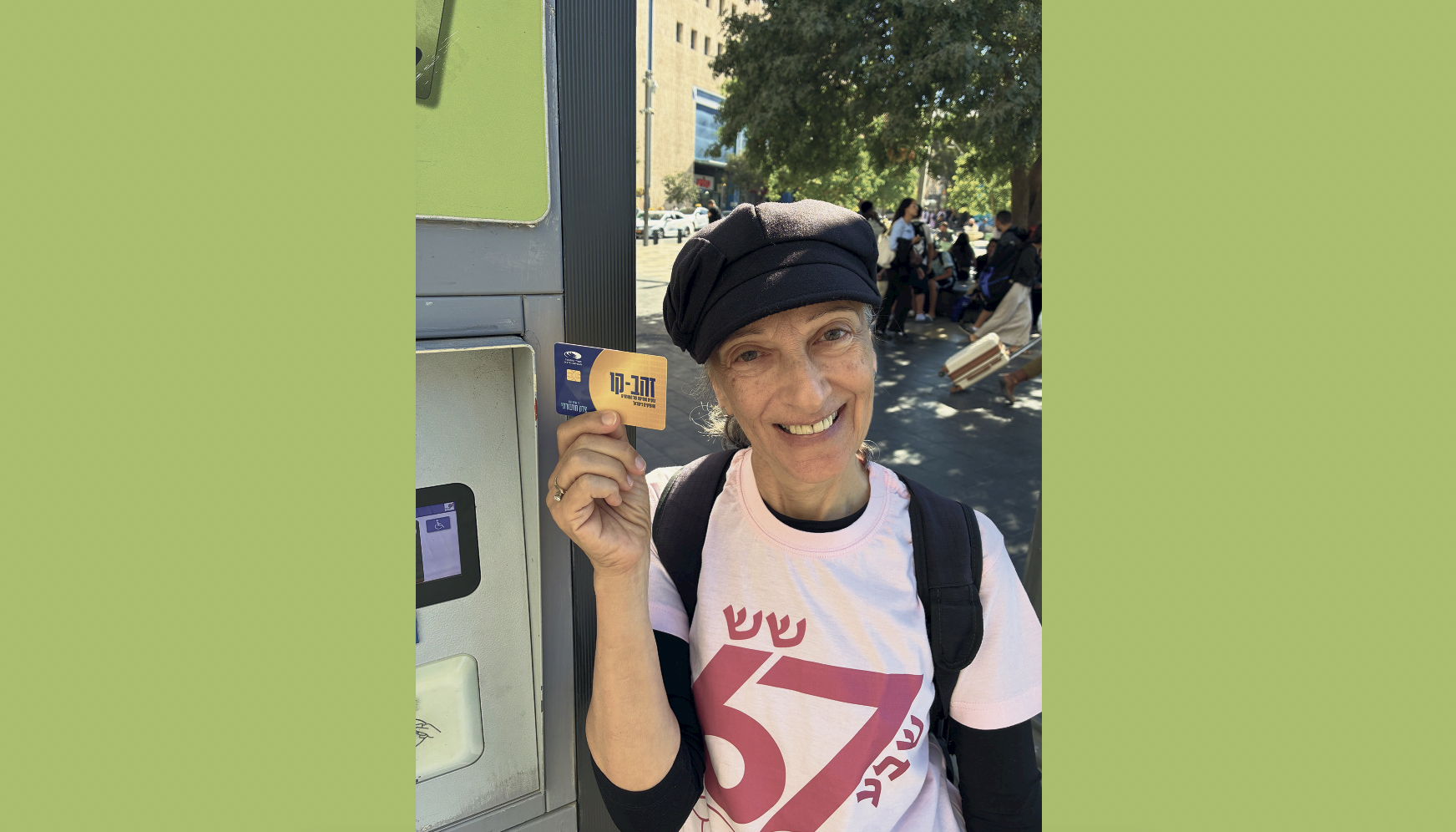
I’m writing this on my 67th birthday.
In Israel, this is a significant milestone because it’s full retirement age. And the benefits include free public transportation countrywide.
From the time I was 62, I enjoyed half-price public transportation using Israel’s green Rav-Kav smart fare card. (“Rav” means “many” and “Kav” is a route or public-transit line). Now I will travel at no cost, no matter when or how far.
Because we do not own a car, and public transportation is more the norm in Israel than in the United States, this leads to huge savings — especially now that we have the time to travel around our beautiful country more than ever.

My husband, Steve, accompanied me to a Rav-Kav office to obtain my new Zahav-Kav (Gold Line) card. All I have to do is tap it on the bus or train’s electronic reader for the sake of ridership recordkeeping. Or I can use an app instead.
Steve also turned 67 this summer. So I stopped into a souvenir shop and bought his-and-hers “67” T-shirts for us to wear on my birthday.
Why would souvenir shops sell such shirts? Because these days, across the world, 67 is the coolest number around.
In case you didn’t know, “6-7” is a viral social-media meme and playground chant accompanied by an up-and-down hand motion. Type “67” into the Google search bar, tap the return key, and see what happens!
Apparently, 6-7 is a concept lifted from a rap song and expressed a relatively positive rating on a scale of 1 to 10. From there, it morphed to mean… well, not much of anything. It became wildly popular in kind of the same way that “Seinfeld” became wildly popular despite being a show about nothing.
In some countries, the 6-7 craze was even banned from schools for being too disruptive and from fast-food joints because customers were practically rampaging for the privilege of snagging the number 67 for order pickup.
But Israelis adore this kind of silliness. Naturally, it was our preschool and grade-school aged grandchildren who introduced us to the ubiquitous 6-7 trend at least six months ago.
Before buying the T-shirts, I consulted our little experts to ensure that the fad hadn’t faded. They assured us it’s alive and well — or at least, it’s alive and well in Israel. Indeed, our city used 6-7 as a gimmick to build excitement for its summer cultural activities – “6” referring to June and “7” to July.
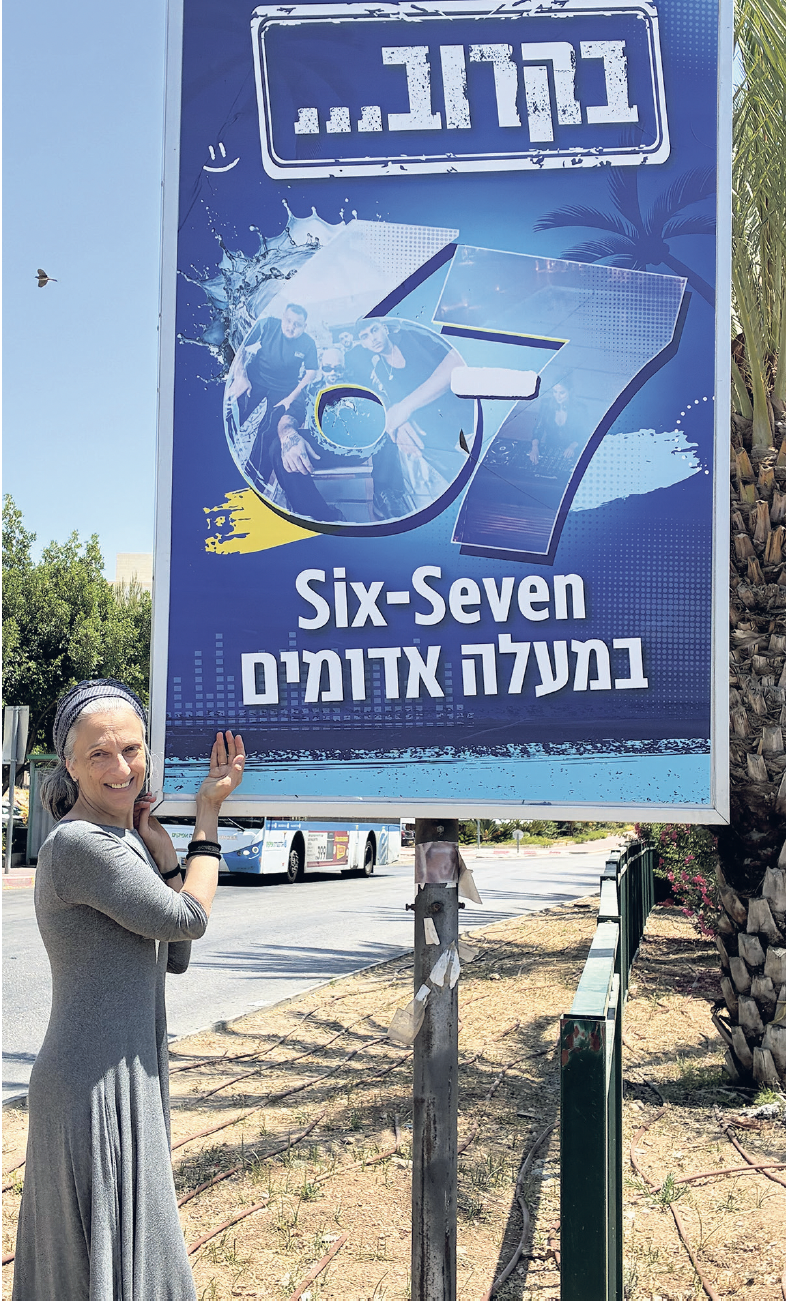
Meanwhile, we are marking another milestone this summer: 19 years since we made aliyah from Teaneck to the beautiful Jerusalem suburb of Ma’aleh Adumim.
Technologically, much has changed since we stepped off that plane. In the area of public transit alone, 2007 seems like the dark ages.
There was no Moovit app to help map your route and inform you when the next bus was coming. You went to the nearest bus stop, asked strangers for directions, and hoped for the best. Since 2012, Moovit (proudly developed in Israel) has revolutionized commuting in 112 countries.
There was no contactless farecard and certainly not a payment app. You handed cash or a 10-trip punch card to the driver, who somehow made change or punched your ticket in the right spot without taking his foot off the gas pedal.
There was no fast train between Jerusalem and Tel Aviv. The options were: (1) buses that crept excruciatingly along the jammed highway; or (2) weird-smelling 10-seat jitneys that shuttled from one city’s central bus station to the other’s all day long, departing not according to any schedule but whenever the seats filled up. Nowadays, the railroad linking Jerusalem and Tel Aviv makes the trip shorter, more reliable, and much more pleasant.
There was no public transportation between Jerusalem and Ben-Gurion International Airport. The options were (1) paying an arm and a leg for a taxi; (2) paying an arm and a leg for long-term parking; (3) hitting up a friend for a lift; or (4) booking a seat on a private shuttle that made so many stops along the way that it could take three hours for the one-hour ride to Ben-Gurion from our home. Sometimes the driver refused to make dropoffs beyond Jerusalem, leaving us desperately hailing a cab for the final leg of the journey. Today, those headaches have disappeared; the train to Tel Aviv stops conveniently at the airport.
There was no light rail in Jerusalem or Tel Aviv. Now these electricity-fueled trains provide a faster, quieter, and greener way to get from Point A to Point B across two perpetually crowded cities. Additional light-rail routes are under construction in both locales.
In 2026, there’s still no light rail in Ma’aleh Adumim, so buses remain our only mass-transit option for reaching the transportation hubs in Jerusalem. But the buses are fairly frequent and reliable.
I’d have to say the situation is a solid 6-7, and counting.
Abigail Klein Leichman, a longtime Jewish Standard correspondent, lived in Teaneck for 20 years. She and her husband made aliyah in 2007 and live in Ma’aleh Adumim.