

‘That’s our minhag’
An investigation of shul choreography
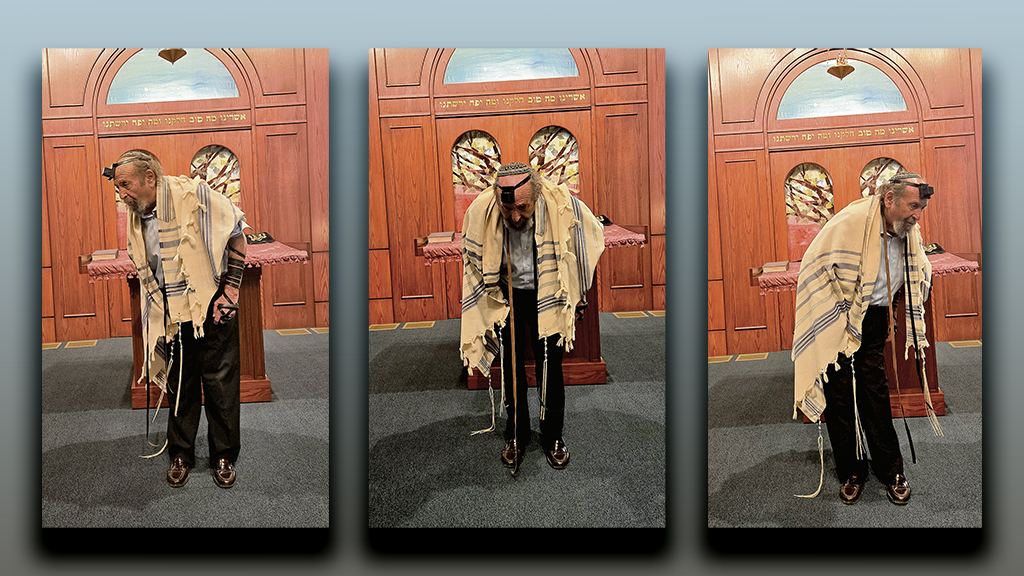
Stand up, sit down, bow and sway, bow and sway, bow and sway,
Stand up, sit down, bow and sway, that’s the way we Jews all pray.
My drash was about the choreography of prayer, and we all know that the way we move while we daven came centuries before Bob Fosse.
I wondered if the origins were halachic (coming from the collective body of Jewish religious laws) or minhag (custom), and the answer is both: some are halacha and others minhag.
Their origins were less relevant to me than why we do what we do and when, so let’s begin with bowing.
We bow at different times in different ways, and for different reasons, and we do not bow at every “baruch atah HaShem,” because if we did, the bow would lose meaning.
We bow in gratitude while blessing God — Baruch Atah, Blessed are You — and rise at Adonai, standing tall, acknowledging God’s presence with dignity. We don’t bow when the blessing is actually a request: healing, personal gain and the like.
Every erev Shabbat our first bow welcomes the Sabbath Queen, the Shechinah: “boi Kallah, boi Kallah.” There are some who bow three times (left, right, and center) but since my dad always bowed twice, each bow acknowledging each boi Kallah, I do that as well; bowing during L’chah Dodi is absolutely minhag.
Unlike most blessings, where we bend our knees at “baruch,” bow at “Atah,” and stand at “Adonai,” Barchu is different. Barchu isn’t really a blessing, it’s the call to communal prayer. It’s a slight bow at “Barchu et,” inviting the congregation to join in prayer, but we are still acknowledging God as a blessed sovereign, so just like every blessing we stand tall as we say “Adonai.”
During the Amidah (which literally means standing), we are standing lifnei haMelech — before the King. We take three steps forward entering sacred space, and bow (beginning with bent knees), and our feet stay together with no movement for the entire Amidah.
We bow at the beginning and again at the end of Avot, with the blessing that ends Magen Avraham.
During Kedushah, as we chant “Kadosh, Kadosh, Kadosh,” we rise on the balls of our feet with each “Kadosh.”
Are we trying to rise to a higher plane? Are we trying to imitate the angels in the midrash: The angels “lift themselves” in awe, so we are lifting ourselves in awe of God?
Even I can’t come up with an answer that works for me, other than it is minhag and doesn’t require any explanation.
We bow left, right, and center, and take three steps backward as we end our silent Amidah, and although some feel that we do that to show our reluctance to leave that sacred space, I look at it differently.
As opposed to standing up, waving our hand, saying “bye bye, God,” turning on our heels and leaving, respect demands that we retreat while still facing the throne. After three bows and three steps backward we can turn and leave God’s presence.
Near the end of the first paragraph of Aleinu we say: “Va’anachnu kor’im” (we bend the knees) “u’mishtachavim” (and bow) “u’modim” (and give thanks — we stand tall here). And we exclaim why: “lifney Melech Malchai Hamlachim,” in the presence of the King, the King of all kings, “HaKadosh Baruch Hu,” the Holy One Blessed Be He.
Even though this is minhag, it has become common practice.
My favorite minhag story is about a young rabbi who gets a pulpit in a small town in the Midwest. When the congregation get to the Shema in the davening, half of them stand, the other half sit, and they scream at each other.
The rabbi didn’t understand, so he asked a man at the oneg, “What’s the minhag here during Shema?” The man replied, “We stand.”
The rabbi walked over to someone else at the oneg, asked the same question, and got the reply: “Our minhag during Shema is that we sit.”
This happened at every service. Half the congregation stood, and the other half sat.
One day, the rabbi went to the hospital to visit an older congregant who was a patient there. He walked into the room, made a Mesheberach, and sat with the patient for quite a while. As he was about to leave, he turned to the old man. “May I ask you a question?” he said.
The old man nodded, and the young rabbi said, “I don’t understand the minhag at shul during Shema. I don’t know if you stand or you sit, because every time we come to the Shema in the davening, half of the congregants stand, half of the congregants sit, and they scream at each other.”
The old man smiled. “That’s our minhag,” he said.
Cantor/Rabbi Lenny Mandel, who left the wilds of Manhattan almost 50 years ago and lives in West Orange, has been the hazan at Congregation B’nai Israel in Emerson for the past quarter century.