

The Klezmatics at 40
They welcome the new year and their new decade
Time moves in only one direction. Forward. And the more of it you’ve lived through, the faster it seems to move. (Being a kid lasts for an eternity, high school takes nearly forever, college, well, not so long, and after that, whoooosssh….)
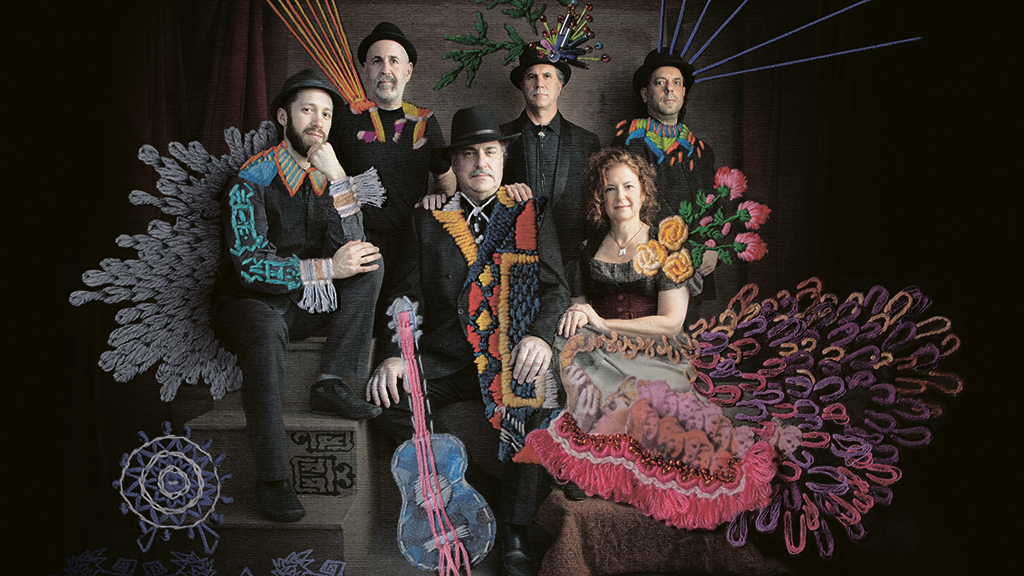
So maybe it makes sense that the Klezmatics, the iconic group that came together at the beginning of the klezmer revival in the 1980s and has expanded the sound of klezmer music to include other kinds of music and other traditions, is celebrating its 40th birthday this year.
To mark the group’s 40th, though, in May it released an album — its 14th — called “We Were Made For These Times.” And on September 24, the Klezmatics will be in Symphony Space, on the Upper West Side, in a performance that will be “celebrating 40 years of radical joy.” (See box.)
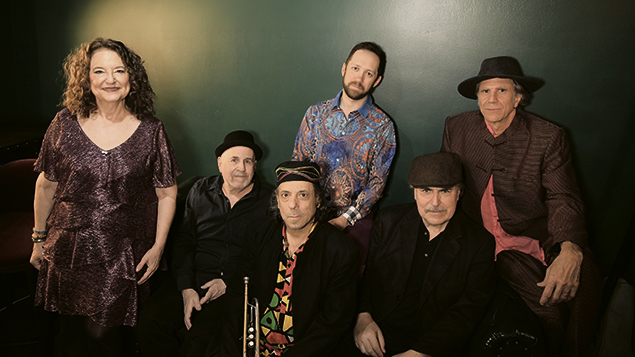
The band has not remained entirely unchanged over those four decades — unsurprisingly, some members have left and others have joined — but those changes have been minimal.
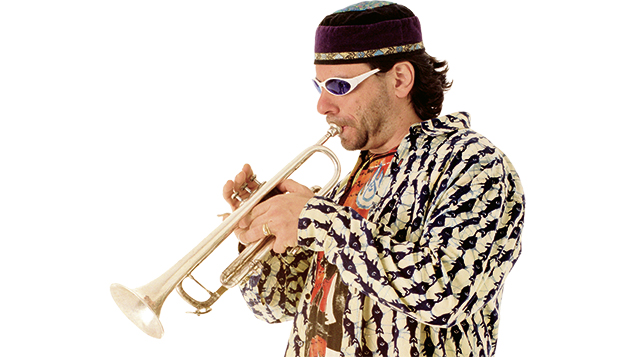
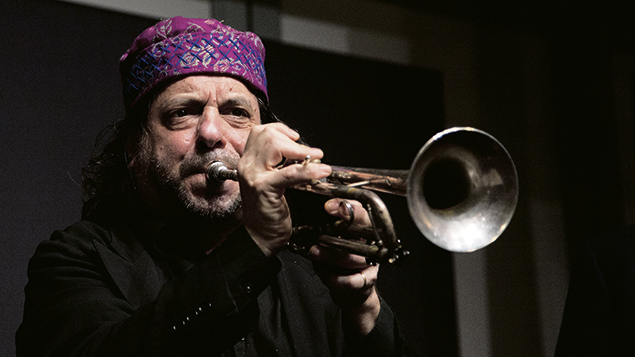
Of the group now, “four of the six of us were on our first recording in 1988,” Frank London, who plays trumpet and is possibly, along with singer (and YIVO sound archivist) Lorin Sklamberg, the group’s most visible representative, said. “And the other two members, well, one of them has been with the band for 25 years, and the other’s been with the band for 16 years. So we have continuity.”
That continuity reaches both backward and forward.
“We’re called the Klezmatics, but even more than a klezmer band really what we are is a Yiddish band,” Mr. London said. “And when I use the world Yiddish I don’t mean only the language, although the language obviously is a crucial part of it, but I mean the culture. And that’s older, Eastern European culture, which includes the music, the art, the dance, the literature, the poetry, the food — you know, the everything! — and it’s also the Yiddish culture that’s one of the cornerstones of New York culture. One of the important things that gives New York its character is the Yiddishness of it.”
New York isn’t formed only by Yiddish culture, Mr. London added — “there’s also the Puerto Ricanness of it, the Blackness of it,” and those are just the biggest, most obvious tiles in the mosaic. “But we’re a Yiddish music group,” he said. The Klezmatics have “done everything, from just us to collaborations with everyone from Chava Alberstein to John Zorn to Itzhak Perlman.”
There are many ways in which the band is celebrating its anniversary, Mr. London said; he discussed some of them, in what he said was no particular order other than the way in which they came to mind.
“We’ve always tried to have a social and political message, even from when we were formed. Our first record, in 1988, was from the height of the era of the AIDS debacle. It’s called ‘Shvaygn = Toyt’ — the Yiddish translation of ‘silence equals death.’
“We were quoting the AIDS Act Up slogan. But we were also referring to Yiddish. If people don’t speak and sing in Yiddish, the language dies. That’s always been a part of who we are.
“Another part of who we are is collaborating with other artists. We feel that because of our knowledge of Jewish and Yiddish music and culture, because of our strength there, we are on firm ground to meet with people from other cultures, traditions, languages, and collaborate as equals.
“Over the 40 years we only made one album where we said, you know, enough is enough. Enough of this collaboration stuff. It’s just us who’s going to make this album.” That was Apikorsim, in 2014. “But in this album, ‘We Are Made For These Times,’ we decided to go in exactly the other direction.
“It’s about collaborations. With one exception, it’s about New York collaborations, because it’s a New York record. In fact, before we came up with the title, we just kept calling it the New York Sessions because we kept working with New York artists of varied ages and styles and backgrounds.
“So we have Janis Siegel of the Manhattan Transfer, which is even older than the Klezmatics — they’ve been around for 50 years. She’s jazz royalty, and she has a Yiddish background.
“Then there’s the Lavender Light Gospel Choir,” he continued. “And it’s funny — I realize I’m doing it in age order. They’re the nation’s first lesbian and gay gospel choir — maybe the world’s first — and they’ve been around for 40 years, and like us they’re celebrating their 40th anniversary.
“There’s Joshua Nelson. We recorded ‘Brother Moses Smote the Water’ with him.” Joshua Nelson is Black and Jewish and is called the “prince of kosher gospel.” He sings gospel in a way that few other Jews can manage and commands a stage, vocally, visually, and charismatically, in a way that few other people can manage. He is from Newark and South Orange and has been the music director and taught Hebrew school at Temple Sharey Tefilo-Israel there; that was his synagogue as he grew up.
“I’ve known Joshua for a long time, and I love him and respect him, and he’s a genius,” Mr. London said.
“We also work with two of the absolute royalty of the New York avant garde jazz and improvised music scene, William Parker and James Brandon Lewis. They’re at the top there.
“And then there is a group of very young Columbia women who are all expats and live here now. They’re called La Manga.” They’re all percussionists, they all sing, and like the Klezmatics, they use the culture they came from as background and base and roots, not as confinement or curtailment.
“We first heard them play at Barbes” — a jazz club in Brookyn — “and we were blown away with their energy and their spirit.
“The album is really multigenerational,” Mr. London said. “Now I am in the senor citizen camp. I was in the youth camp when I started. What I love about this world that we live in, the Yiddish world, is that it’s always been intergenerational.
“I’m one of the co-founders of Yiddish New York, which is an annual retreat to study Yiddish music, language, dance, and culture.” This year the festival, which is both live, mainly downtown, at the Museum of Jewish Heritage, and online, will be from December 26 to December 29. Mr. London and klezmer clarinetist Michael Winograd, another festival co-founder, will curate.
Back to the album — it also included a collaboration with Crimean Tatar musicians, expats who now live in Brooklyn. “For interesting historical reasons, there’s real overlap between klezmer and Yiddish music and Crimean Tatar music,” Mr. London said. (Crimean Tatars, like Jews, have a history of oppression, wandering, and picking up overlays of music and food and culture from the people among whom they found themselves.)
They also recorded with Enver Izmaylov, a master Crimean Tatar guitarist and composer. “He’s super famous, and he happened to be touring in the United States, just as we were recording,” Mr. London said. “We knew that this was an opportunity too good to pass up, so “we jumped. We grabbed him on a day off from his tour and jumped into the studio.”
(Strikingly, in his videos Mr. Izmaylov wears a hat that looks like a Bukharian kippah. The style comes from Uzbekistan, where the Crimea Tatars took refuge and Mr. Izmaylov grew up.)
When it comes to musical collaborations, “I break them up into two different categories,” Mr. London said. “One is when there is clearly some connection between the music, and the other is where there is absolutely no connection between the music. And then we find different strategies to make it work.”
Mr. London told a story about the title song of the Klezmatics’ new album.
“We’ve always had a social justice bent,” he began. “There’s a radical puppet theater collective called Great Small Works, that grew out of both Bread and Puppet Theater and the Eighth Street Theater. They do annual spaghetti dinners. At the spaghetti dinner I think a year ago, there was music, and they asked us to do a song called ‘We Were Made For These Times.’ We did. So when we were getting ready to record, I said that this song is perfect for our theme. Let’s do it.
“I thought that the song was written by a woman named Angela Gabriel, who is one of the important people in the Poor People’s Campaign. She sort of did — but when I spoke with her, she said, ‘I didn’t really write the words. I took them from a letter written by Clarissa Pinkola Estés.’
“That name might not ring a bell for you, but in 1990 she wrote ‘Women Who Run with the Wolves.’
“Well, about 25 years ago Estés wrote something called ‘The Letter to a Young Activist During Troubled Times.’ It’s way more inspiring than anything I could ever say. It starts: ‘My dear friend, do not lose heart. We were made for these times.’
“So Angela Gabriel took the letter and made a song out of it. The letter is so inspiring. She wrote it 25 years ago, and she wrote then, in 2003, ‘Ours is a time of almost daily jaw-dropping astonishment and often righteous rage over the latest degradations of what matters most to civilized, visionary people.’
“She could be writing to us right now. And she says ‘Do not despair. Do not lose heart. We were made for these times.’”
Then Mr. London reached even farther back, to a 1948 song by the American folk song pioneer and visionary Woody Guthrie. “Deportee (Plane Wreck at Los Gatos)” is about a crash in California that killed 32 people; 28 of them were Mexicans being deported back south of the border. The impetus for the song was a New York Times story about the crash, which named the four Americans who died but called the others simply “deportees.”
“Woody was incensed that they were not named. The song is about giving them names. It’s in English, Spanish, and Yiddish, with our guest artist, Sofia Rei.
“So there’s this letter from Clarissa, 25 years ago. This story, from more than 75 years ago. And the first song on the album, ‘Un Du Akerst,’” — “‘And You Plough” — “is written about 175 years ago, about the failed German student uprising. The point is that you plough the fields and make food for everyone, but what is on your table? You weave and sew in your shops, but what does your family get to wear? Rise up, and break the chain of slavery. We have power as workers.
“It’s a window into the dawning of the industrial modern age. And then the text was translated into Yiddish about 60 years later by Chaim Zhitlowsky, a Yiddish anarchist translator and writer.”
One of the many things that he loves about his work, Mr. London said, is that “there’s so much history. I love that musically, textually, everything is like a window opening up so that you’re looking at something else.
“For me, that’s why we’re still together as the Klezmatics 40 years later. And you know, it’s not like we’re the Rolling Stones and we get paid $10 million a concert. If I got paid $10 million to sing ‘Ale Brider’ all day long, I would sing it all day long.” (“Ale Brider” — “All the Brothers” — one of their first songs, was among their most popular.)
“The point is that it’s all still so fascinating. We’re still growing. We’re still learning. What we do still is relevant.”
The point, Mr. London said, is that they all love what they do. It’s not as if it’s so lucrative that at no point could they have afforded to do something else. Klezmer engenders passionate loyalty from its audience — but its audience is fairly niche. The Klezmatics don’t sell out Madison Square Garden.
They play what they love, and what resonates with them.
“People would ask us for all the clichéd Yiddish top hits,” he said. “Can you sing ‘Bei Mir Bist Du Schoen’? Can you sing ‘Romania Romania’?” (Not that those aren’t wonderful songs. They’re just not — and not by accident — Klezmatics songs.)
“Yes, we could have. But we decided, at the beginning, that we were against that kind of nostalgia. We didn’t know what we were going to be for yet, but we knew it wasn’t going to be that.
“And just recently I was doing some research into the etymology of the word nostalgia. It comes from two Greek words, nostos and algia. Nostos means homecoming or returning home and algia ia pain. Nostalgia is an illness. You could say that it means homesick, but when it was first coined, it was seen as a sickness, the longing for something that’s past, and that messes you up. Now it has a softer meaning, but it’s still about longing for something that doesn’t exist. Something that maybe never existed.”
Then Mr. London laughed. “I have a slogan for the Klezmatics,” he said. “How does this sound? ‘Eschewing nostalgia for 40 years.’”
Who: The Klezmatics
What: Will be in concert; it’s called “The Klezmatics and Friends: Celebrating 40 Years of Radical Joy”
Where: Will be at Symphony Space on Broadway at 95th Street on the Upper West Side
When: On Thursday, September 24, at 7 p.m.
Why: To celebrate the group’s 40th anniversary
For information and tickets: Go to symphonyspace.org; you can also email boxoffice@symphonyspace.org or call (212) 864-5400.