

A life of extraordinary journeys
Father’s yahrzeit stirs a son’s deepest and fondest memories
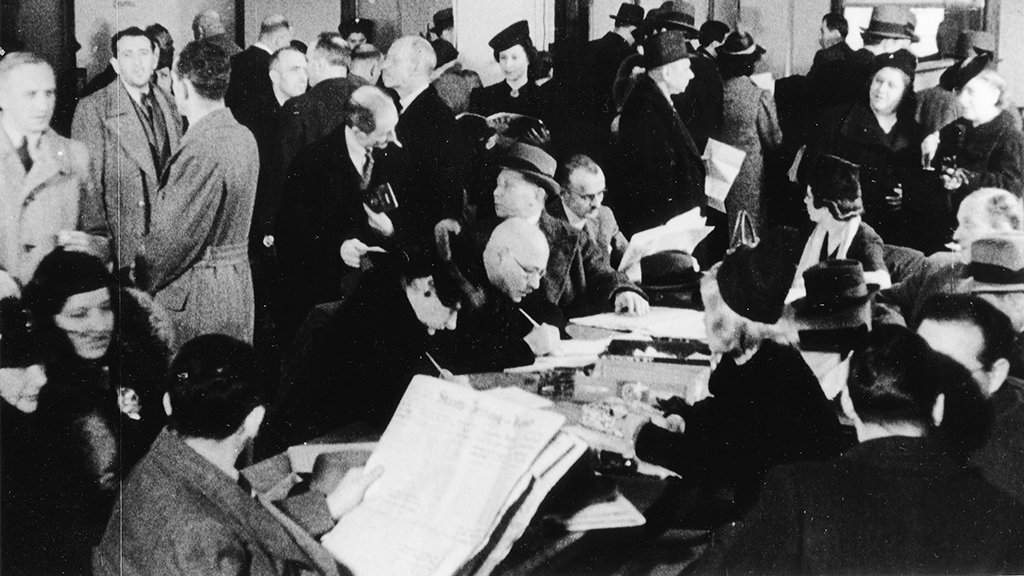
It was in December 2004 that I watched a documentary, “Into the Arms of Strangers,” about the Kindertransport.
The film included photographs and footage of Jews in various parts of Europe, including the American consulate in Vienna. One photograph showed a long line of Jews stretching around the block. Another showed people lined up on the stairs. The final photograph revealed a room filled with people.
I stared in disbelief. My dad — he was Jechiel David Mandel then; later, when he came to the United States, he became Dave Mandel — was standing in the corner of that room.
No one could have known that this photograph existed, and I wondered what stroke of fate — or luck — had led me to watch that film on a Sunday morning.
To say that my dad lived an interesting life would be an understatement.
His father was a renowned rav and a chasid of the Belzer rebbe. Around 1912, the family — Bubbie, Zeide, my dad, and his two older brothers — left Poland and moved to Vienna.
My dad’s oldest brother remained very observant. But my dad was different. One day, a teacher yanked my dad by his payes, so my dad grabbed a pair of scissors and cut them off. His father was livid, and my dad was punished severely. Nevertheless, he continued attending cheder, albeit without his payes.
As he grew older, he strayed from religious observance. He played soccer with Hakoah Wien, the Jewish sporting club, was a ballroom dancer, and rode a motorcycle. When the Nazis came to power, they arrested him and confiscated his motorcycle.
He managed to escape, fled to Germany, and boarded a ship in Hamburg bound for New York. Halfway across the Atlantic, the passengers broke into a hora.
Once in America, he found work as a plasterer at St. Patrick’s Cathedral in Manhattan. One day, while he was high up on a scaffold plastering the cathedral’s ceiling, Francis Cardinal Spellman climbed all the way up to speak with him.
Having learned that my dad was from Vienna, the cardinal asked whether he knew what had happened to the Archbishop of Vienna, Cardinal Theodor Innitzer. My dad explained that Cardinal Innitzer had been the target of a violent Nazi assault. Upon hearing this, Cardinal Spellman fell to his knees, blessed himself, and wept.
Most, if not all, of the workers at the cathedral were Catholic. When they saw the cardinal on his knees, in tears, they rushed up the scaffold, threatening my dad. By the time they reached the top, however, the cardinal was up on his feet, explaining what had happened.
He was set up on a date with my mother, and while they dated he was drafted into the American Army. Mom took the train out to Kansas City, where they were married in August, 1942. Soon after that, Dad was sent to Europe to fight in World War II.
His sergeant, Smith, from the deep South, was a raging antisemite who mistreated my dad horribly. Because he was a private, my dad had little choice but to follow Smith’s orders. The company eventually was shipped to Belfast. Three days into the voyage, my dad told Smith that if he ever came up on deck, he would throw him overboard. Smith never came up on deck.
Within a year, my dad had become a sergeant and was stationed in London. He knew that there was a kosher restaurant in Piccadilly and wanted to eat there. Unfortunately, Piccadilly was off-limits to American servicemen. Undeterred, my dad and three other Jewish soldiers went anyway. They were declared AWOL, and each was busted down one rank.
Eventually the war came to an end, and my dad’s unit was among the liberators of the Dachau concentration camp. It was there that he experienced one of the most moving moments of his life.
As he walked through the camp, one of the prisoners, almost all skin and bones, gestured toward him and asked, “Kenst du Yiddish?”— “Do you know Yiddish?”
“Avada,” my dad answered. Certainly. Yiddish was the only language spoken in my dad’s parents’ home, so he understood the man perfectly.
My dad sat down and held the prisoner in his arms. The man told him that he had buried a sefer Torah in his shtetl in Poland to keep it out of the Nazis’ hands. He asked my dad to promise that he would either dig it up or arrange for someone else to do so.
My dad agreed, and then the old man died in his arms.
My dad was discharged from the Army in 1945, and I came along in 1946.
There are countless stories about my dad, but some of my fondest memories have nothing to do with war, escape, or extraordinary encounters. They are about family.
When our son, Wayne, came along, both my dad and my mother were beside themselves with joy. We would visit them at their apartment in Brooklyn, ring the bell, and wait for the door to open. My dad would greet us with the same question: “Where’s my million-dollar baby?”
Wayne would hide behind me, and I would respond, “I’m your million-dollar baby. He’s mine!”
My dad loved spending time with Wayne. When Wayne was 8 or 9, he played soccer; my dad would come to watch him and whisper strategies in his ear. Dad took great pleasure in being part of his grandson’s life.
In 1994, my dad became very ill. He suffered episodes in which he would black out and remain out of it for a couple of days. When he finally woke up, he would ask what he was doing in the hospital.
One weekend, I rented a van to drive up to visit Wayne at college. Sadly, my dad suffered another episode on that Friday afternoon, so I called Wayne and told him to fly down instead. I picked him up, and we drove to Beth Israel Hospital in Manhattan. When we entered my dad’s room, he was awake. The moment he saw Wayne, his face lit up like the lights on Broadway.
It was wonderful to see, and even more moving to watch the two of them sitting together, chatting and enjoying each other’s company.
Wayne flew back to school that afternoon, but he had to return on Tuesday. My dad didn’t make it. His final days, however, had been filled with what mattered most to him — time with his million-dollar baby.
Ironically, Kaf Chesvan is his yahrzeit, and this year it falls on October 31 (yup, Shabbat this week).
My dad was 110 percent American. Although he was an observant Jew, his favorite holiday of the year was Thanksgiving. He never forgot what it meant to have escaped Europe, come to America, and make this country his home. He gave thanks every minute of his life for the opportunity to live here.
Looking back, I realize that my dad’s life was extraordinary not simply because of what he survived, but because of what he went on to build. He experienced persecution and war, witnessed the horrors of the Holocaust, and encountered moments that most of us can scarcely imagine. Yet he also found joy in family, took pride in his grandson, and remained deeply grateful for the country that had given him a home.
And perhaps that is what makes the photograph I saw that Sunday morning in December 2004 so remarkable. There he was, standing in the corner of a room filled with people whose lives, like his, had been shaped by uncertainty and fear. I could never have anticipated that I would find my dad in that photograph, or that watching a documentary would bring me face to face with a piece of his past.
It was a moment of fate, perhaps, but it was also a reminder of just how much of his extraordinary journey I was fortunate enough to know.
Cantor/Rabbi Lenny Mandel of West Orange is the spiritual leader of Congregation B’nai Israel in Emerson.