

A wedding in Cartagena
Bienaventurados los que vienen en nombre de Dios. No matter the language, welcome and feel the love
The Kreiman-Gavzy family had been members of my synagogue, Congregation Bnai Israel in Emerson for many years. Jamie Kreiman served as the president of CBI and remained a trustee until she died in December 2023.
Ike Gavzy was a Bergen County assistant prosecutor for 25 years, retired in 2008, and became a criminal defense attorney (don’t they all do that?). He died in 2011, when he was 57.
Jamie and Ike had a son, Sam. I co-officiated at his bar mitzvah in 2000, sat with him and his parents before they died, and co-officiated at their funerals.
I think that Sam’s passion to become a doctor was to help diagnose and treat patients with diseases that caused his dad’s untimely death.
That’s the backstory, but not the story I want to tell.
I got an email from Sam last April, wanting to know if I would officiate at his wedding in Colombia in October.
“I would be honored,” I said. “D.C. is only about an hour south of Baltimore,” so it would be easy. What’s the venue there, I asked.
Sam started to laugh and through his laughter he said, you spelled Columbia incorrectly, Lenny. It’s Colombia — Cartagena, Colombia.
“I’m in,” I said.
I sent Sam and his fiancée a couple of different Jewish wedding ceremonies that I wrote or adapted, and they wanted to know how much of the ceremony would be in Spanish. I wrote back asking the same question. Most of it, they answered.
The next email was to make sure that we took salsa and merengue lessons, so that we could dance the night away just like the locals do. (That, of course, would be after the hora.)
They wanted a traditional Jewish wedding ceremony in Cartagena so that Carlos’s family could experience a Jewish wedding. Yes, Doctor Carlos Acosta Gavzy is Sam’s husband.
Meryl Kutzin was the president at Bnai Israel, and then a trustee there for decades. She and her husband, Larry, had a very close friendship with Jamie, Ike, and Sam. They were in Cartagena, and arranged all of the tours for us while we were there, both during the day and at night. Each one was fabulous.
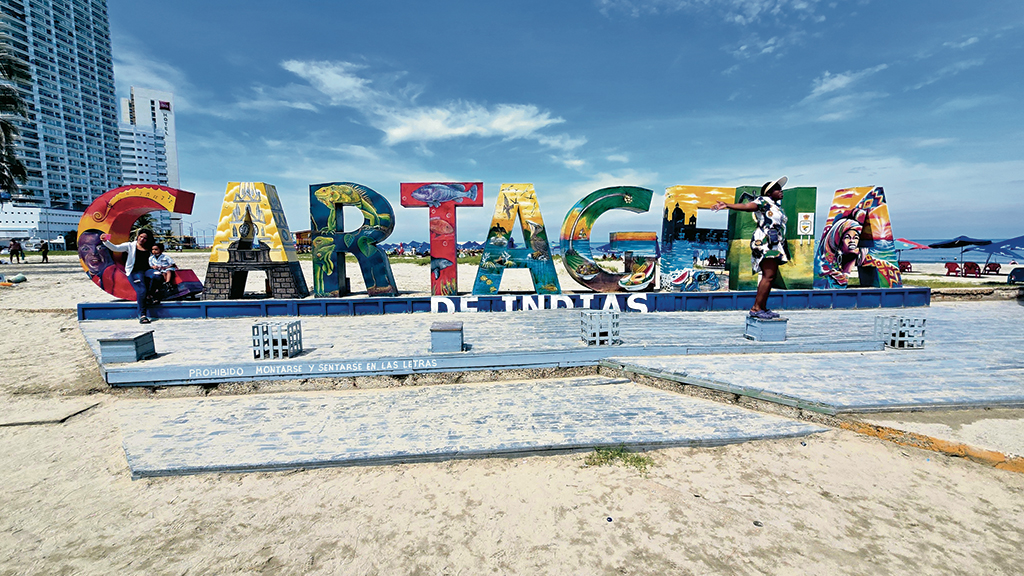
In 1984, Cartagena’s colonial walled city and fortress were designated a UNESCO World Heritage Site, but the city is best known for its incredible nightlife. Getsemaní, once a very dangerous neighborhood, has become “Cartagena’s hippest neighborhood and one of Latin America’s newest hotspots,” according to Wikipedia.
We walked the colorful streets at night, hardly able to move through the crowds. Bars, restaurants, boutique hotels, and art galleries lined both sides of the streets. The flags of every country in the world (yes, the Israeli flag was among them) hung from the upper floors. There was color everywhere. And everyone was so young. I think that we brought the average age of the kids in Getsemaní up about 30 years.
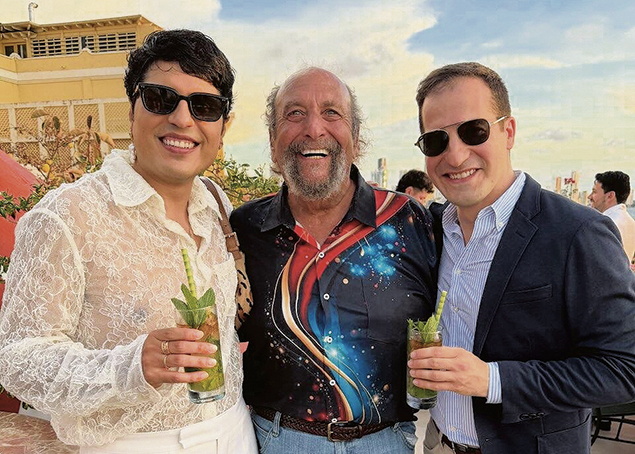
The night before the wedding there was a cocktail reception on a rooftop bar overlooking the Caribbean Sea. Tapas, wine, beer, and mojitos flowed, with a glorious sunset a pre-cursor to what would be an incredible wedding night.
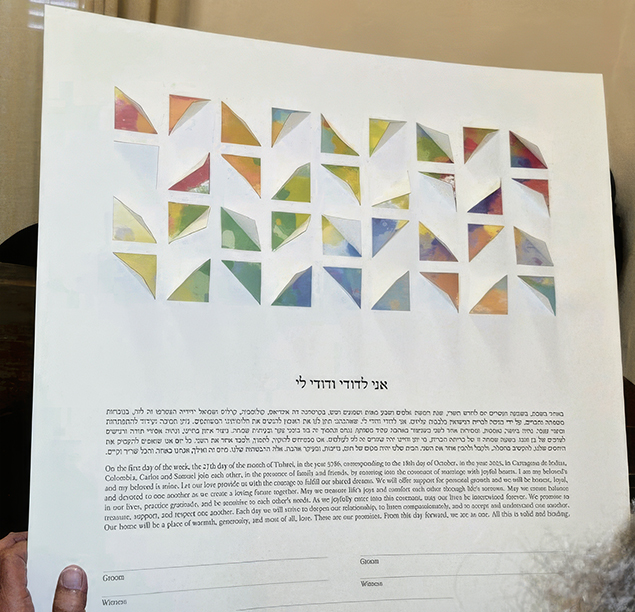
The night of the wedding, while the guests came in and took their seats downstairs in the chapel, the couple, their families, their witnesses, and I were upstairs, where we read and signed the ketubah. The roof of the chupah was Sam’s tallit. It made me smile.
Sam walked down, flanked by his mother’s siblings, and then so did Carlos, walking in between his parents.
Carlos’s mom and dad sat in the first row on the right side of the chupah, but the two chairs on the first row on the left had an iraca (a hand fan of intricately woven palm leaves, to cool you off in the heat), a boutonnière, and placards. One was for Jamie Kreiman, and the other was for Ike Gavzy.
I looked at the chairs as I began chanting Bruchim Ha’Baeem, and had to stop. I was thinking of Sam’s parents, and because I cry at the opening of a CVS, you can only imagine the emotional roller coaster I was on. I started again — Bruchim ha’ba’eem b’shem Adonai — using the melody from the song made famous by the Four Seasons: “Can’t Take My Eyes Off You,” and I continued — Bienaventurados los que vienen en nombre de Dios.
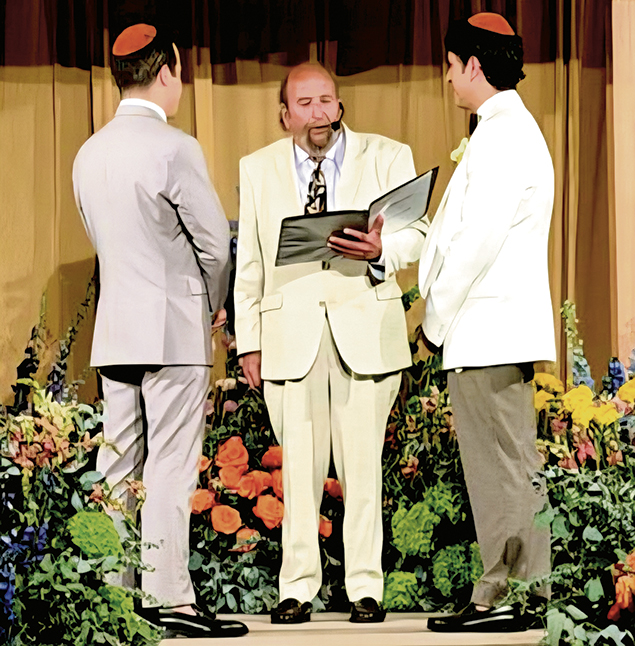
I explained the chuppa (jupa in Spanish) both from the Biblical perspective and in own modern way, as living without walls, we chanted the blessing over wine — borey pri hagafen in Hebrew, Creador del fruto de la vida in Spanish — and exchanged rings in the traditional Hebrew way, saying that, too, in Spanish as well.
They asked to be wrapped in a tallit in the Sephardic tradition (I used my dad’s), and I explained the seven blessings (las siete benediciones), and then recited them in Hebrew, with the seventh in all three languages.
They read their own vows, I chanted Birkat Kohanim, again in all three languages, and then explained why a glass is broken at the end of a traditional Jewish wedding ceremony — romper una copa al final de una boda judía).
This wedding, I continued, brought people from different religious and cultural backgrounds together, and that we hope that breaking the glass will help break down the barriers between people and help create a world based on love, unity, peace, and understanding (Esperemos que con la ruptura de la copa, veamos cómo se rompen las barreras entre las personas y contribuyamos a crear un mundo basado en el amor, la unidad, la paz y la comprensión.)
Each groom had a glass under his feet, and while still wrapped in my dad’s tallit, they did what I refer to as the double stomp. Each broke his glass, and then they kissed and walked back down the aisle.
Weddings in Cartagena don’t stop there. The couple and all the guests walked out of the venue into the street and were greeted by what is called la caminata — the parade.
There’s live music from tamboreros — men with drums and mulatas and female dancers all dressed in white. The street feels like it’s pulsating as everybody dances and sings.
Carlos was right; we all danced the salsa, the merengue, and a couple of others all around the block. Even strangers who just happened to be in the neighborhood joined in the dance, and we moved nonstop until reaching the venue for the dinner.
Of course, there were speeches and more cocktails. Carlos, who thought he would be a professional dancer before he went to medical school, danced the salsa and merengue with his mom, and Sam danced with his mom’s sister Jennifer. There were more tapas, dinner, and even dessert before the real dancing began, and when the dancing stopped, four-plus hours later, the party was over. (My wife, Shelly, and I were long gone by then.)
It was an incredible week, filled with beauty, history, and connecting with new people. There was so much love, and so much joy it mitigated a bit of the sadness.
When I officiate at weddings, I ask the couple if they want to mention the people who are there only in spirit during the ceremony. The great majority of them say yes; Sam and Carlos were no different.
I mention the names that the couple give me and I end by saying (at this wedding in both English and Spanish): “I want you to know, unequivocally, that even though they’re not here physically, they have the best seats in the house. They’re right in your hearts.”
Jamie and Ike were with us that whole week, but as we stood under the chupah, I know that they were standing right there with us too.
Cantor/Rabbi Lenny Mandel, who left the wilds of Manhattan almost 50 years ago and lives in West Orange, has been the hazan at Congregation B’nai Israel in Emerson for the past quarter century.