

The power to create light
Rabbi Sharon Kleinbaum of CBST describes what she’s learned from the AIDS epidemic till now
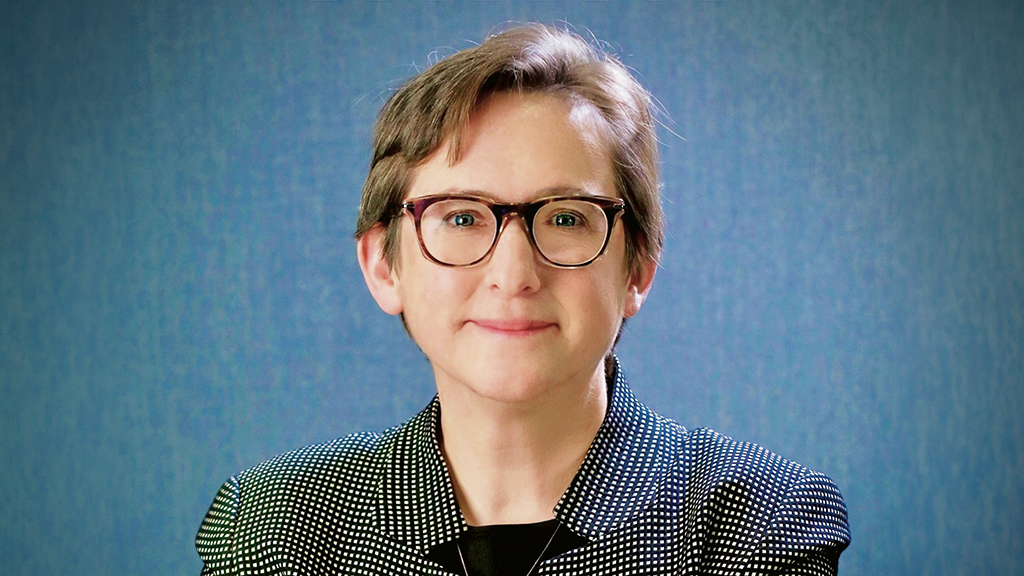
When Sharon Kleinbaum became the rabbi of Congregation Beit Simchat Torah in 1992, she was 33 years old, the struggling shul’s first official spiritual leader, and CBST was dealing with unending tragedy.
The shul’s community was mainly made up of gay men and lesbians, and AIDS was rampaging through it. There was no cure for AIDS then — there still isn’t, but therapeutics have made it not a death sentence but something someone can live with — so funerals were constant, and grief was ever-present.
Rabbi Kleinbaum retired from the thriving shul 32 years later, with wisdom gained from that terrible time. She has learned how necessary joy is, and how grief and joy can intertwine, resulting not in some bland recusal from reality but instead depth and intensity in engaging with the world.
She also has learned the necessity of paying attention to the world and advocating for what is right.
She’ll talk about all those things, and about her new book, “With All My Heart,” a collection of her sermons, at Beth Sholom in Teaneck on June 9. (See below.)
Sharon Kleinbaum grew up in Rutherford; her family belonged to Congregation Beth El. That’s the synagogue that was destroyed by fire last August. The fire was the result of old, faulty wiring, and no one was hurt, but the story evoked many fond memories from many people who had grown up as part of that community.
Rabbi Kleinbaum was among them. The shul was Conservative then, and her family was deeply involved. Her father was the executive director of the Jewish Welfare Council of Bergen County, which now, after some intermediate incarnations, is the Jewish Family and Children’s Service of Northern New Jersey.
She was the youngest of four children and lived in a town “where the school system really was falling apart. We were a deeply committed Jewish family,” so in 10th grade, she left public school for the Frisch School in Paramus. “I was there in its very early years,” she said. “There were 18 kids in my graduating class.” She became frum, spent most Shabbatot in Teaneck, staying at her friends’ houses and going to B’nai Yeshurun, then the only Orthodox shul in town.
By the time she graduated from high school, in 1977, she was no longer Orthodox. She went to Barnard College as a “deeply committed Jew.” She took courses in Jewish history at both Columbia and Barnard — her teachers included Paula Hyman — and she studied Yiddish as her foreign language. “My grandparents never spoke any English, and my father grew up on the Lower East Side, and spoke only Yiddish until he went to kindergarten. And here I was, getting college credit from Columbia for it.”
She majored in political science, and studied Gandhi in depth, “with a professor with whom I’m still close, all these years later.”
Soon after she graduated from college, Rabbi Kleinbaum was hitchhiking in Massachusetts — it was 1982, the world was different then — when a man in a van picked her up. “I am sitting in the back of the van, next to boxes of books,” she said.
“They were Yiddish books. They were the collected works of Mendele Mokher-Sefarim. So I said to the driver, ‘What are you doing with the collected works of Mendele Mokher-Sefarim?’ And he slammed on the brakes, and he said, ‘What are you doing as a hitchhiker?’”
That driver was Aaron Lansky, the recently retired founder of the then absolutely brand new Yiddish Book Center in Amherst. “That’s how my friendship with Aaron began,” Rabbi Kleinbaum said.
Mr. Lansky convinced her to move to Amherst to work at the center; eventually she became its assistant director. She stayed there for about three years. And then, in 1985, she applied to rabbinical school.
Her choices were limited. The Jewish Theological Seminary did not accept women (or gay men) then, and Hebrew Union College did not accept openly lesbian or gay students. “So I went to the Reconstructionist Rabbinical College, spent a year in Jerusalem, graduated in 1990 — and when I graduated, I was the last person in my class to get a job,” she said. There were 10 newly ordained rabbis in her class. But she did get a job — at the Religious Action Center of Reform Judaism — the RAC. “I was their director of congregational relations, organizing all their synagogue and social justice work.
“I was there for two years, and then the position at CBST opened up, and I decided to apply for it.”
That decision was a surprise, even to her. She hadn’t thought of being a congregational rabbi for most of her life, in large part because as she grew up, such a position would not have been possible. Women were not rabbis, much less congregational rabbis.
But — she had led a congregation during rabbinical school. “I led the High Holiday services at the gay synagogue in Atlanta one year, and I just loved it.” She got there accidentally, in a classic star-getting-sick-understudy-going-on-and-leaving-the-stage-a-star way; another student was supposed to take that job but got sick. But there was a difference. “I was the understudy for a job I didn’t know I wanted.” She continued to go down to Atlanta every few weeks for the rest of her time at RRC. “They didn’t have a rabbi, and it was in the midst of AIDS, so I did a lot of pastoral counseling,” she said.
When she got to CBST in 1992, AIDS was ravaging the community. The therapeutics that tame it weren’t available until 1997. “Within a year, 40 percent of my synagogue died of AIDS,” Rabbi Kleinbaum said. Someone would die, and then his caretaker would get sick and die, and then the caretaker’s caretaker would sicken and die. It was endless, and for 16 long years there was no hope.
The CBST community had been lay-led, and had rabbis as members. It hadn’t needed a rabbi — in fact, it had no paid staff at all, unless you count the one person whose extremely part-time job was collecting and distributing the mail — until the need for someone who could provide full-time pastoral care became unmistakable. “They needed someone who was thinking about them and taking care of them every day,” Rabbi Kleinbaum said.
“I was 33, and I was burying my own generation. Every funeral was for a young man my age. It wasn’t like burying parents. That’s sad, but not tragic. This was tragic.
“In some cases, families would not acknowledge that their son was gay, or died of AIDS. They would have funerals, and then we would have a second funeral, with no body, so that people could be honest, and talk about who that person really was.”
Something that Rabbi Kleinbaum and the CBST community learned was that although they were dealing with tragedy, they could not be completely crushed by it.
That was particularly evident at Friday night services.
“Every Friday night there would have been new people hospitalized and who had died that week,” she said. “That very week, every week, every single week.” So CBST’s custom was to say the name of the person who had died that week, and to read S.Y. Agnon’s Kaddish — a poem of grief and hope — in his memory, to honor him.
“But also on Friday night there was a clear dedication to maintaining joy and prayer. The gay community was very good at this — going to funerals and memorial services during the day, but to singing and dancing as well.
“Joy itself is an act of spiritual and physical and political resistance. Experiencing joy in these moments is actually a deeply significant and important act.
“Sometimes people need to remember that in order to feel permission to feel joy.”
It’s something Jews, like other oppressed peoples, are good at. Jewish humor, which is inherently subversive, springs from that need as well, she said. “All humor in an authoritarian state is subversive. It’s not letting them dictate when you can laugh.”
So CBST grew. “I started a lot of programming in those early years,” Rabbi Kleinbaum said. “CBST had a lot of people, but it was embryonic in its development. It was my job to create an institution, with an infrastructure and programming that would create community.
“When I got to CBST, the annual budget was about $40,000. We had a very inadequate space. We have raised over $24 million, and we have our own space on 30th Street.”
Now Rabbi Kleinbaum is CBST’s rabbi emeritus and still very much part of the community.
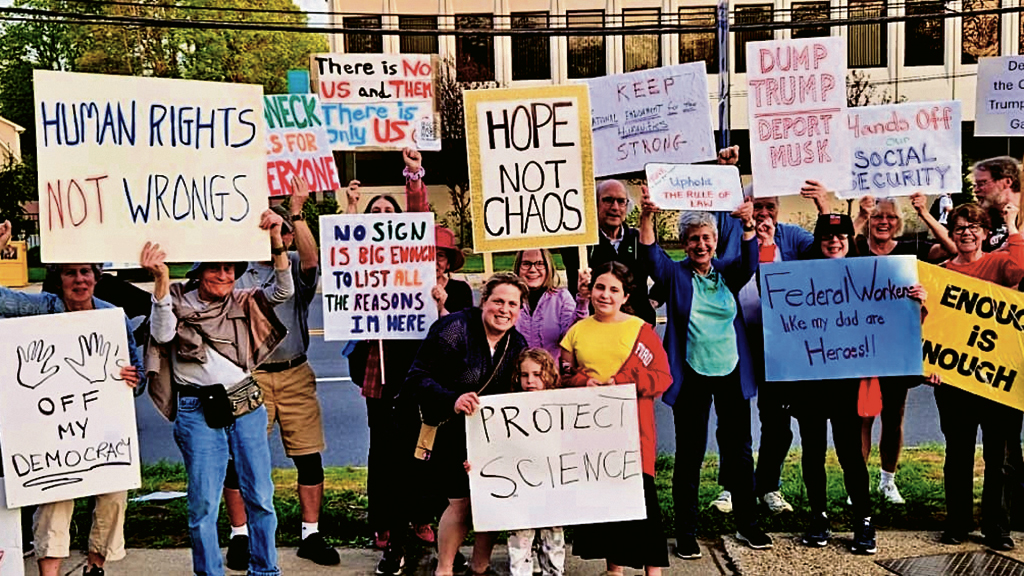
She’s also started a group called Beacon for Democracy, inspired by a similar movement in Israel. “How do you spread light when darkness feels like it is encroaching everywhere?” she said. “The idea is to remember that you always have the power to spread light, to create beauty, to be of help.
“So we came up with the idea of getting people in their neighborhoods to go out for 30 minutes a week. We picked Thursdays, for people to just go out and hold up signs about what you believe the world should look like, and what your values are.” That program is called Shine the Light.
“It’s been a little over a year, and there are groups doing it all over,” she said. “It can be two people, it can be 20 people. You don’t wait until you have a million people. You start with what you have and who you are.” There’s a group that meets every Thursday in Teaneck.
“You can’t just stay at home and scream at the TV.”
Not only do you show your values, you also form a community with the other people who also are holding signs. “A lot of people go out for pizza afterward,” Rabbi Kleinbaum said. “And somebody said to me two weeks ago that this is the only time all week when she laughs.” That’s because earnestness and joy can work together.
Beacon for Democracy’s website, logically enough, is beaconfordemocracy.org. Rabbi Kleinbaum’s website is rabbikleinbaum.com.
Who: Rabbi Sharon Kleinbaum
What: Will talk about “Thriving in Difficult Times: Lessons From the LGBTQ+ Community
When: On Tuesday, June 9, at 7:30 p.m.
Where: At Congregation Beth Sholom in Teaneck
How much: It’s free
To register: Go to www.cbsteaneck.org and follow the link.