

Aging at center stage
June Squibb talks about her very long theatrical career
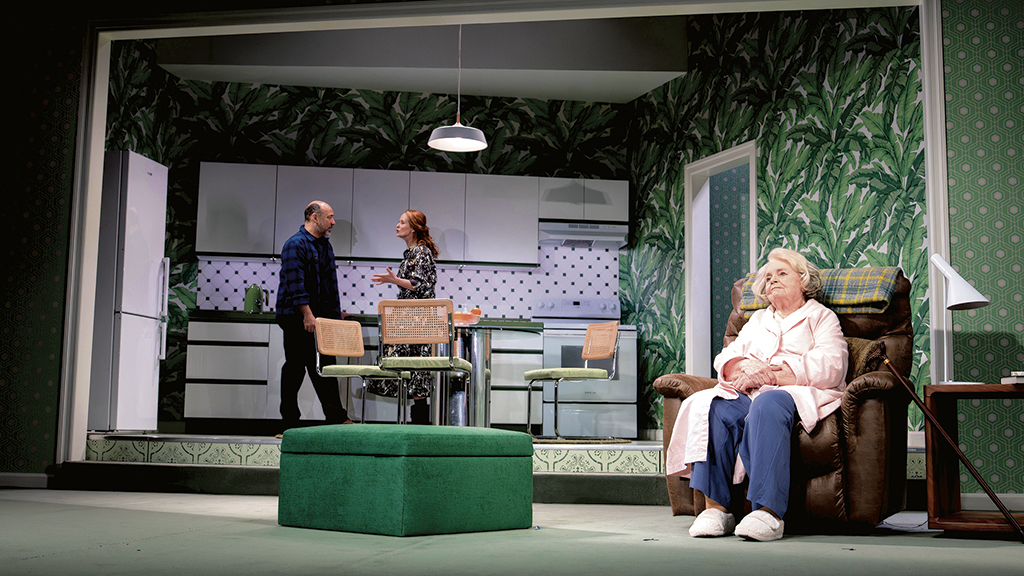
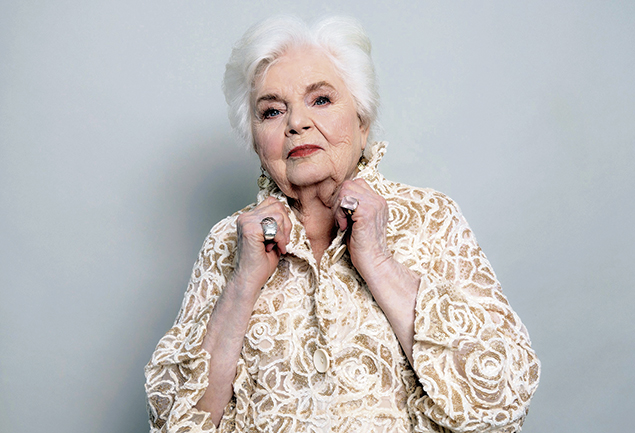
June Squibb, the 96-year-old star of the new Broadway play “Marjorie Prime,” remembers when she saw an earlier production.
“It was first done at the Mark Taper theater in Los Angeles,” she said in a Zoom interview from her temporary, run-of-the-play apartment in Manhattan. “I think somewhere between 11 and 13 years ago.
“I liked it. But I wasn’t knocked out by it. So when they asked me if I was interested in doing it, I immediately said, ‘Send me a script,’ which is my answer to everything. I read the script and I thought, ‘my God, this is brilliant.’
“I just thought it was so wonderful, so beautifully written. I was really entranced by it.
“I have no idea what changed,” she added, but that may be because over the last decade, the show, which is rooted in science fiction, has become more science and less fiction.
It opens with Marjorie (Ms. Squibb) sitting in an easy chair talking to a young man. We soon realize that the man, Walter (Christopher Lowell) is an AI-generated replica — a Prime — of Marjorie’s late husband, looking as he had looked when he was about 30.
These Primes — Walter isn’t the only Prime we meet — provide emotional support and an opportunity to get answers to unasked questions and resolve unsettled issues.
I asked if experiencing loss impacted the way the actors responded to the script. “Yes, it did,” she said. “In fact, the director, Annie Kauffman, asked me questions about how at my age I felt about certain things, and loss was one of them.”
In real life, one of her co-stars, Danny Burstein — he plays her son-in-law, Jon, married to Cynthia Nixon’s Tess — lost his wife to ALS a few years ago. “He talked about that,” Ms. Squibb said. “The four of us were very open in rehearsal, talking about our own experiences in relation to the play.”
And yes, she would like a Prime of her own — sort of. “Yeah, I think it would be kind of fascinating,” she said. “I would like to talk to my husband a few times — but I don’t know that I would want one in the house.”
Ms. Squibb, a Jew by choice, grew up in Vandalia, Illinois, with large-scale show-business ambitions from the get-go. “There was nothing else on my mind,” she said. “From the time I came out of the womb, I knew I was an actress. And it was never I’m going to be. It’s always I am. I have no idea where that came from.”
After a brief stint at a local college, she moved to Cleveland and landed an apprentice job at the Cleveland Playhouse. She later moved up to a staff job there, and stayed for five pivotal years. It was in Cleveland where she met her first husband, Edward Sostek.
And that’s where she converted to Judaism.
Her conversion had nothing to do with her new Jewish husband or his family, she said. “It was my decision,” she told me. “Neither he nor his family demanded that I do it. Or even talked about my doing it. I just felt I wanted to.
“There was a temple very near our theater and a young rabbi. (She doesn’t remember the names of either the rabbi or the synagogue.) I saw him for a few hours a day Monday through Friday for a few months. It was a wonderful experience for me.
“The rabbi and I got very close. We would talk about everything under the sun, and he would say, ‘You know, we got to get back to Jewish. That’s why we’re here.’ We used to laugh and say that I knew more about Judaism than my husband.”
She can’t put her finger on what made her decide to convert. “I have no idea,” Ms. Squibb said. “I don’t question myself when I make a decision. I just sort of go ahead.”
She and her husband celebrated holidays with her husband’s family, even after the couple moved to New York “We always went back to his family,” she said.
While she’s not observant, she says she very much feels Jewish. It became very personal. “The other day, a very close friend asked how I felt about everything that was happening in the war in Gaza. ‘Do you feel that it’s personal?’ I said, ‘Of course I do. I feel it’s part of me.’”
In fact, after a divorce from Mr. Sostek, she married Charles Kakatsakis, who was not Jewish but accepted her Jewishness and “was cool with it.”
In the late 1950s, Ms. Squibb moved to New York and immediately became the envy of the thousands of aspiring actors who come to the Big Apple waiting — on tables and for their big break.
Ms. Squibb almost immediately landed roles, first off-Broadway and then as a replacement in “Gypsy,” which was already a big success. “I played it for eight months on Broadway and then did the road tour with Ethel [Merman] for eight months,” she said. “Oh, I worked constantly.”
Interestingly, most of the recent stories written about her make it seem as if she’s a Juney-come-lately who exploded on the scene out of nowhere. In fact, she’s had a solid career that is likely the envy of many actors. Not only in theater, but in film and TV, working with the likes of Martin Scorsese, Brad Pitt, Jack Nicholson, and Al Pacino.
But yes, her recognition factor took a giant leap after she co-starred as Kate Grant, the foul-mouthed and beleaguered wife of Woody Grant (Bruce Dern) in “Nebraska.” The role earned her an Oscar nod for best supporting actress.
She followed that most notably with the title role in “Thelma,” about a Jewish grandmother who falls victim to a phone scam and sets out to retrieve her money. Earlier this year she had another title role, “Eleanor the Great,” in Scarlett Johansson’s directing debut.
In “Eleanor,” Ms. Squibb plays Eleanor Morgenstern, a woman mourning the loss of her best friend, Bessie. She moves to Florida to be closer to her daughter, who encourages her to make friends. At a local JCC, she accidentally gets involved with a group of Holocaust survivors and winds up adapting Bessie’s survival story as her own. The film deals with the ramifications of that action.
“The script was sent to me about three or four years before we actually shot it. They wanted me to do Eleanor. I read the script, loved it and said I would do it.”
At some point, however, the director dropped out, and the deal fell apart. The producers said “they still wanted me to do it, but they were directorless. When they heard Scarlett was interested, they asked me to write a note to her, which they were going to present with the script. They wanted her to know I was connected to the film. Luckily, she wanted to do it and she wanted me to do it.”
Ms. Squibb believes that being Jewish was part of the reason she was cast. “I know with the first director it did, and I‘m sure it did with Scarlett, too,” she said. “I think my understanding of Jewishness is something they wanted in the film.”
And there is no end in sight. She’s signed to do three films after “Majorie” closes in February. In none of them does she play a Marvel hero. In fact, she says when thinking about a part she’s concerned “about what will be asked of me physically. At my age, there are certain things I can’t do anymore.
“So when I read the ‘Marjorie Prime’ script, I saw that I’m sitting practically the whole time. When I walk, I use a cane, but I do walk. So what you saw on the stage was my reality. That’s how I move.”
The cast is very solicitous of her, in one case overly solicitous. “It was funny with ‘Marjorie Prime,’” she said. “The director asked me if I wanted one of those ear things. I said, ‘ear things’? I didn’t even know what she was talking about. You know, a device that feeds you your line.
“I said, ‘Oh God no. That would drive me nuts.’ I told her I still know how to memorize. They were very surprised by that.”
Finally, I ask her how she looks at her career. “I’m thrilled that I’m still able to work,” Ms. Squibb said. “I’m thrilled that people want me to work with them. And at this point in my life and all the work I’ve done, I think I can honesty call myself an artist.”
comments