

And again, this time in Sydney
Looking beyond Bondi Beach
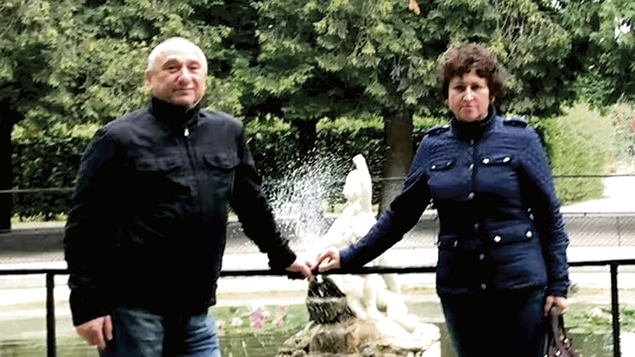
Rachel Simons owns a highly specific store, Seed + Mill, in Chelsea Markets in downtown Manhattan. The store sells only sesame and products made from sesame. In October, she talked about her store and her new cookbook, “Sesame: Global Recipes & Stories of an Ancient Seed,” at the Kaplen JCC on the Palisades in Tenafly.
Earlier this month; she and her husband, Chris Green, went back to their native Australia; she was packing up her late mother’s house — the house where she had grown up — and plans both to sell the house and to write a book based on some of the archival material her parents had kept there. Their children are planning to meet them in Sydney when school — the Abraham Joshua Heschel School — breaks for the winter.
This is perhaps a long explanation for why Rachel and Chris were on Bondi Beach on the long, late summer afternoon of December 14, leaving for their hotel apartment just a few blocks away at about 6.
“I had been packing boxes, 50 years of memories, and it was just so sad,” she said. “I was covered in dust from the boxes. My mother’s house was about five minutes from Bondi Beach, and I had said to my husband, ‘I really need to swim in the ocean. I really need to get the dust off my body and get the dust out of my soul.
Bondi Beach has always been a place of catharsis and purification for lots of people. It always was for her. “‘I grew up swimming at Bondi Beach. So we went down to the beach and had a swim, and we went and sat on the sand. It was about 5:30.
“And I said to Chris, ‘Gosh, Sydney and Bondi Beach don’t feel the same anymore. It doesn’t feel the same.’ I had gone there every day to swim. We had birthday parties there. It was my beach.
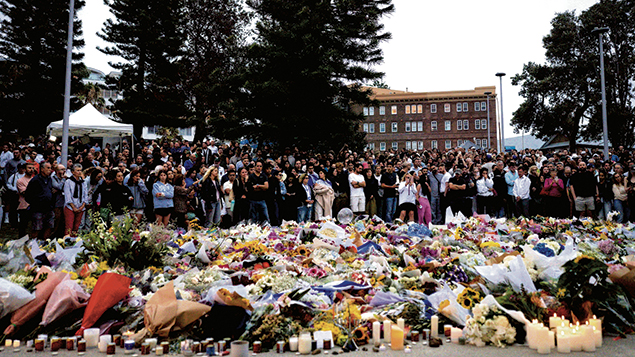
(Audrey Richardson/Getty Images)
“And Chris said to me, ‘Don’t you think that things have settled down?’”
(We will get back to this part of the story, but the horrifying and necessary background to it is that antisemitism has swelled to terrifying levels in Australia since October 8, 2023, the day after Hamas terrorists invaded Israel from Gaza, slaughtered more than 1,200 people, and held about 250 others hostage, some for years, and murdered others of them. Despite Hamas’s butchery, public sentiment turned against Israel almost immediately.)
“And I said yes, the algorithms don’t feel quite as angry,” Ms. Simons said. Social media had been serving them less raw rage. “We aren’t being fed as much hostility. It doesn’t feel quite as angry.
“And then we got up from the beach at about 6 and walked back to our hotel.
“We were staying in a place now called the Adina Apartment Hotel on Hall Street. It’s been called that for about 15 years, but before that it was called the Hakoah Club, and it was an important Jewish center.”
In 1982, bombs went off outside the Israeli consulate in Sydney and about five hours later another bomb went off outside the Hakoah Club. There were no serious injuries — the bombers apparently weren’t very good at what they did — but there were many people inside the club and competent bombmakers could have killed many of them.
“Everybody had their bar and bat mitzvahs at Hakoah Club,” Ms. Simons said.
But that was then. Now, she and her husband were walking back to their apartment in the hotel. “I was meant to be at a friend’s house that evening,” she said. “A friend was picking me up at around 7.” So she waited for her friend; “I came out at about 7:05, and there was this strange eeriness,” she said. “So I said to Chris, ‘Honey, something is going on.’ Because suddenly there were police driving up the street, speeding their way down the street, and there were hordes of people running up Hall Street.
“And then the hotel staff came out and said, ‘Everybody get inside! There’s an active shooter! Get inside!’
“So we ran back off the street into the hotel lobby.
“The shooting began at around 6:50 and this was now about five minutes after 7, and at that point there was no information other than everybody was in a panic. So I spent a few minutes googling, trying to find information. I rang my friend who lives not far from where I was, the friend I was meant to be having dinner with, and I walked to my friend’s house — she lives in Bondi — and I sat with my school friends, who were meant to be hosting me for a sort of welcome-back-to-Sydney dinner.
“So we sat together. There were about 12 of us, childhood friends, just sitting there in Bondi Beach and listening to hours and hours of helicopters, police cars, ambulances, some driving backward. Just sitting there trying to grapple with what had just happened.
“So two hours earlier I told my husband that it didn’t feel the same, and now we know that it’s not ever going to be the same.
“Not ever.”
But, Ms. Simons urged, please do not feel sorry for her. Remember the victims who were killed, the victims who were maimed, the victims whose parents’ or partners’ or children’s or friends’ death permanently changed and impoverished their lives.
She said that last week she went to a local synagogue to give it some of her mother’s many siddurim. “I delivered a box of siddurim to one of the men who was in the synagogue,” she said. “I asked him if I could leave them with him, and we had a brief conversation. And I think he was killed. When I saw his face on the news, I think it was him.”
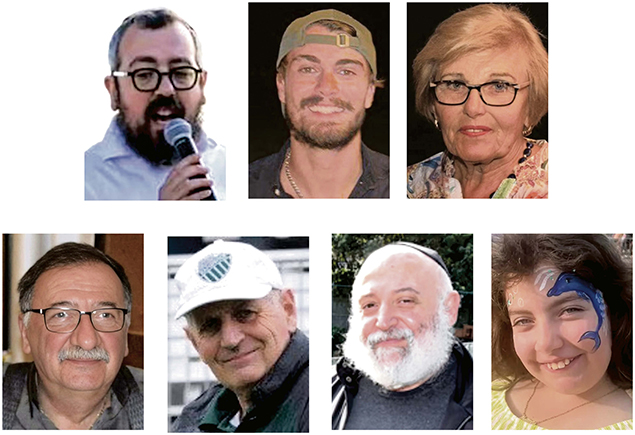
As most readers probably know by now, the attack on Bondi Beach (pronounced Bond-eye; until this massacre, only the world travelers among us would have known that), was committed by a father-and-son team (the father’s now dead and the son is hanging on in critical condition) who had some connection to the Islamic State and apparently got some training from that murderous group in the Philippines. The attack, on the first night of Chanukah, killed 15 people, who range from a 10-year-old girl to an 87-year-old Holocaust survivor, and injured around 40 others.
Until October 8, 2023, Australia had been a haven for Jews. And it also was a place where strict gun laws kept deaths from firearms, and the kind of wholesale, random slaughter at which the Bondi gunmen excelled, from happening more than very occasionally.
Australia had slightly fewer than 117,000 people identifying as Jews in 2023, out of a population of about 28 million, “but it is a community that really punches above its weight,” Shelly Freeman said. Ms. Freeman, a lawyer and entrepreneur from Melbourne, now lives on Manhattan’s Upper West Side; she’s YIVO’s chief of staff, a job the organization created for her.
The first Jews in Australia came as part of the shipments of convicts that England sent Down Under, on what was called the First Fleet, in 1788; there are believed to have been at least eight of them. By 1845, one of them, Judah Solomon, had not only worked through his sentence and earned release, but became successful enough to build the first synagogue in Australia. The Hobart Synagogue, in Tasmania, still operates today.
Some Jews, particularly Sephardi and Mizrachi Jews, trickled into Australia throughout the 19th and early 20th centuries, but many more went there as World War II drew closer, and the need to escape the Nazis became ever more clear. It was hard to get further away from Central and Eastern Europe than Australia, so many went there. “And then you had mass migration, as Eastern European Jews came in after the war,” Ms. Freeman said. “Traditionally, more Polish Jews went to Melbourne, and more Hungarian Jews went to Sydney. Later, many Russian and South African Jews came in the 1970s and ’80s, and went to both Melbourne and Sydney, and a lot of South African Jews also settled in Perth.”
She told her own family’s story. Ms. Freeman’s paternal grandmother, Elka Ruchel Victor, was born in Poland. She and her brother were orphaned young. They had a distant relative in Australia but were otherwise alone, so they made their way there, before the war. “The tragedy of losing her parents saved my grandmother’s life,” Ms. Freeman said. “In Australia, she held on to her Yiddishkeit so so strongly.” She insisted that her Filipino neighbors spoke Yiddish but pretended not to, Ms. Freeman said, and once, when she saw “footage of the queen of England around Rosh Hashanah, she said that the queen is coming to Australia for Rosh Hashanah.” Why did she think that? “Because of her deep belief that no one could be a queen if she were not Jewish.
“She had a tough life, and Yiddish songs were a balm to her soul,” her granddaughter said, her tone loving and her accent heavily Australian.
“She married my father’s father, Sam Freeman, who was one of seven siblings; his brother Michael came to Australia before the war and set up drapery stores in rural Victoria.” The last name had been Frajman until it was anglicized; the story could have been American if the place names were changed.
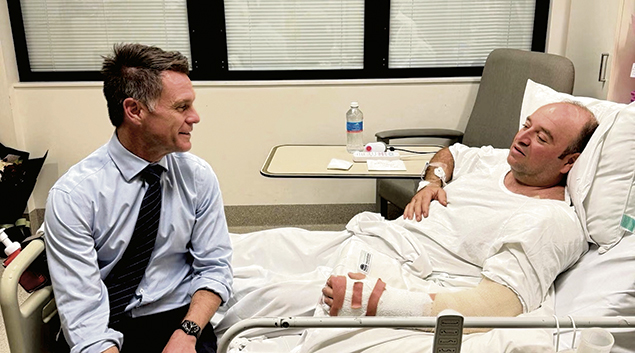
New South Wales Premier Chris Minns visits hero Ahmed al-Ahmed at a hospital in Sydney. (NSW premier Chris Minns Account / Handout/Anadolu via Getty Images)“We don’t know why he thought of drapery stores,” Ms. Freeman said. “But we know that his first wife was Jewish, he spoke eight languages, and he served in the Australian army. He slowly brought out all his brothers and sisters and put them to work in the stores.
“Then he divorced his first wife and married a non-Jewish German woman and had four kids with her. They lived in the rural town of Beechworth, and although his wife wasn’t Jewish, my cousins said that they faced real antisemitism there.
“My grandfather died tragically when my father was 6 years old, my uncle was 5, and my auntie was 3. My grandmother had a nervous breakdown. She didn’t speak the language and had three kids under 7.” So the kids were put in a Jewish orphanage; their mother remained involved in their lives but did not live with them.
(This is reminiscent of the Daughters of Miriam in Clifton; it is now a nursing home, primarily for the elderly, but began as an orphanage. Parents who lacked the money or emotional resources to bring up their children often placed them there.)
“My father said he got a very good upbringing there,” Ms. Freeman said. And she grew up knowing her grandmother, who lived until she was 89.
Her maternal grandparents, Guta and Edek Melman, who were married in Poland, fled to Russia, where they were put in a labor camp. After the war they went to Uzbekistan; Ms. Freeman’s mother was born in Samarkand. Next, they went to Warsaw, where Ms. Freeman’s aunt was born, and then to Israel — like many would-be olim during that period, they could not make it there — and then on to Australia. “My grandfather was a watchmaker and repaired watches,” Ms. Freeman said. “They bought an apartment in Queensland — in Surfers Paradise, which is the Miami of Australia — and all their friends would go to each others’ houses.”
(This sounds like stories of Holocaust refugees not in Queensland but in Queens, going up to the Catskills in the summertime.)
“Growing up, I had the view that every Jew was affected by the Holocaust,” Ms. Freeman said. “I didn’t have any friends with grandparents born in Australia. I didn’t know anyone who wasn’t directly affected by the Holocaust until the South Africans started to immigrate to South Africa.
“I went to a Chabad school first, not because my parents” — Sylvia and Maurie — “were religious. They were just traditional, but they wanted my brother and me to have Jewish educations.” That school, for girls, was Beth Rivka; her high school, which was not Chabad, was called Mount Scopus, and is “the largest Jewish day school in the Southern Hemisphere,” she said.
“When I was about 12, my parents became partners in the largest Jewish bakery in Australia, Glick’s bagels. Mr. Glick, who started it in the ’70s, came out of the camps. He was a survivor. And he knew how to make boiled bagels.
“I worked in the shop and I went to Jewish schools and the B’nai Akiva youth movement. My whole life was Jewish. I went to Monash University, which was named after Sir John Monash, a very famous Jewish general, and all my friends at the university were my Mount Scopus friends. So I didn’t really have any proper non-Jewish friends untiI I started working.”
The Australian Jewish community was both proud of Israel and protective toward it, she said, and the community’s sense of identity was strong.
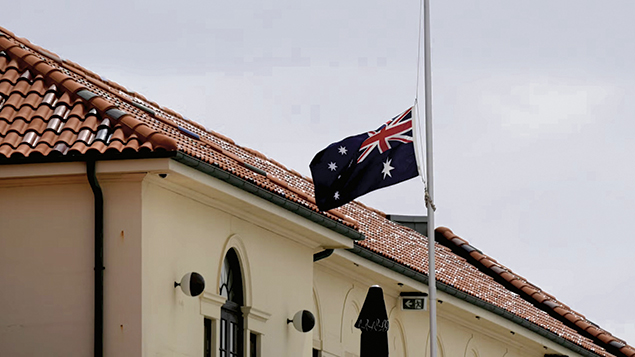
An Australian flag flies at half-staff at the scene of the shooting at Bondi Beach on Dec. 15. (Izhar Khan/Getty Images)She worked with Australian politicians, and it was a point of pride for her to show them some of the “incredible infrastructure and community the Jewish people had established.
“This was the goldene medina,” she said. The golden land. “We were proud to be Jewish. We punched way above our weight. We had so many doctors and lawyers who came out of the ashes of the Holocaust.”
Ms. Simons’ family story is similar, and we told it in this paper in October. It’s not exactly the same — no two families have identical stories — and hers has roots in Prague and a detour to Bulawayo. But like Ms. Freeman’s, it is planted in Australia, which welcomed all of them and promised them freedom from hate as well as freedom to flourish.
Either everything changed on October 8, 2023, or everything that had been hidden underground surfaced that day.
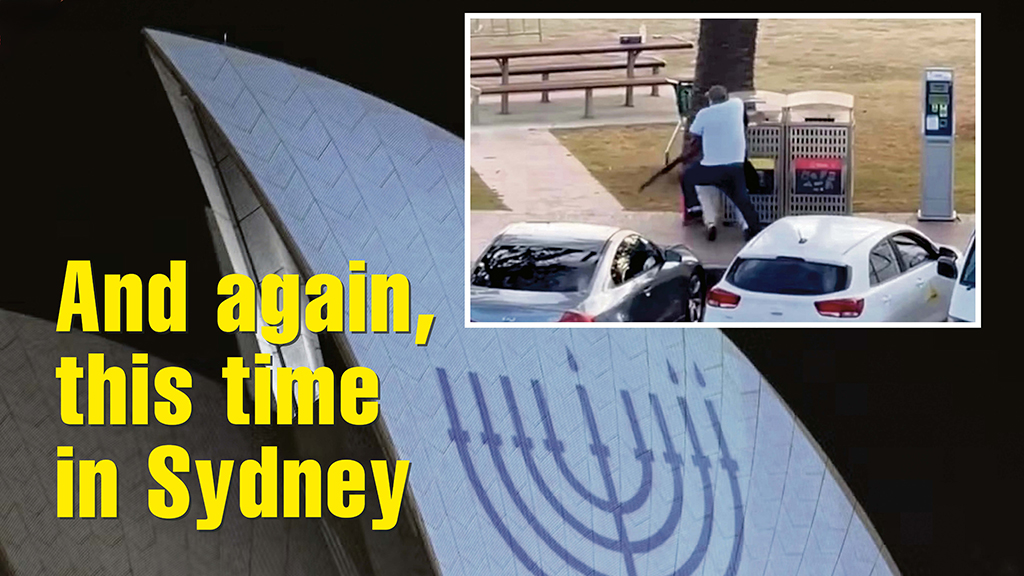
On October 8, 2023, the day after the Hamas attack, the Sydney Opera House — an iconic place — was lit in blue and white, in solidarity with Israel. That drew a demonstration from pro-Palestinian protestors, shouting such slogans as “Gas the Jews.” “The police told Jews not to come into the city that day, because they couldn’t guarantee their safety,” Ms. Freeman said.
The demonstrations have continued. “There are weekly protests,” she said. “They chant ‘Long live the Intifada’ and ‘Death to the IDF’ and they hold signs with pictures of the Ayatollah Khomeini and that say ‘We are all Palestinians.’
“In August of this year, there was a big march on the iconic Sydney Harbor Bridge — they say anywhere from 90,000 to 200,000 people, organized by a group called the Palestinian Action Group, which is banned in the U.K. for glorifying terrorism.
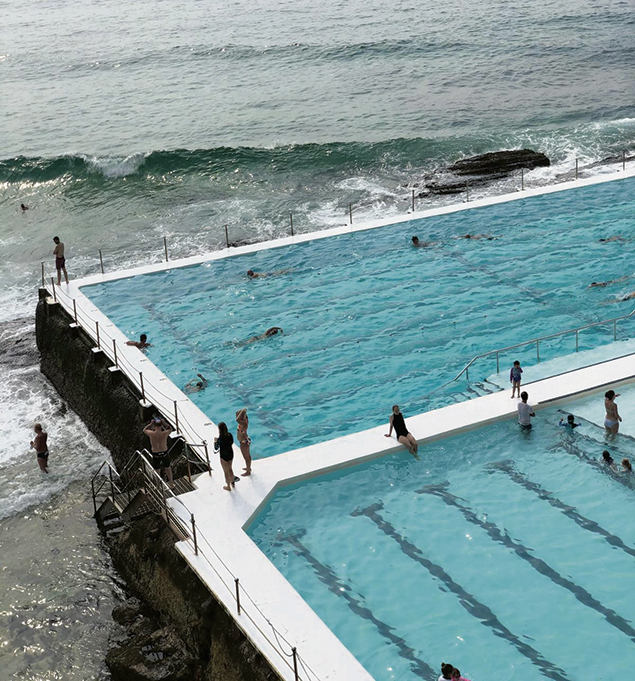
This pool, at Bondi Beach, is where she and most of her friends learned to swim, Rachel Simons said. (Rachel Simons)“They spread lies, and we have had attacks on synagogues and Israeli-owned business, and they target visibly Jewish individuals.”
So while the shooting at Bondi Beach was a huge shock, realistically speaking it was not entirely a surprise, she said. But it’s important to remember that unlike the United States, Australia has strict gun control laws, which were implemented after a mass shooting in 1996. Thirty-five people were killed in the Port Arthur Massacre, and the federal government took action immediately after that.
Mass shootings are usually defined as when at least five people are killed. There had been none — as in zero — in Australia since 1996. There have been more than 300 people killed in such incidents in the United States just this year, statistics show, and of course that does not count people killed one at a time. So when it comes to gun deaths in these two countries, it is pretty much apples and oranges.
But antisemitism is on the rise in both places.
And there also is real goodness.
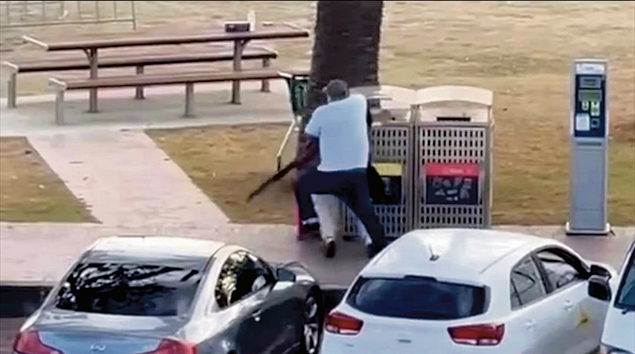
There is Ahmed al-Ahmed, the Muslim Arab man who saved the lives of an unknowable number of people by throwing himself on one of the gunmen. He’s a Syrian-born fruit merchant and he’s now recovering in the hospital from the serious injuries he would not have received had he not acted heroically.
On a smaller scale, “I was talking with a friend in a café in Bondi on Monday, processing what had happened, when an elderly man I didn’t know who was just sitting next to me leaned over and said, ‘Hello. I can tell you are talking about what happened at Bondi,’” Ms. Simons said. “‘I am not Jewish. I am a Greek immigrant, and I have lived here for 50 years.
“‘I want you to know that the people of Greece and the people of Australia who I know love you.
“‘The Israeli flag is blue and white and the Greek flat also is blue and white. Your flag is the same color as my flag. We love Israelis. We love Jewish people. We have a long history, the Greek people and the Jewish people, and we love you, and we are so sorry for your community.’
“And he gave me a hug.”
“One of my dear friends who is not Jewish sent a message to her entire street saying that she’d like them to light a Chanukah candle for our Jewish neighbors, and they did.”
Rabbi Menachem Creditor is the scholar in residence at UJA-Federation of New York. He’s also the brother of Tzeira Ostrovsky, whose husband, Arsen, a lawyer and activist, was shot on Bondi Beach. Perhaps ironically, Rabbi Creditor is one of the founders of a nonprofit coalition called Rabbis Against Gun Violence.
When we talked, on Monday night, his brother-in-law was in surgery; he was having shrapnel removed from the back of his head, Rabbi Creditor said.
Mr. Ostrovsky is from Sydney; he moved back with his family, including two daughters, one 8 and one just about to turn 6, just about three weeks ago. “He is surrounded by family and friends, and he is likely to recover,” Rabbi Creditor said.
He said that his brother-in-law “bore witness to October 7; he was in the south of Israel the day after. “He described the scene at Bondi to me as similar to what he saw at Nova — bloody and indiscriminate slaughter, a festival that was turned into violence by terrorists.”
His brother-in-law’s “ability to speak the way he does inspires his family,” he added.
And “it is deeply moving that Ahmed al Ahmed, a Muslim fruit vendor, a father, risked his life to save people he didn’t know.” People, moreover, he knew were Jewish. “That gives us hope that perhaps one day we will see more humanity in each others’ eyes and leave this terrible way of being behind us,” Rabbi Creditor added.
The nights after the murders, Jews gathered once again on the beach, and they lit candles. This is what Ms. Simons texted after Tuesday night: “I went back to light Chanukah candles again tonight. Amazing scenes of courage, resilience, and Jewish joy. It was very moving.
“This community is strong and will rebuild,” she concluded. “But will never forget.”