

‘Between Two Worlds’
West Caldwell library to host Yiddish Book Center program

“Ven mayses voltn nisht dertseylt gevorn oder bikher voltn nisht geshribn gevorn, volt der mentsh gelebt vi di khaye, nor farn tog.”
“If stories weren’t told or books weren’t written, man would live like the beasts, only for the day.”
— Isaac Bashevis Singer,
“Naftali the Storyteller and His Horse, Sus and Other Stories”
That declaration is arguably an ideal motto for a public library. That it was originally written in Yiddish makes it particularly ideal for the West Caldwell Public Library and its mission of cultivating cross-community connections while promoting a love of literature and a commitment to opening portals into diverse worlds.
That’s especially true of its latest offering.
For the three-plus years she has served as the library’s adult programming coordinator, Alexis Prussack-Martin of West Caldwell has been organizing activities designed to further those aims. In addition to hosting many book discussion groups covering a wide range of genres and themes, Ms. Prussack-Martin has presented programs focusing on a diversity of cultural landscapes, including the customs of Diwali, the Lenape Native American clan, Japanese origami, Scandinavian weaving, and a bagpipe and drum concert for St. Patrick’s Day.
All these activities were designed to fulfill the library’s principal aim — beyond of course the purveying of books and a rich trove of other media and materials — which is “to nurture and build community while fostering a love of reading and a spirit of discovery,” Ms. Prussack-Martin said. And it worked, she said; she’s seen participants “engaging in interesting conversations and deep explorations of cultures that flourish far beyond the Caldwells and forming lasting friendships with others they might not have met otherwise.”
Given that, Ms. Prussack-Martin realized there was one area that had not been broadly spotlighted: Jewish literature and culture.
The local synagogue, Congregation Agudath Israel in Caldwell, where Ms. Prussack-Martin and her family belong, has been “an intimate part of our community for over 100 years,” she said. The Caldwells — that’s Caldwell, North Caldwell, and West Caldwell — form a supportive and congenial community, she noted. West Caldwell in particular has a multi-generational demographic, with people returning to raise their families where they grew up. But she has seen a downside, Ms. Prussack-Martin said. “Small-town vibes and traditions create intimacy and security but can also foster seclusion and a lack of diverse experiences.”
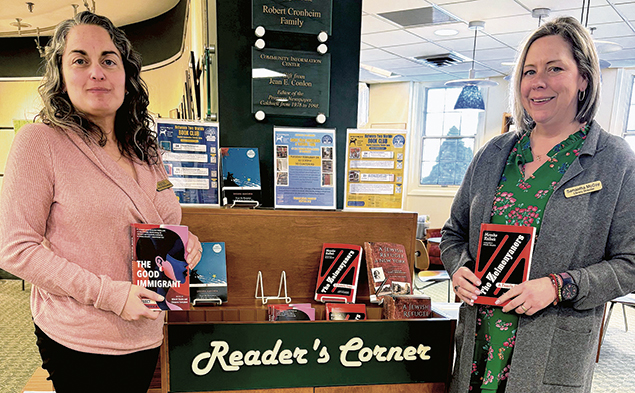
programming coordinator at the West Caldwell Public Library, and library director Samantha McCoy display the books for “Between Two Worlds.”
That awareness, and the knowledge that antisemitic incidents had taken place in the area, made Ms. Prussack-Martin excited to learn about a grant that the Yiddish Book Center and the American Library Association were offering that would further the goal of fostering tolerance and understanding.
The grant, funded by the Lilly Endowment Inc., was to enable libraries to stage “Between Two Worlds: Exploring Jewish Culture and Religion through Yiddish Literature.”
The YBC, in Amherst, Mass., was founded by Aaron Lansky in 1980. It preserves and celebrates Yiddish literature to advance a fuller understanding of Jewish history and identity. Its collection includes about one-and-a-half million Yiddish books, and it originates a wealth of literary, educational, and cultural initiatives.
Ms. Prussack-Martin applied for the grant, part of the YBC’s Public Libraries Program. The overarching goal was to make Yiddish literature accessible to all and to foster cross-cultural conversations about “religion, assimilation, identity, and immigration” — precisely in sync with her vision for the library.
She pointed out that she has little background in Yiddish — she’s half-Sephardi — which, arguably, added to her attraction to the program. So did her desire to be part of YBC’s mission to maintain the writings and traditions of what is often perceived to be a “disappearing language and culture.”
The YBC asked applicants about outreach to others in the community. Ms. Prussack-Martin turned to a trusted source: Agudath Israel. There, she talked to Susan Werk, its education director, and Felice Nichols, a teacher in its religious school.
Ms. Werk was immediately enthusiastic about a local institution hosting an exploration of Yiddish literature, which, she said, “uses layers of humor and emotion to explore lives and communities. It’s also powerful in its ability to open readers’ eyes to the very particular Jewish experience and transform it into an expansive and universally human one.” She was especially glad that the program was designed to convey “profound messages about immigration, adaptation, and creativity, in particular the power of story-telling that can be transmitted through Yiddish works of art.”
Ms. Nichols, a longtime member of the YBC, saw the program as highly worthwhile in many ways. Besides the obvious benefits for participants, she said, she anticipated that they will “gain an appreciation of the YBC and perhaps will become visitors, either digitally” — some 12,000 works are available for free from the center’s Steven Spielberg Digital Yiddish Library — “or in person, and take advantage of its vast resources and cultural treasures.”
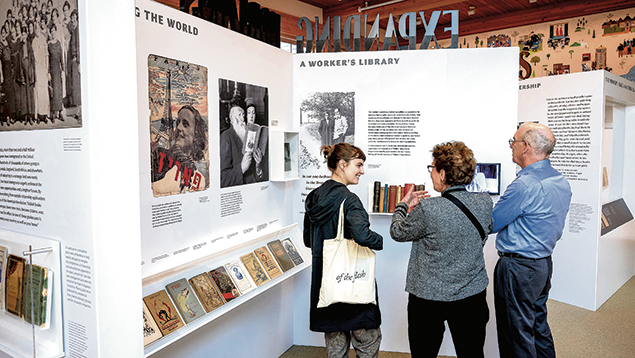
Both Ms. Werk and Ms. Nichols continue to offer advice and guidance as the program progresses.
The WCPL’s grant application was accepted, and it was chosen as one of the 38 libraries — large and small, rural and urban, from Texas to Wisconsin, California to New Jersey (including in Highland Park, New Providence, and Lakewood) — to receive the grant.
The WCPL’s director, Samantha McCoy, is championing the program. She said that it “will give the library numerous ways to spark conversations about culture, identity, and community through the power of literature.”
Ms. Prussack-Martinsaid that the grant would allow her to use the well-honed structure of the many groups and programs she runs. The chief requirement was to form a reading group to discuss three books of Yiddish literature in translation, selected and provided by the YBC. (See box.)
Librarians were directed to choose a fourth book that “feels right for the community”; Ms. Prussack-Martin picked “The Good Immigrant: 26 Writers Reflect on America.” A multi-voiced portrait of America reflecting the struggles of a range of newcomers, its contributors are insightful writers representing immigrants whose humanity and right to be in this country is under attack. It was a perfect complement to the other works under consideration, Ms. Prussack-Martin said. So many Yiddish texts “deal with the issues of change and the family that pretty much everybody — at some point in their family’s American journey — has experienced.”
As nonfiction, it also adds another layer of discussion to the other works, especially “A Jewish Refugee in New York,” a fictional memoir echoing the stories of change and survival found in the other two Yiddish works, “Tevye the Dairyman” and “The Zelmenyaners: A Family Saga.”
The YBC also provides grantees with reading guides and educational materials and access to online talks with authors, translators, and scholars as well as virtual field trips. In addition, the library will host a small exhibit on the history of Yiddish, and a $2,000 stipend will go toward special programming, included guest speakers and ancillary projects.
All this, YBC’s president Susan Bronson, who succeeded Mr. Lansky in 2025, said, is meant to further the objective: to “embrace Yiddish literature as a way to spark meaningful conversations across diverse communities…and deepen understanding of the Jewish people at this critical time.”
The Lilly Endowment is a natural supporter of the endeavor, as it works “to highlight the contributions of diverse faith communities to civic life,” its vice president for religion, Christopher L. Coble, said.
The librarian facilitators attended a three-day training at the YBC in November. Ms. Prussack-Martin said she was grateful for the opportunity to “meet with translators and experts on Yiddish language and culture, attend spoken word and musical performances, and learn about the importance of the language’s global reach.”
Given the grant’s goals, she was inspired by “Yiddish: A Global Culture,” the YBC’s permanent exhibition. It displays 150 years of modern Jewish creativity, telling the story of “the language as a reflection of international identity, creativity, migration, and belonging, particularly as it served to bridge the gaps for immigrants to new worlds.”
At workshops with ALA representatives, participants learned how to run effective and inclusive book discussion groups and handle the logistics of the project.
Ms. Prussack-Martin wants to engage a non-Jewish audience, and the WCPL has a well-tested means of outreach to the community, effective pathways to fulfilling the cross-cultural goals of the program. More events are in the works — Ms. Prussack-Martin mentioned the possibility of musical performances, films, local author talks, and collaborative efforts with area clergy and civic organizations, retirement communities, and schools.
She emphasized that this program is open to everyone — she said that 99 percent of the library’s activities are free to all. It’s in keeping with the library’s mission, which she is confident “Between Two Worlds” will advance: “the development of a strong and inclusive community, a welcoming, multicultural place reached through exploring universal human experiences.”
Between Two Worlds at the West Caldwell Public Library
The schedule (so far):
Tuesday, February 24, 3:30 p.m. — screening and virtual tour
The short documentary “A Bridge of Books” shows how Aaron Lansky, as a young graduate student, launched an epic effort to rescue Yiddish texts from the garbage heap, a mission that yielded over a million books and led to the founding of the Yiddish Book Center. A virtual tour of the center and a Q&A with a staff member will follow.
Discussions of four works, three of them Yiddish literature in translation, all on Tuesdays at 2 p.m.
March 24 — “Tevye the Dairyman” by Sholem Aleichem (translated by Aliza Shevrin): Featuring one of the most celebrated characters in Jewish fiction, the lovable, Bible-quoting Tevye, father of seven daughters and the inspiration for “Fiddler on the Roof.”
April 28 — “The Good Immigrant: 26 Writers Reflect on America” (edited by Nikesh Shukla & Chimene Suleyman)
May 26 — “The Zelmenyaners: A Family Saga” by Moyshe Kulbak (translated by Hillel Halkin): This classic comic novel of Yiddish literature describes the travails of a Jewish family in Minsk disrupted by the new Soviet reality.
June 23 — “A Jewish Refugee in New York: Rivke Zilberg’s Journal” by Kadya Molodowsky (translated by Anita Norich): The fictionalized reflections of a young woman who arrives in New York from Poland after the Nazi invasion and her struggles to build a new life as a Jewish refugee in the U.S.
Books are available to members of the BCCLS consortium; nonmembers can obtain copies at the West Caldwell Public Library. For information or to register, call Alexis Prussack-Martin at 973-226-5441 or go to WCPLNJ.org.