

Born to write
Faygie Holt describes the roundabout route to her children’s books
It seems like it would be easy to write a good children’s book. It’s for kids! What do they know?
And to be fair, it probably is pretty easy to write a bad one.
But there’s a real art to children’s books. They have to be approachable, with imperfect but good-hearted protagonists who are open to learning and growing. They usually — maybe always — teach something, because children are so open to learning that they pick up lessons in just about everything, but they shouldn’t be didactic. No kid wants to be preached at from a book. They can be scary, but the situation should resolve itself by the end. They can — often they should — tackle tough situations, because kids often have to face those situations in real life. And they should offer hope.
They should be able to make their readers laugh, and maybe get a little teary, or feel that tingle at the back of the neck that means there’s real beauty there.
And all that is just about the general market.
If you want to write specifically Jewish children’s books, you also have to know the vocabulary and rhythms and assumptions of Jewish life. Because the range of Jewish life is so broad, you have to know which section of it holds your ideal readers.
Sounds hard, right?
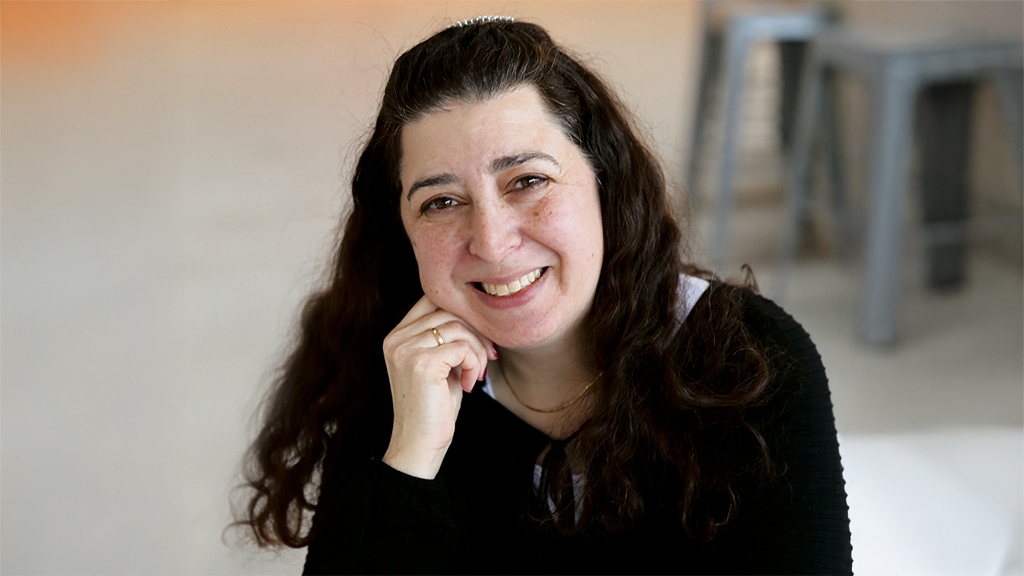
Faygie Holt of Livingston always knew she wanted to write, but it wasn’t until she was well more than a decade into her career that she realized that Jewish children’s books were exactly where her talents, interests, and life experience had brought her.
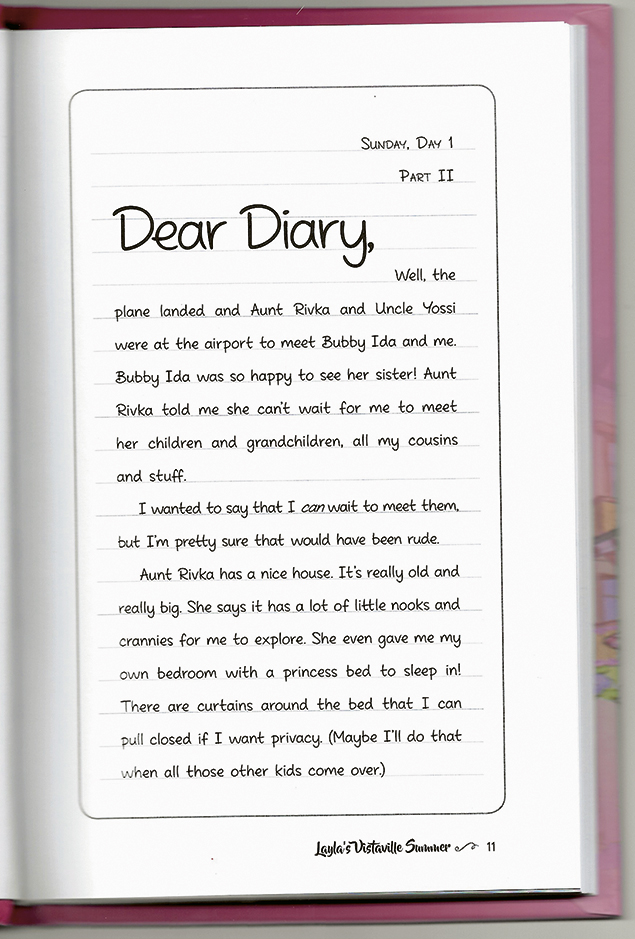
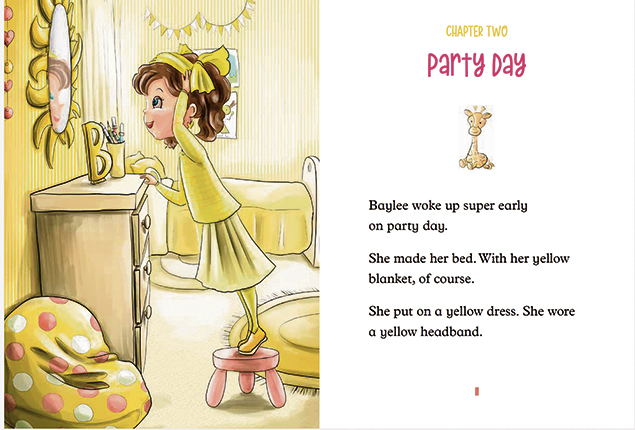
She now has written books in three series — about Baylee, a generally Jewish series for early readers; about Layla, in diary form, mainly for second, third, and fourth graders; and the Achdus Club books, for readers of the same age as the Layla books but, in general, from a more frum background.
Her path to these books was winding but logical, Ms. Holt said.
“When I was a kid I read a lot, but I don’t know if you’d qualify me as a compulsive reader. But here’s the thing — I was always making up stories. Whenever we would play games, I would make up a story or imagine a new one. I would imagine a new story for ‘Little House on the Prairie.’ I would imagine being Agnes Nixon, writing for soap operas, and I would create a lot of soap operas.”
Ms. Nixon was known for writing soap operas that were both enormously successful and also straightforwardly addressed social issues.
Ms. Holt grew up in Monsey as part of the Orthodox community; she has maintained her allegiance to the Orthodox world throughout her career. The balance between the deeply Jewish and the secular has always been part of her life.
“Writing for soap operas or ‘Little House’ was not a Monsey thing to aspire to, but I always thought that I would be a television writer,” she said.
She majored in TV and radio and minored in journalism at Brooklyn College; she also read constantly, including books about writing.
And she kept her eyes open, learning from experience and looking for opportunities.
“I interned at ‘Another World,’ a long-gone soap opera that was being filmed in Brooklyn,” she said.
How did she get that internship? “I walked into the building where they were filming and said, ‘Hey, guys, are you looking for an intern?’” As it turned out, they were. “It was a lot of fun,” Ms. Holt said.
After college, Ms. Holt did some teaching — it was 1992, and “it was one of those economic downturn times,” she said. “Someone I knew who was working at a Jewish school asked if I could sub, and I said okay. I did that a lot, and I taught secular subjects for a year.”
At the same time, “I was trying to break into writing as a professional. I was writing scripts and romantic suspense novels.” Soon it became clear that she had to make a choice. “I would take a year to make or break it as a professional writer. If I were to continue to work at a school, I’d have to get a master’s. That would be fine, but I wanted to try for a year to see what would happen.
“JTA” — that’s the Jewish Telegraph Agency, the news service that this paper uses for our Jewish World stories — “had an opening for an editorial assistant. I got lucky. I got hired. My job wasn’t writing, but they gave me the opportunity to write a few articles here and there. And then, after about a year and a half, through my contacts, the Jewish Exponent in Philadelphia hired me to go work there.
“I was hired to help with some editing but to be a writer; I became the regional editor and then the news editor. I was there for about six years. And I kept writing my own stuff.”
Soon after she got the JTA job, she’d been offered the chance to be part of a Writers Guild of America training program. That was exciting and would have been perfect except she couldn’t take six weeks off from a new job for a course in California. So she turned it down. “And I submitted an ‘X Files’ script,” she added. “It never clicked, but we stayed in touch. It was nice to have been considered at that level.
“I was very involved in pop culture,” she continued. “I could tell you everything about it back then. I would watch TV all the time. I would read all the trades. All the industry papers.
“I also was fascinated by the news. It was on all the time in my house.
“There was no clash for me between that and being an Orthodox Jewish woman. I knew my values. I never ended up working in the industry, so I can’t say what would have happened, but for me it was ‘You take me as a package. This is my observance. This is who I am.”
Ms. Holt was the Exponent’s news editor on September 11, 2001. “We did some incredible coverage throughout the next few months, under the banner of the War on Terror,” she said. “I wrote many of the stories, and we ended up winning a Pennsylvania state journalism award. We came in second only to the Philadelphia Inquirer. It is one of the things I did as a journalist that I’m super proud of.”
Eventually Ms. Holt decided to move back to the tristate area. “I went to work at a women’s book magazine that doesn’t exist anymore,” she said; it was called Romantic Times. “They brought me in to move it forward a little bit. It was more romance-based then, and they wanted to move it forward.” Its name was changed to RT Book Reviews.
“There was nothing Jewish about it,” she added. “It was as far from Jewish as you can get.”
She was able to interview big-name writers — Mary Higgins Clark, James Patterson — “and some other really fantastic authors,” she said. “It was really fun. And all this time I was also working on my own stories.”
Ms. Holt stayed at RT for six years. She met Jeff Holt that last year; they married and moved to Los Angeles. “It was ironic,” she said. “After all those years thinking that I would live in L.A., I finally moved to L.A.,” without immediate job prospects as a writer or editor. But “there was a girls’ day school looking for a fourth-grade teacher for secular subjects. So I went back to the classroom.
“I had a student who wasn’t allowed to read secular books. She said, ‘I wanted to read every book in the library, and I did. And now I have nothing to read.’ And it was a very well-stocked library. It wasn’t like it had only five books.
“I decided, as a fluke, that I would write a book about my students. So I went home one day, wrote the first chapter, and read it to my students. They were on the edge of their seats. I hadn’t expected that reaction. So for the rest of the school year, I would write a chapter and bring it to school. If the class was good, they got to hear it. And it even became part of the curriculum. I would join with the other fourth-grade class, and we would read it together.
“The kids were learning different writing techniques. One was persuasive writing. The questions was: ‘Should Mrs. Holt finish the book?’ One of the girls said, ‘Mrs. Holt, I wrote that you shouldn’t finish the book, but I really hope you do.’ She said that she thought it would be more fun to write that I shouldn’t, but she really didn’t mean it.
“That’s when I knew that I was on to something. That was the manuscript that became ‘The New Girl,’” the first book in the Achdus Club series.”
The Holts moved back to New Jersey after that school year, and Ms. Holt polished the manuscript, submitted it, got some rejections, and sold it to Menucha Publishers. The company was “starting to build its list, so I became one of the first authors targeting Orthodox middle-grade girls. There were not a ton of people doing what I was doing.”
Her books focus on themes familiar to preteens — and everyone else — bullying, problems with parents, insecurity, body image. The setting and vocabulary in the Achdus Club series might not be familiar to young readers outside the Orthodox world, but the feelings are.
Ms. Holt plans to continue with the series. She also has written a nonfiction book, “March,” due out late this year, about the Orthodox rabbis who marched in Washington in 1943, hoping to alert President Roosevelt to the horror facing the Jews in Europe. And she’s working on a new series, called Jewish History Minute, which will kick off with a book about Cesar Kaskel, the Jewish man from Paducah, Kentucky, who reacted to General Ulysses S. Grant’s order to expel Jews from the city by getting on a train to argue his case to President Abraham Lincoln, who then overruled the general Although few of us have heard of Kaskel, this is a work of nonfiction and he is an American Jewish hero. Ms. Holt will help young readers learn about him.
So now Ms. Holt is putting together all her interests — writing, reporting, storytelling, pop culture, history, education, middle-schoolers — into books that pique her readers’ interest as hers once was piqued. She knows what she’s doing.
Learn more about Faygie Holt and her work at her website, faygieholt.com.
comments