

Catch me if you can
Our analyst looks at the meeting between Putin, Witkoff, and Kushner as the war drags on
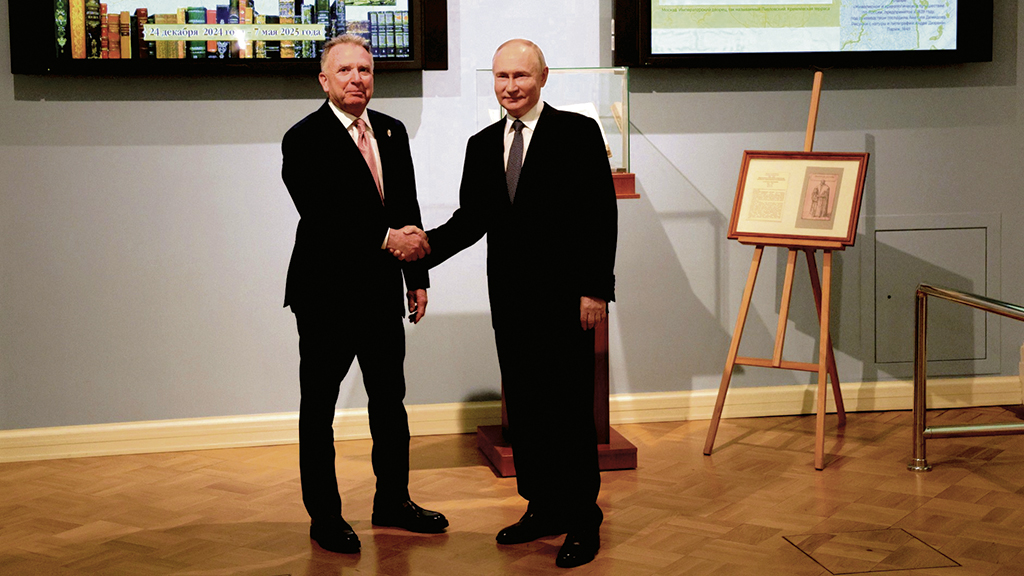
Two weeks ago, Alexander Smukler of Montclair, the Soviet-era Moscow-born Jew who shares his insights on the war Russia began in Ukraine, the reactions to it, and the probable motivations behind what he calls the global game of thrones, talked about the dire straits that Ukrainians must face.
To be obvious, war is hell, and Ukraine is about to enter its fifth year of it.
Mr. Smukler talked about the first version of the 28-point peace plan proposed — in theory, at any rate — by the United States; it involved Ukraine’s capitulation and seems to have been written by Russia.
That plan apparently has fallen apart. President Donald Trump demanded that it be accepted by Thanksgiving and implemented by year’s end — when Nobel Peace Prize nominations must be in, Mr. Smukler said. But that seems not to have happened. On Tuesday, he said that he wants to hear from Ukraine before Christmas, and that he wants Ukraine to hold a presidential election as soon as possible. That was a version of one of the 28 points in the original so-called peace plan.
Meanwhile, on the front lines, “we have been seeing extremely intensive developments in the war,” Mr. Smukler said. “I can’t say everything is quiet on the eastern front.”
Although the so-called peace plan has fizzled, it is both interesting and useful to examine how it came about.
“This has been an extremely active time for diplomatic attempts to stop the war, and obviously the centerpiece was on December 2, when Steve Witkoff, the United States special envoy to the Middle East” — we duly note that neither Russia nor Ukraine is in the Middle East, but Mr. Witkoff has attempted diplomacy there as well — “and Jared Kushner, Trump’s son-in-law, came to Moscow.” (Mr. Kushner grew up in Livingston; Mr. Witkoff is from Long Island.)
“Before they met with Putin, Kirill Dmitriev” — the Stanford- and Harvard-educated Russian businessman who is his country’s chief negotiator about the war with Ukraine — “showed them the beautiful city, decorated amazingly for Christmas.” It is gorgeous, particularly when it glows with fairy lights, Mr. Smukler acknowledged.
It wasn’t new to the visitors either; Mr. Witkoff has been to Russia to talk to Putin six times, Mr. Smukler said.
“Dmitriev took them to the most expensive and fanciest restaurant in the city, Savva; it’s near the Bolshoi Theater. The restaurant is in walking distance of the Kremlin, so they walked there before the meeting.
“Putin kept them waiting for an hour and a half before he showed up. He does that all the time. It’s a signal of where everyone is in the hierarchy.

“When the sovereign comes for a meeting, it is the custom to be late, so people have to wait. They have to be tired. They have to be nervous.”
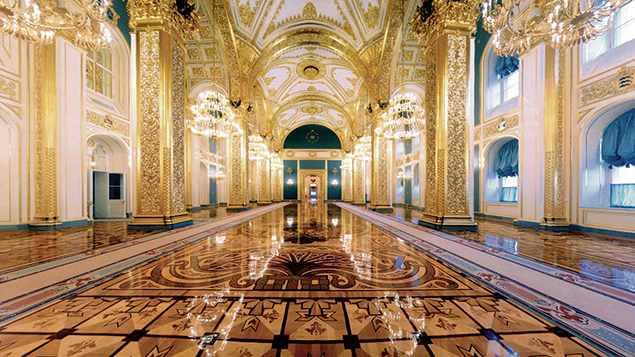
The meeting for which the Americans cooled their heels was “in one of the most historic parts of the Kremlin,” Mr. Smukler said. “It was in Imperial Hall. That’s where Peter the Great and Catherine the Great met with ambassadors.
“It has always been closed to the public. You can’t get into it without being invited by the ruler. It is another message from the ruler that ‘I represent the empire.’
“The Imperial Hall is magnificent, absolutely magnificent, but it also is a symbol and sends a message.”
That message, Mr. Smukler said, went to the visitors — “I can’t call them negotiators, or a diplomatic team, because they’re not. They’re just two visitors, who spent five hours with Putin, just sitting and talking.
“They do not represent the United States of America. So we can’t call their talks formal peace negotiations. It’s just a discussionl.
“That’s highly, highly unusual,” he continued. “Putin doesn’t meet for five hours.
“I don’t know of anybody except heads of countries who Putin meets with for five hours. And this is his sixth meeting with Witkoff.
“I can give only one explanation for why this meeting took place, and why Putin is so interested. Forget the war. Putin’s not taking discussions about ending it seriously.
“Remember that Putin is a professional spy.” He was trained by the KGB, the agency where he began the career that catapulted him to where he is today. “He’s not looking for a solution to a bloody conflict. He’s gaining information from these nonprofessional visitors.
“He’s sucking information from them. So what kind of information? He will analyze what they know about the administration’s intentions, and about Trump’s personal intentions, and what kind of information he can suck from them about Ukraine.
“It will help him understand Ukraine’s position and attain his own goals. Obviously, Kushner and Witkoff are very informative about European countries and their policies.” So Putin, the trained spy, could have used charm and an understanding of what makes them tick to get into their heads. “And they wouldn’t notice. They’d think that it was the most pleasant, friendly, effective meeting, where they were looking for ways to reach a peace agreement. They really can’t understand that a person who was trained by the KGB, who was a professional spy, and now has ruled a country for 26 years — for him, for Putin, the most important thing is to get as much information as possible, and then to analyze it.
“Obviously, I was not at that meeting, but I can swear to God that Witkoff — not Kushner, Witkoff — was talking 75 percent of the time, and Putin was listening and talking maybe 25 percent of the time. That’s why the meeting was so long.
“A practiced negotiator coming with a prepared plan that had been discussed previously wouldn’t need five hours of Putin’s time. They probably would just exchange several of the most important bullet points. But Putin really wanted more time with them.”
There was visual evidence too. “When I saw the very brief footage of the meeting shown by Russian and western news outlets, I saw Putin’s face. I watched it maybe 20 times.
“I saw that he likes being with Witkoff. He likes toying with him.”
Putin’s face is catlike to begin with; in that footage he looked less like he was going to pounce on the mouse that was Witkoff than he was toying with him. “You can see how much pleasure Putin was getting from it,” Mr. Smukler said.
He saw, in that brief footage, that Mr. Witkoff and Mr. Kusher brought an interpreter with them — Mr. Witkoff had relied on a Kremlin-supplied interpreter in earlier meetings.
“I am reluctant to use the word stupid, but I think that they are very naïve. We are speaking on the 1,381st day of the war” — that was last Friday — “and very soon the war will enter its fifth year.
“They are not professional negotiators. They are not professional diplomats. They are not politicians. Not elected officials. Not official representatives of the State Department. They don’t understand the Russian character. They don’t understand the people with whom they are dealing.
“I always say please don’t underestimate Putin. He is the last product of the KGB and one of the best fruits of its garden.”
Since that meeting, the plan, which Ukraine found unacceptable — it would have demanded that it give up land that Russia covets and has spent thousands of lives to get but so far has failed to conquer completely, that Ukraine pare down the size of its army, and that it abandon any hope of joining NATO, among other big asks — has been whittled down to where Russia, too, finds it unacceptable.
In response, Putin has threatened to start a war with Europe; Europe so far has remained unmoved. “On December 4, Putin said that ‘if Europe suddenly wants to wage a war with us and starts it, we are ready right away.’”
Meanwhile, Russia has gained the city of Pokrovsk; there are still some Ukrainians fighting back there, but that will end soon, Mr. Smukler said. “It’s the most important logistical and railway hub in Ukraine’s defensive line. If Russia has Pokrovsk, the road to Kramatorsk and Sloviansk will be open to them. If these two cities are taken, that will mean that Russia has completed its occupation of the Donbas region. And the Russians are advancing in that direction.
“Russia is attacking Zaporizhia; the battle is taking place in the city called Gulay Pole. It’s a completely flat landscape, and there are hundreds of kilometers of steppe. It’s agricultural land — all grain — and when it is frozen, the Russians will gain a corridor and an incredible opportunity to use heavy machinery to start a winter offensive.
“So maybe six months ago, I said that Ukraine’s front line will collapse and be broken. I still think that will happen, maybe not this winter but definitely during the spring and summer offensive operation. “During his press conference in Delhi on November 4, Putin said that people don’t understand, but Russia is fighting very gently in Ukraine. It’s not real war, he said, because we haven’t used much force there. We are being so gentle.”
But, Mr. Smukler said, “after four years of fighting, Russians, their president, and their general staff are in war mode. They’ve created stable logistical lines, modernized their military industry, and have no shortage of military equipment, particularly artillery shells and drones, which they are producing themselves or getting from North Korea, China, or Iran.
“They are advancing fast in their drone technology. Four years ago, they had almost no drones and paid very little attention to the technology. Now, they produce thousands of drones a day in factories inside Russia.
“Unfortunately, Ukraine is suffering with a deficit of almost everything — bullets, shells, guns, heavy machinery, and especialy manpower.”
But it’s not so great for Russia either. “Putin doesn’t want to stop the war now. The country is now in military mode. He’s playing games, running away from peace plans, because when the war stops, he will face severe domestic problems.
“Approximately 200,000 criminals were drafted or signed contracts to fight in the war. If they survive, they receive a complete pardon, no matter what they’ve done. Murderers, rapists, criminals who were sentenced to prison for 20 or more years — they were released, pardoned, and decorated, and they will come back from the front lines.
Criminals who already have returned from the front lines are documented to have killed about 1,000 people. “They’re not just criminals, they’re killers,” Mr. Smukler said.
“Hundreds of thousands of them are dead, but even if only 100,000 of them come back from the war, it will be a huge problem for Putin. Some of them were sentenced to 20 or 30 years; now they are pardoned and decorated. They are not only criminals, they are killers.
“And even the people who signed contracts and lost their lives, left their widows and children enough money to bring them up to the middle class. So during these four years of war, in order to create the army, Putin paid so much money to working-class or lower-class people, or people below the poverty line, that they immediately became middle class.”
But when the veterans come back, their families will lose that income, which “was five times more than they’d make working in a plant in the Russian provinces,” Mr. Smukler said.
“So if all these people suddenly come back — there are approximately 1.7 million people involved in the Russian military operation right now in some way or another. How will they maintain that level of income?
“That will put enormous internal pressure on the Russian economy.”
The Soviet Union “had the same problems after the Second World War,” Mr. Smukler said. “It was on a much bigger scale then, because in 1946, they were not paid. They were just drafted and mobilized, and when the survivors came back, they had nothing to do. There were no jobs for them.
“It was a huge problem for Stalin’s regime, to absorb people who had been fighting the Nazis for five years and then came back home to nothing.”
It’s also not entirely unlike the American experience in Vietnam, where young Americans — not convicts, that part of the Russian story does not parallel what happened here — came home to anger from other Americans, and had no understanding about what they’d been fighting for.
“The Russians were fighting for Putin’s imperial ambitions,” Mr. Smukler said. “They were paid crazily for it. And now they’re coming back to work in the coal mines, for a salary five times smaller. Oops! And most of them weren’t from the European part of Russia, but from the rural industrialized part.
“That part of Russia will become a huge pain in the neck for Putin.”
“So Putin isn’t prepared yet to deal with internal problems. He won’t sign a peace deal for anything but full capitulation from Ukraine.”
But those internal problems keep growing, Mr. Smukler said.
“Russia is suffering economically. Trump implemented sanctions against the two biggest Russian oil companies, and they’re working. There are signs that the Russian economy is moving into deep recession in 2026. Fewer and fewer buyers are taking the risks involved in buying Russian oil. The only solid buyer is China,” but on its terms.
A failing economy leads to a flailing society. “Putin is preparing for internal bleeding, and therefore political repression is growing rapidly,” he continued. That includes many scientists and many, many journalists.
Last week, “Russia blocked FaceTime and WhatsApp.” They don’t work anymore. “We hear more and more about people who just say something about the Russian military or president and are arrested and thrown in jail. Every day we hear more about political prisoners.
“According to polls, 63 percent of the Russian population today wants Russian to stop the war and sign an agreement with Ukraine. This number is growing; two years ago, about 33 to 37 percent were against the war. And that number grows every month.
“So the Russians are tired of the war, but the Russian leadership is not prepared to deal with the internal problems that would result from stopping it.”
Putin knows what he wants, and he is holding out for it, Mr. Smukler said.
So at the meeting with Witkoff and Kushner, “he was dancing around, playing with them, gathering information.
“He was playing catch me if you can,” just as Leonardo DiCaprio did in the 2002 Steven Spielberg film by that name. about the brilliant grifter Frank Abignale, Mr. Smukler concluded.
“He’s always smiling in one-to-one meetings. He’s such a pleasant person, so nice, always saying, ‘Oh, I understand you perfectly, try to understand me.”
Mr. Smukler pictures himself in that meeting.
“I can imagine being there, sitting next to them, and he says, ‘What do you think? Tell me about what your European partners are thinking. We have such a doable plan, but they’ll be against it.
“‘What do you think they think about it? How could you convince them?’
And the cat keeps toying with the mouse, Putin continues to make outrageous demands, and the war drags on.