

Demolishing the process
Former Architect of Capitol shocked, saddened by East Wing’s sudden destruction
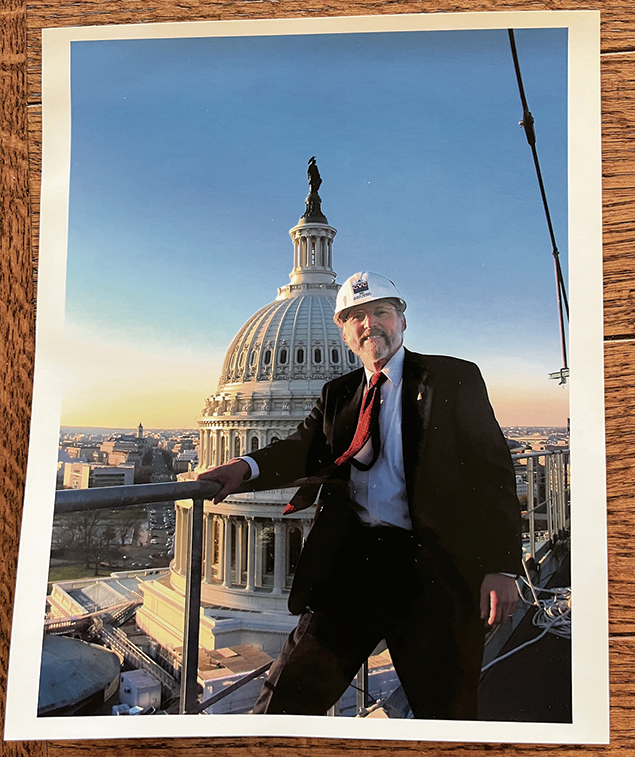
It’s all about the process, Alan Hantman of Fort Lee said.
Mr. Hantman was the 10th person (and not surprisingly therefore the 10th man), the first and so far only Jew, and the first Senate-confirmed candidate to hold the title of Architect of the Capitol.
It’s a huge job, entailing oversight of “the landmark buildings and ground of Capitol Hill in Washington, D.C.,” as its website, www.aoc.gov, puts it. (Perhaps confusingly, the entire office and the person in charge of it are called by the same name.) When Mr. Hantman held the job, from 1997 to 2007 — he was nominated by President Bill Clinton — he oversaw “a 2,000-member legislative branch agency” and “18 million square feet of space across 30 buildings, more than 500 acres of grounds, and thousands of irreplaceable works of art.” That’s from the foreword to his book, “Under the Dome: Politics, Crisis, and Architecture at the United States Capitol,” which Georgetown University Press published last year.
In 2024, Mr. Hantman and his wife, Rosalyn — whose career was in Jewish museums, and who has always been an intellectual and emotional partner to her husband — were the subjects of a story in this newspaper. “Meet the 10th Architect of the Capitol” told the Hantmans’ story, from the Bronx to Teaneck to D.C. to Fort Lee.
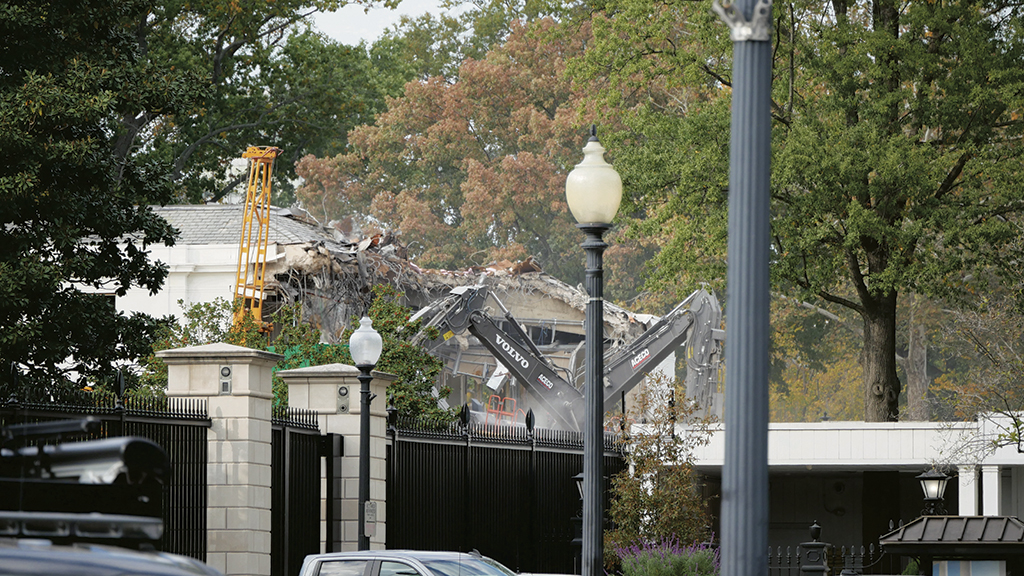
So the Hantmans were the logical people to call when the news of the demolition of the East Wing of the White House broke last week. (Work on taking down the building began on Monday, October 20, and was complete by Thursday, October 23. It was done to provide space for the new ballroom that President Donald J. Trump had promised to build, although until demolition began, he’d said that the new construction would not affect the older building but simply stand next to it. The demolition came as a surprise to onlookers and stunned many officials who felt that Mr. Trump evaded standard review procedures.)
Mr. Hantman oversaw the buildings and grounds not only of Congress, but of the Supreme Court and the Library of Congress as well. He presided over the construction of the Capitol Visitor Center, an expansion of Congress that both provided an appropriately stately entrance to the building and also allowed for far greater security than it had before. Remember, September 11 happened on Mr. Hantman’s watch.
The demolition of the East Wing “certainly parallels the work that we did on the expansion — but in reverse,” Mr. Hantman said. His work was construction; last week it was destruction.
“Both the White House and the Capitol have evolved over the years,” he elaborated. “The Capitol was built in 1800 for a nation of four million, and it has expanded ever since for the needs of a national of 340 million.
“The number of senators and members of the House also has increased, and so have their needs, and the ability to meet and welcome people to their house — to the People’s House — has changed over time.
“So the question is how we deal with historic structures in the United States, and particularly with structures of such important public stature. So the National Historic Preservation Act was passed in 1966. It basically required federal agencies to look carefully at the impacts of proposals on the historic structures.” (The proposals Mr. Hantman mentioned were for amending or expanding buildings or changing the landscaping.)
“There is a process involved,” he continued.
“First, once there is a need identified, you look at how those needs could be satisfied. Could you build something adjacent to the historic structure that’s already there? Could you build underneath it?”
In fact, the East Wing was built in 1942 primarily to provide cover for a bunker, the Presidential Emergency Operations Center, where President Frank Delano Roosevelt could have retreated during World War II had he needed to. The offices that provided work spaces for the First Lady, her staff, and others who planned social events were built over the bunker.
But there would be a process.
“It might often involve coming up with a series of conceptual alternative designs,” Mr. Hantman said. “You” — as in he, when he still was the Architect of the Capitol, and his staff — “review those designs and bring in experts, people who could look at them and give comments. And then you go on to modify those designs into a schematic level, before you start doing construction or demolishing anything.”
But — a big but — there’s a hole big enough to drive a wrecking ball and the rig it came in on through the process mandated by the preservation act. The White House, the Capitol, and the Supreme Court are exempt from it. That hasn’t stopped other administrations from consulting with experts before making changes, but such consultation isn’t necessary.
Still, “you wouldn’t do demolition on a historic structure before you’ve gone through all the processes to determine what is the best design and how it impacts the historic structure. But the demolition has foreclosed that type of review.”
Ms. Hantman said that her husband “also served on the Advisory Council for Historic Preservation, where his main purview was federal structures.” The council advises the president and other federal officials on work that the federal government wants to do on federal buildings “as related to the needs of the individual states that they would be doing the work in. You mediate between the federal government agencies and the concerns of states and municipalities.”
During his time on the council, it considered “housing on Ford Island in Pearl Harbor, looking into using the grounds of the Panama Pacific International Exposition of 1915 for commercial development. We looked at issues like where cell towers are placed, if they’re on tribal lands or in historic districts or in lighthouses along the coast. We look at preserving things that are in public venues, and there are interests other than those of the federal agencies.”
Basically, this means that Mr. Hantman and other architects doing work examined proposed changes to existing structures with great care and a close eye to detail.
On October 24, the American Institute of Architects, of which Mr. Hantman is a fellow, released recommendations for oversight of the East Wing project. “They called for a rigorous historic preservation review, for transparency, and for public accountability,” Mr. Hantman said.
“One of the key things is proportionality of the design with the rest of the White House,” Mr. Hantman continued. “It should harmonize with the White House’s scale and architecture, ensuring that the final design complements its historic character.”
The speed with which the demolition was done is another possible problem, he continued. “It seems unlikely that demolition could have been approved this quickly if normal procedures have been followed,” he said.
The main part of the White House is about 55,000 square feet — the East and West Wings together were about 12,000 square feet — and the new ballroom, according to White House statements, will be about 90,000 square feet. “And it looks like it will be about 25 to 30 feet high, so the volume of the building may well overwhelm the White House,” Mr. Hantman said.
“So there is some concern that the ballroom wing might overwhelm the historic building in scale and function. Is this a hotel complex, or a place where business is done? Diplomacy would occur in smaller rooms. Interior design is important too.
“Clearly this space is modeled after Mar-a-Lago or a Hilton Hotel ballroom. It will become the premiere element that you see when you look at the White House.”
Mr. Hantman led the team that designed the expansion of the United States Capitol. “The building itself was 775,000 square feet in area, and we were designing a 580,000-square-foot addition,” he said. “Our biggest concerns were respect for the historic nature of the Capitol building itself, and for the historic Frederick Law Olmsted grounds that were designed so beautifully in the 1890s.” Olmstead was the pioneering landscape architect whose work includes Manhattan’s Central Park. “So our design was basically to build underground, not to compete with the Capitol building, and not to disrupt the trees and the alleys and views that were constructed by Mr. Olmstead.”
When he and his team worked on the Capitol, “our client was basically the Congress,” represented by “a Capitol preservation commission composed of nine members of the House and nine members of the Senate, of both parties, the leaders of major committees and of those bodies.”
After presenting the designs to the commission and the General Services Administration, “we had a peer review of the proposed designs, bringing in people such as David Childs, who designed the World Trade Center replacement after 9/11, and Edward Larrabee Barnes, who did the Thurgood Marshall Federal Judiciary Building in Washington, adjacent to Union Station, and someone from I.M. Pei’s firm to look at the designs and come up with comments and criticisms. They really informed important changes in design.
“I don’t know if this has occurred with the White House.”
But it should have, because it involves “both the historic building and the grounds. It has the history of the American nation tied up with them. And I’m not sure who reviewed the plans,” Mr. Hantman said.
“I think that this has been rushed,” Mr. Hantman concluded. “I think that there hasn’t been due consideration of its impact on the historic nature of the White House building itself, and that taking the step of actually going into demolition before you have a full design review by anybody other than those people directly involved — and certainly not for the public or those who are professionals in the fields of architecture, landscape architecture or design — is shocking.
“We lived through a similar project, and we were so careful about anything that we did relating to both the building and the landscape. I’m concerned that some level of review and consideration would have said, Okay, let’s not move so quickly. Let’s really take a look at this and its impact on a structure that is so critical to the history of the United States.”
Both Hantmans said they were uncomfortable with the size of the interior of the as-yet-unbuilt ballroom as they’ve seen it described.
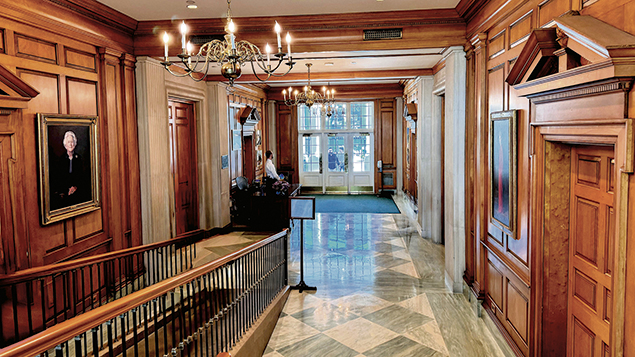
“We’ve had the honor of being at the White House for many Christmas parties over our tenure, and for other meetings as well,” Ms. Hantman said. Those parties were in the East Wing, “and the rooms certainly did not accommodate hundreds of people at seated dinners.
“The entire Congress would come for these Christmas parties. It was a standup buffet type of thing with bands and entertainment, and it was a little crowded, but it worked well.
“All those spaces had multiple uses and were used throughout the year. How often are you going to have 1,000 people come to a party at the White House?
“I’m so very disappointed,” Ms. Hantman concluded. “The White House is a national icon, and I can’t say that it’s being destroyed, but it’s being changed irrevocably, and that saddens me. It saddens me a great deal.”