

‘Divrei Halev’
Rabbi Ronald Price talks about his teacher, Rabbi David Weiss Halivni
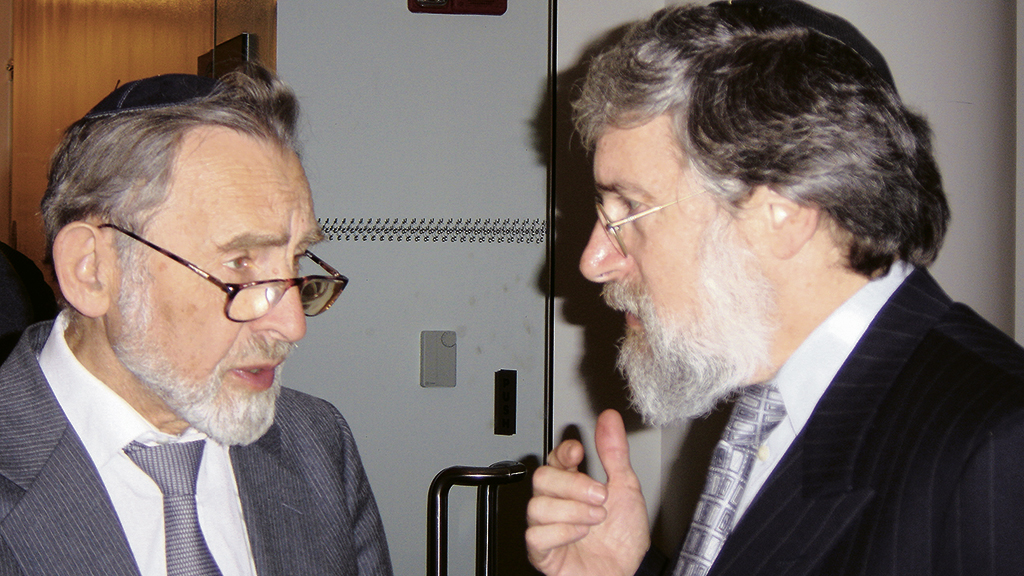
When Ronald Price was a student at the Jewish Theological Seminary in Manhattan, his contact with Rabbi Professor David Weiss Halivni was minimal.
“He was too far above me,” Rabbi Price said. “One of the first times I sat in his class, my eyes glazed over when I was trying to understand how he was reshuffling the text in the Gemara.” And he was not the only student wearing a blank expression. When Rabbi Halivni saw the many puzzled looks, he joked, “‘I think I’m davening b’yehidus,” praying without a minyan. “So I think that as a student, I never could have imagined that I would get to the point that I would have a warm and close relationship with this man, who was head and shoulders above anyone I knew, and virtually all of the other scholars that I came in contact with.”
After receiving smicha from JTS in 1977, Rabbi Price became the dean of academic affairs there. That was when Rabbi Price — who lived in Teaneck for 25 years, made aliyah, and now lives in Ashkelon — began to develop a relationship with Rabbi Halivni. That relationship continued until Rabbi Halivni’s death in 2022. Rabbi Price’s new book, “Divrei Halev,” a collection of Rabbi Halivni’s thoughts on the weekly Torah portion, is based on years of conversations between Rabbi Price and Rabbi Halivni.
In the book, Rabbi Price describes Rabbi Halivni as “a child prodigy.” Rabbi Halivni was raised in Romania and received rabbinic ordination when he was 15, not long before he was deported to Auschwitz. He was the only member of his family to survive the Holocaust.
When Rabbi Price was an assistant dean at JTS, “things were becoming stressful for the traditionalists,” he said. “I was, I guess, the youngest among the administrators, fresh out of rabbinical school, but I spent a lot of time meeting with my teachers. Rav Halivni was one of those with whom I was able to spend a fair amount of time talking about how things were changing and how we as traditionalists were going to move forward in a movement, the Conservative movement, that we felt was shifting away from its original tenets.
“It was in those conversations that I saw very, very clearly the kind of person that Rav Halivni was, not just as a scholar.”
The traditionalists were concerned with “the move away from halachic process,” Rabbi Price continued. This was around the time the school decided to begin ordaining women. Ultimately, Rabbi Halivni and other “rabbis and lay people left the Conservative movement when there was a sense that there was a breach of halachic process in the decision on the ordination of women,” Rabbi Price said, emphasizing that the concern was with the way the decision was made, rather than with the decision itself.
“There were people who did not object to the idea of women becoming rabbis but felt that the way in which that decision had to be made was through study led by the senior Talmud and halachic scholars,” he continued. “Unfortunately, the decision was made administratively that it was to be decided by the entire faculty, by — we’ll call it popular vote — regardless of what your connection was to observance, to learning, to halacha. It was turned into an administrative decision as opposed to a halachic decision, and that was the breaking point, I think.”
Rabbi Price left JTS in 1980 to lead Congregation Ramat Zion in Jerusalem. He and Rabbi Halivni “were out of touch for a fair amount of that period,” but in 1985, Rabbi Halivni invited Rabbi Price to help develop the newly created Union for Traditional Judaism, which was being started by the group that had left the Conservative movement, and to become the organization’s executive vice president. UTJ was based in Teaneck at the time, and Rabbi Price left Israel for Teaneck; in 2011 he moved to Florida, and then made aliyah, this time for good, in 2020. “Rabbi Halivni was the spiritual leader, the teacher, I think, of all of us, and he became the head of the organization’s new rabbinical school, the Institute of Traditional Judaism,” Rabbi Price said. “In the process of developing the UTJ and the ITJ, he and I would meet I would say more than frequently. There were times when we either spoke or met on a daily basis.
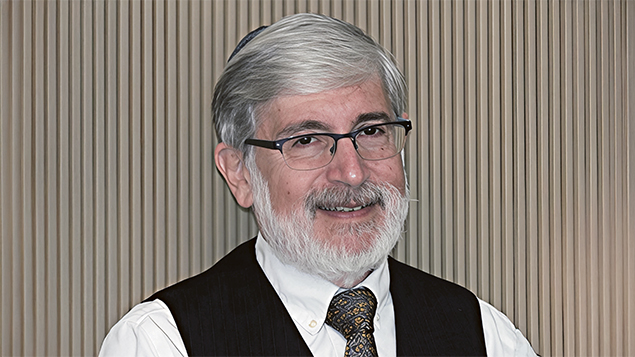
“That’s when we became that much closer, because in a sense, we were at least a footnote in history, if not making some history, by creating the organization and developing the rabbinical school.”
The relationship became a close one. “We discussed very personal issues, life decisions, at different points, critical moments in my life, and in his as well,” Rabbi Price said. “And he was able to give both myself and my wife advice for living that helped us through a couple of different crises in our own lives. So the relationship was not simply scholarly and textual. It was one that was very, very personal and very warm, and I will say he was certainly my rebbe.
“He was a model not just for Jewish scholarship, but also for Jewish living. The way he lived his life, a man who came through the Shoah, who was so deeply, fervently God-fearing, and at the same time completely intellectually honest and able to say, you know, there are problems in the text that I have to figure out, I have to work out for myself.
“His humility and his openness was something that for me was a model, an accessible model. Intellectually, I saw him as far above me, but he never saw himself as far above me. There was no gap as far as he was concerned. When he spoke with me, we spoke as equals. And it wasn’t just with me — that was the case with everyone he met.”
Rabbi Halivni was primarily a scholar and a teacher. “His work on the Talmud is really only accessible to serious Talmud students and scholars,” Rabbi Price said. “People are aware of his philosophical ideas and his textual approach to the Talmud, but they’re not familiar with what he termed his Torat chayim,” his Torah of life.
Rabbi Halivni led a shul, Kehilat Orach Eliezer, on the Upper West Side of Manhattan, where “he touched many people with his words of Torah and advice.” He also served as a “rebbe for many of his students — students who were in university, students who were scholars in other parts of the world who came to learn with him. If they were able to spend time with him, they learned not only how to parse the text, but also how to live their lives.”
It is this aspect of Rabbi Halivni’s teachings that Rabbi Price felt needed to be disseminated. His goal in writing “Divrei Halev,” which means “words from the heart,” was to make these ideas accessible to the larger community. “Obviously many of the insights on the parshiot are unique,” Rabbi Price said. “They are wonderful explications of the text. But they also generally conclude with a message that helps us with yardsticks to manage the vagaries of life.”
When Rabbi Price suggested the idea of the book to Rabbi Halivni, “he said it sounded like a great idea and ‘who better to do it than you, Ron?’” Rabbi Halivni was busy on other projects, Rabbi Price acknowledged, but “I frankly think that the core reason that I ended up writing it was because he wanted to do something for me, not the other way around. It was part of his generosity to me.
“I didn’t consider myself to be amongst his star pupils, I was simply one of his students. But we had a warm relationship, I was fairly literate, and I think he wanted to do something for me and was very gracious in asking me to do this.”
Rabbi Price met with Rabbi Halivni on a weekly basis, by phone or in person, between 2008 and 2012, to hear his thoughts on the weekly Torah portion. The hope was to publish the work around 2013, but competing demands on Rabbi Price’s time kept the project on the shelf.
“Going over the parsha, going over these ideas each week, was just a highlight of my week,” Rabbi Price said. “As we went around each year, he would choose a different aspect or a different part of the parsha.” Since the conversations spanned a number of years, the two men had the opportunity to discuss more than one aspect of each parsha. “Sometimes he would focus on different understandings of the same set of pesukim, or two different lessons would come out of the same pesukim.”
The book offers insights on individual Torah portions, but “you find common themes throughout,” Rabbi Price added. “Trying to achieve closeness to God in your daily life is something that appears repeatedly,” as does “recognition of man’s weaknesses and man’s strivings. The need for humility is another recurring theme. The jumping-off point is always the text, but the goal is to conclude with an ethical or moral lesson.”
“What always amazed me, given his background, given the fact that he was the sole survivor in his family, was his optimism,” Rabbi Price said. “If you go through ‘Divrei Halev,’ you will see the lessons that he teaches are lessons of a person who is optimistic about the ability of man to do good. To do the right thing. He had every reason in the world to be bitter, and yet he was one of the kindest, warmest, most optimistic people you could meet. It’s not that he was unrealistic — he knew how bad man could be. His messages, however, are about God’s mercy for man, God’s understanding man’s weaknesses, and the need for man to measure up and be better.
“Having the zechut,” the privilege, “to publish ‘Divrei Halev,’ and put forward to the public the words from Rabbi Halivni’s heart, has been my privilege and an honor that I will not forget for the rest of my life,” Rabbi Price said.