

Fair Lawn-based Operation Israel gets protective equipment to the IDF

On Friday nights after Shabbat dinner, Adi Vaxman of Fair Lawn and her family usually turn on the news from Israel. They watch a program that airs at 8 p.m. Israel time, “so kind of the rerun of that evening’s Friday night news,” Dr. Vaxman, who grew up in Israel and holds a Ph.D. in business, said.
That is what the family was doing at around 11:30 p.m. on Friday, October 6, 2023, when they “started getting a lot of weird notifications about something going on,” Dr. Vaxman said. “So we turned on a live broadcast rather than the rerun, and we started seeing that there was an infiltration.
“At the time, my stepdaughter was serving in a search and rescue unit in Zikim,” in southern Israel, “and my husband,” Ronen Magid, “started looking for her.” Her base was one of the IDF facilities attacked by Hamas on the morning of October 7. “We were up all night looking for her.” It turned out that she was not on the base that night, “but the girl she switched shifts with was one of the first to be killed on that base. When we spoke to her, she said, ‘Abba, all of my friends are dead.’
“It was a rough night.”
Dr. Vaxman’s brother is a commander in the IDF’s Armored Corps. “He rushed out of the house and drove down there,” she said. She reached out to a good friend in Kfar Aza who “was locked up in her house. Her kids were stuffed inside closets and she was just waiting, and I was texting with her all night. There were terrorists shooting inside her house and just by some pure act of God, they were released after 26 hours.
“By morning, probably around 5 or 6 in the morning, we started getting calls from friends whose kids were serving as lone soldiers and they started reporting equipment shortages.”
Dr. Vaxman owns a management consulting firm that provides logistical and operational assistance to small and growing businesses, “and everybody kind of knows me as the operations person, as the person who solves problems, and so they reached out to me, kind of hysterical, not knowing what to do. And I started realizing that there was a massive shortage of equipment, specifically ceramic vests, but other things as well.”

Israel’s Department of Defense had a purchasing delegation in New York City. On Saturday, she reached out to a friend in the delegation and asked where she could buy ceramic vests that are approved by the IDF. “He gave me the names of three suppliers in Israel. I waited until it was seven or eight in the morning in Israel and I called these suppliers, and I put $160,000 on my personal and company credit cards, and I bought their entire stock.”
Dr. Vaxman was involved in Jewish communal leadership long before October 7. She began her freshman year at Cornell University in September 1998, about two weeks before Rosh Hashanah. “Within five minutes, I founded an Israeli student organization and started running massive 200-person holiday dinners and other events because I felt like, ‘what do you mean you don’t have that here?’” she said. “‘You have got to have that.’
“It’s very easy to be Jewish in Israel because it surrounds you,” Dr. Vaxman continued. “Here, if you’re not very religious — and I’m not very religious, I’m a little religious — it’s very hard. You have to work at it. You have to make an effort in order for it to be part of your life. This is very important to me. My Jewish identity is something that’s very strong for me.”
After she arrived in Fair Lawn, Dr. Vaxman ran an Israeli cultural organization called Nitzanim and got involved with the Israeli American Council. More recently, she has been an avid fighter against antisemitism in the Fair Lawn public school system. Her older children are graduates of Fair Lawn public schools and her youngest is a student there now. “I am their worst nightmare, because every time something comes up, they see me fighting it,” she said. “And sadly, things come up.”
For Dr. Vaxman, the importance of this work is clear. Her grandfather, Lipek Goldberg, survived Auschwitz, and Ronen’s grandmother, Chaya Magid, was a partisan who fought the Nazis.
After procuring the ceramic vests on October 8, Dr. Vaxman quickly connected with other people who wanted to help. She started receiving a lot of requests for protective gear, so the group set up a logistical system to receive and verify requests and procure supplies. That was the beginning of Operation Israel.
Operation Israel provides a lot of personal gear, including tactical flashlights, boots, solar-powered charging stations, and medical equipment including portable ultrasounds, defibrillators, and heart monitors. In the last year, the organization also started some more strategic projects. One involves creating drone schools and drone repair labs. “Drones are really life-saving,” Dr. Vaxman said. The drones are small and used for surveillance, “to scout areas to prevent soldiers from walking into traps, which, unfortunately, is how many soldiers have been killed.
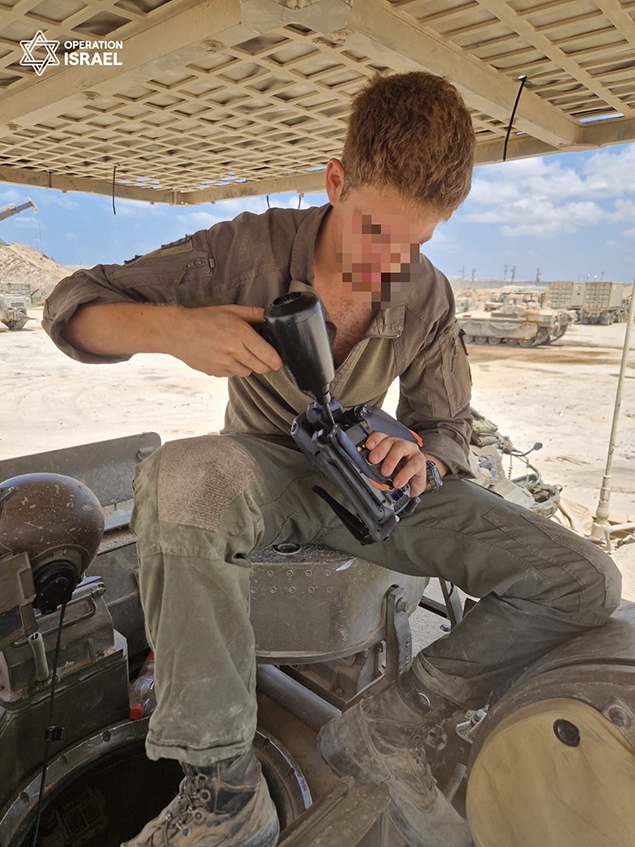
“When we realized that a lot of donors were providing the actual drones, we created schools within bases to teach soldiers how to use them — how to operate them and how to identify the things that they’re looking for. And that has saved I can’t even tell you how many lives. We get texts probably once a week, that include an image from a drone, saying, ‘your donated drone,’ or ‘the drone that you repaired,’ whatever it is, ‘helped me identify this. I would have died if I had gone in there.’ So we know that it saves a lot of lives.”
Dr. Vaxman stressed that Operation Israel focuses exclusively on humanitarian aid and defensive and life-saving equipment. “Everything we do is to save soldiers’ lives,” she said. “We do not touch anything offensive — that’s not our role, it’s just not our place — there’s an army, there’s a government. But as long as there is a war, we can save lives, and it absolutely is our place to make sure that they come home alive.
“Every single person that comes home alive because of a piece of gear that we donated is an entire world,” Dr. Vaxman continued. “And even worse, every single person that died because they didn’t have an $800 vest or a $1,000 helmet or a $1,000 drone is devastating. They have to endure this, they have to do what they have to do. We’re not making the decisions about what they have to do, but they’re there, and it’s our job to support them, to try to make their lives a little bit easier, to make sure they come home alive.”
Another one of the organization’s strategic investments focuses on centipedes, “which are literally robots that are able to get into areas and move things around and again, to identify threats,” Dr. Vaxman said. “They are booby-trapping everything — the IED threat is probably the biggest threat of this war — so literally every step that a soldier takes could be their last. So a lot of our focus is on identifying, preventing, and providing systems and technologies to prevent and identify, so soldiers do not have to go in.
“The centipede and other robotic devices are doing that. They are remote-controlled, with a camera, or with a bunch of different cameras, and they have the ability to maneuver different terrains and open doors and move curtains and move pieces of fabric and kind of scout areas before a force has to go in there.”
Operation Israel is also investing in tank cameras. “When soldiers are inside a tank, they can’t really see if terrorists are coming from underneath them or from the sides, and putting a bomb on the tank,” Dr. Vaxman said. “We’ve lost a lot of soldiers this way. So we equipped hundreds of tanks with 360-degree camera systems that have screens within the tanks, so if they’re inside with the shells closed, which they are supposed to be, they’re able to identify and to move before something happens to them.” For similar reasons, the organization recently started funding the installation of antenna systems on tanks, so a surveillance drone can be operated from inside a closed tank, and it is training soldiers to use the systems. “This program is only a few months old, and we already know that it has saved lives,” Dr. Vaxman said.
Operation Israel is completely run by volunteers, Dr. Vaxman continued. “We see this as a calling, as a shlichut, as something that we were meant to do.” So far the organization has raised almost $10.5 million. “We are 100 percent transparent,” she added. “Donors know exactly where their money is going.
“A lot of the feedback that we’re getting from soldiers is that they appreciate more than just the gear,” she said. They appreciate “knowing that we are there, that we are still thinking about them, that Jewish people outside of Israel care.”
The war has been going on for almost two years, Dr. Vaxman concluded. People are becoming “used to the situation. Everybody has their opinion about the war and the government, but these kids are still out there, and they’re risking their lives. We need to help them, because if we don’t, more of them will die. I don’t make government decisions, but I can save more kids.”