

Finding home at Golda Och Academy
The head of school tells how her new job is part of her life
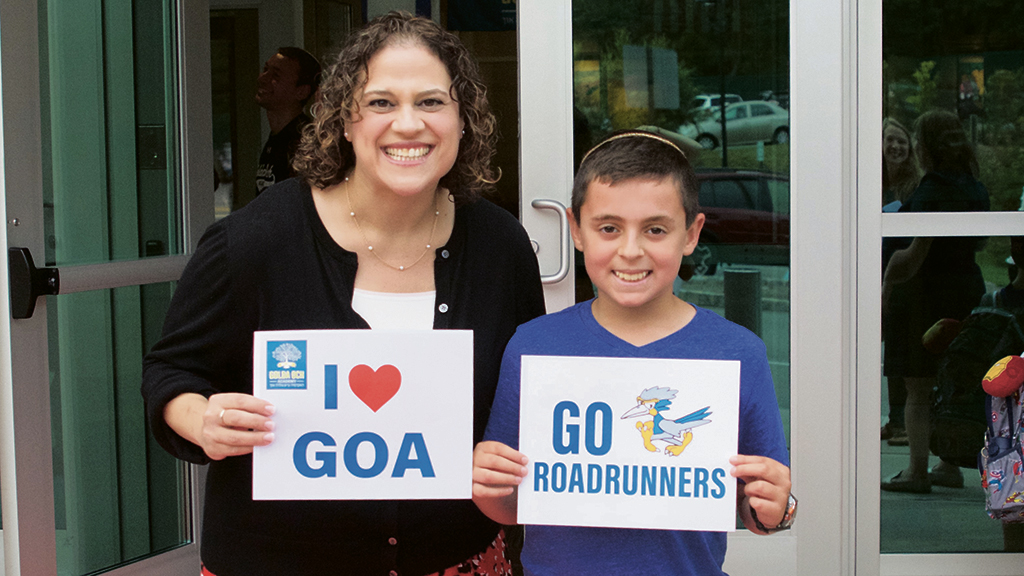
It’s not hyperbole to say that Carrie Zucker Siegel ’92 is woven into the Golda Och Academy in West Orange so profoundly that she’s already inextricably part of it, even though her tenure as head of school there began just this summer. She couldn’t be detangled from it should she want to be — and she doesn’t.
She loves it, she is fiercely proud of it, and when you talk to her, you feel it.
GOA is a Solomon Schechter school, part of the Conservative movement, home to students across the Jewish streams. It runs from pre-K to 12th grade; as the only non-Orthodox high school in the state, it is home to high-school students from across north Jersey, and this year marks its 60th anniversary.
Ms. Siegel’s connection to it began when she was in kindergarten.
Let’s go back a few years before that. Her mother, Alicia Pinchev Rosenbaum, from Seattle, and her father, Stephen Zucker, from New York, met cute, when Alicia moved into the Manhattan building where Stephen’s parents lived. They married soon after they met — when you know, you know, and they knew. They stayed happily married until Mr. Zucker died two years ago, according to their daughter.
After they had two children, Robert and Carrie — their third child, Julie, was born a few years later — the Zuckers realized that they needed more space and decided to move to the suburbs. Ms. Zucker was a social worker; her first job was at the Green Lane Y — formally the YM-YWHA of Union County — and when she worked there, she fell in love with New Jersey.
Both her parents had grown up in deeply Jewish but not particularly religiously observant families, Ms. Siegel said. Even so, when they saw Essex County, “they felt that it was the kind of Jewish community they envisioned for their family.” They were particularly drawn to South Orange because of Congregation Beth El there, and the West Orange Y, as it was called then, just one town over. (The Y’s now the JCC MetroWest.) They moved there in the mid 1970s; Ms. Zucker, Ms. Siegel, and her husband and children live there today, and so do her sister and her family. Ms. Siegel’s niece will be a GOA fifth-grader this year. The family feels a deeply rooted love for the place.
At first, the Zuckers’ plans for the education of their children were straightforward. Carrie went to nursery school at Temple B’nai Jeshurun in Short Hills and then followed her brother to public school in their neighborhood, Newstead, at the top of South Mountain. “But every year people talked about how the school was going to close.” The town and the neighborhood both were flourishing, but there were many public schools, and it often seemed as if this relatively far-flung one might be unnecessary. “So I was in kindergarten, my brother was in second grade, my parents heard the stories about the school closing over and over, and my mom said, ‘It’s not often in life that you get a second chance to make a first decision.’
“So they enrolled us in the school that then was called the Solomon Schechter School of Essex and Union. My life would have been totally different if my parents hadn’t made this decision.
“Our whole lives became the school.” And so did the shul; her mother’s been a member of Beth El for more than 50 years, Ms. Siegel added.

When she started in Solomon Schechter, in first grade, the school met at Temple Sharey Tefilo-Israel in South Orange. By the next year, though, it had moved to rented space in the public school in Newstead, the school that Carrie and her siblings would have gone to had they gone to public school and had it remained open. (The building is housing a public school again; it’s the South Mountain Annex School.)
Back then, Newstead was so Jewish, and so committed to day school, that “it seemed like my whole block went to Schechter,” Ms. Siegel said.
Through most of her time as a student, the school had two buildings; the one in Newstead housed a lower school, and the one in Cranford was home to both a lower and upper school. (That’s why it had “Essex and Union” in its name. The Oranges are in Essex County, and Cranford is in Union.) So when the South Orange students hit fifth grade, they’d commute to Cranford, “and made a lot of new friends,” Ms. Siegel said.
“I spent sixth through 11th grades in that building,” she continued. “We were growing out of it. Busting at the seams. We were so full that we were splitting classrooms. It was so robust, so rich, so energetic. We had feeder schools sending kids to us from all over. From as far away as East Brunswick.
“By the time I finished my junior year, we had broken ground on this campus.” That’s the upper school on Pleasant Valley Way in West Orange, where her new office is. For some time, the school had three buildings, but eventually the school’s leaders bought the one on Gregory Avenue, also in West Orange, that houses the lower school now, and closed the Newstead and Cranford ones. Demographics had changed; more Jews likely to send their children to Schechter lived in Essex than Union County. Still, “that was hard,” she said. Now the lower and upper schools are just a few miles apart.
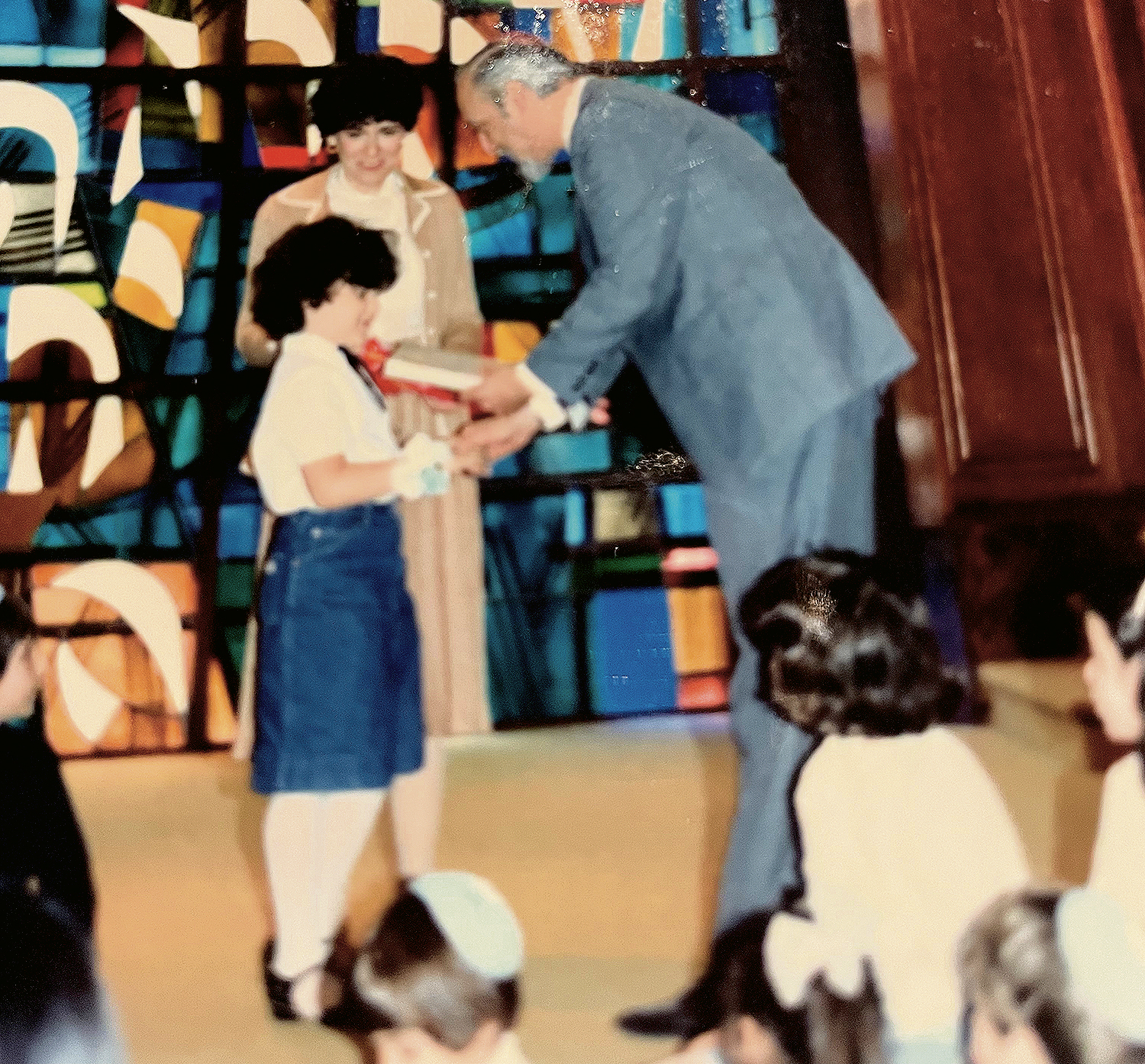
“I was in the first graduating class in this building,” Ms. Siegel said. That was the class of 1992.
“Once my parents decided to send us here, they never looked back. They didn’t have day school backgrounds. Their ties to Judaism and to Israel were strong — my father had a lot of family in Israel — but they wanted us to have what they didn’t have.”
In that process, her parents’ lives changed and improved too, Ms. Siegel said. “They gained a beautiful community. What the day school world provided is something so extraordinary that once they were in it, it opened doors to what they hadn’t even realized they’d wanted.
“We quickly surpassed our parents in what we knew,” she continued. “We taught them. We were the ones coming home talking about the parasha, doing the birkat hamazon. I would sit next to my grandfather at the seder, which he led, and say, ‘No, grandpa, you left that part out.’
“We were so entirely engaged, and we were so supported and loved.”

It wasn’t accidental that the school where the Zuckers found a home was part of the Conservative world, Ms. Siegel said. “That’s especially true from the perspective of egalitarianism. My parents wanted to make sure that my sister and I had the same opportunities that my brother had.”
Still, she said, Schechter has students from across the Jewish world. As long as they’re comfortable with the school, the school is comfortable with them.
Ms. Siegel did have another entirely different strand of Jewish life that enriched her Jersey Schechter experience. “My uncle, my mom’s brother, was the camp director at Camp Alonim,” she said. That’s a nondenominational Jewish camp in Brandeis, California, formerly part of the Brandeis-Bardin Institute and now the American Jewish University. “It had a lot about Israel, and Israeli dancing, music, the arts.
“We went to camp there, and my kids went there too, and so did my brother’s kids. It’s a bond that keeps you together.
“All these Jewish experiences were special, and I didn’t take any one of those experiences for granted. And neither did my parents.”

By the time she was in high school, Ms. Siegel had her future career mapped out. “I knew early on that I would go into Jewish education,” she said. She had role models at school. One was Golda Och, who was a teacher and administrator at the school long before her son named it in in her honor. Ms. Siegel knew Ms. Och both from school and from shul. “She told me that I had to go into education,” she remembers.
Ms. Siegel earned her bachelor’s degree at Brown — she had a double major, in political science and Judaic studies — and from there, after spending a spare minute or two toying with the idea of rabbinical school and then rejecting it, she worked toward a master’s degree in Jewish education at the Jewish Theological Seminary. Her focus was on day school education and administration, because even then, she knew what she wanted.
It would be no surprise to any reader of this story that Ms. Siegel did her student teaching at SSDS, and when she graduated from JTS with her degree, she began to work there. At first she commuted from Manhattan, but she and her husband soon moved to South Orange.
“I focused on high school Tanach, rabbinics, Jewish philosophy, and Jewish history,” she said. “And I don’t think that I was there more than five minutes — okay, maybe 10 minutes — before Joyce Raynor and I had a conversation about thinking bigger.” Rabbi Dr. Raynor was a head of school; Ms. Siegel has known all of them, and been close to many of them.
“Joyce and I talked about experiential education, about creating a Shabbaton program, and a more robust tikkun olam service program,” Ms. Siegel said. She did all of that and more, working with various teams to make the education the school offered as wide-ranging and emotionally engaging as possible. “We tried to create as close a simulation of the camp and youth group world as we could. Those are key stages. They matter.

“Middle schoolers and high schoolers are not kindergarteners, who skip into the school singing songs. Nor should they be.” They are far more likely to roll their eyes than widen them. “But informal, experiential education gives them the opportunity to think. To reflect.
“I love this place, this family, so much,” she said. “This is what I want to create for our families. I want to create the magic” that worked for her.
Ms. Siegel is a serious planner. Her career is not accidental. Because she was interested in administration, “because I felt that at some point in my career I would want to be a head of school, I got a certificate from the Day School Leadership Training Institute,” she said. That program, originally sponsored by JTS but now part of Prizma,” the foundation that works with Jewish day schools across the Jewish spectrum, is for aspiring day school leaders. Dr. Raynor nominated Ms. Siegel, and she took advantage of the opportunity, even though she thought it was early in her career to gain such a credential. But, she thought — correctly, it turns out — that it couldn’t hurt.
Ms. Siegel taught upper school for eight years. She thought — no, she knew — that it was her emotional and spiritual home, but “there was an opportunity available to be the assistant principal and director of Judaic studies at the lower school,” she said. “I took it. I thought it was an important step in my professional journey.
“I knew that I had a good handle on the upper school, and that was where my passion was, teaching-wise,” she said. “I understood the culture. I also wanted to understand the lower school — not just the kids but also the parents and the teachers. It gave me an opportunity to continue to grow.

“I thought I’d be down there, like, three years, and then come back to the upper school.”
She didn’t expect to fall in love. But she did. “I was privileged to work with the principal, Gloria Kron, and with the third- and fifth-grade teachers,” she said. “I got to have the experience of working with a different type of administrator.”
But the unexpected love was for the children and their parents. “I ended up being in partnership with the parents of children in early childhood,” she said. “I got to do a real revamp, and to be in a different kind of partnership.
“When you are working with 4-year-olds, you become a co-parent. You’re being in partnership with a parent who is figuring out how to parent. To understand what to be worried about and what is totally natural. There is a respect and a love that grows from that.
“I knew that I would love watching kids skip into school, I would love working with teachers to create a curriculum that felt rich and nourishing, and I would love continuing to move the bar on what we offer.
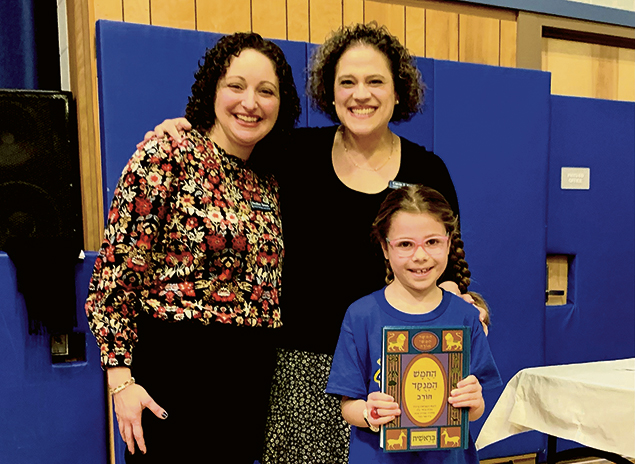
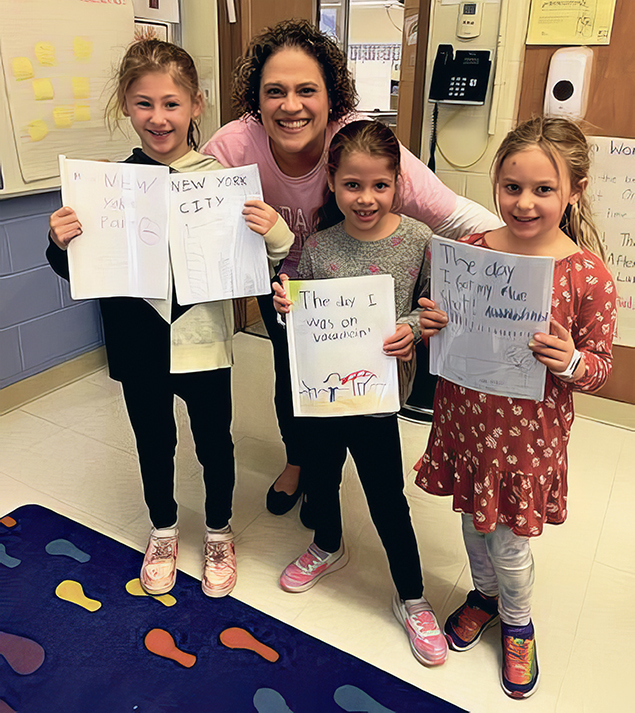
“But the co-parenting part! The people part! It gave me an incredible sense of fulfillment. And those parents who were with me at that time still will call to talk about something, to pick my brain about something. It’s not always easy to be a parent, or an administrator, but you are building trust, so that you as a parent are just one step removed from a person who can help you.”
So those three years that Ms. Siegel was going to spend at the lower school? They turned into 18 years. “I’ve been on the faculty for 27 years,” she said, her voice revealing a mixture of pride and astonishment.
During that time, Ms. Siegel and her husband, Jeff Siegel, have seen their two children, Stefanie and Zack, go all the way through GOA. (The name was changed in 2011.)
Jeff Siegel “runs a media distribution consultancy for a variety of clients from startups to legacy media,” Ms. Siegel said, disclaiming any possibility of explaining his work more clearly than that. “He’s from Milwaukee,” she said. “He went to a Conservative synagogue, but it’s just different in the Midwest.” Basically, he didn’t know what he was getting into — but he loves it.
“When he saw each of our kids become bnai mitzvah, he saw that they had no nerves. They were so poised. It wasn’t that way when you went to Hebrew school. To watch your own kids do that — it’s awesome.
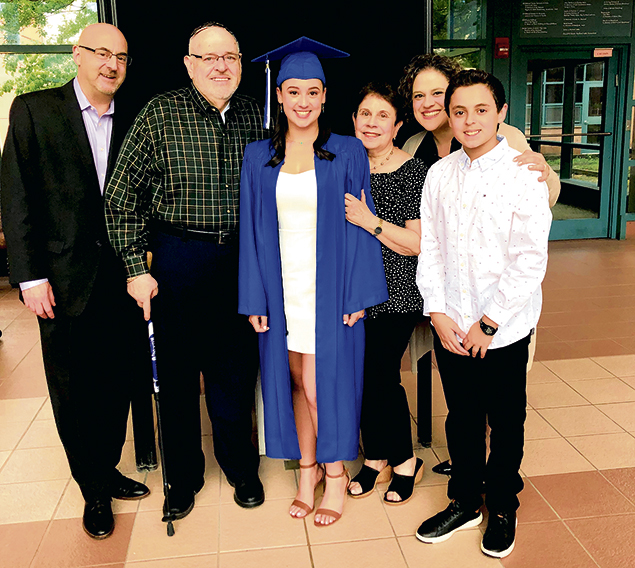
“He has been so happy to see the kids we have raised, and to see their friends. That’s because of the community. They are kind, they are respectful, they feel a sense of responsibility to the community — to the Jewish community, but also to the larger community.
“These are the kinds of experiences we are creating, to make the world around us a better place.”
Stefanie, who graduated from GOA and then from USC, is 24, works as a medical assistant, and hopes to become a physician. Zachary, also a GOA grad, is starting his sophomore year at the University of Wisconsin, moving from his mother’s turf to his father’s.
Ms. Siegel feels very deeply that everything in her life has led to where she is now. “We have built a community because I came home to South Orange and I came home to Solomon Schechter Day School of Essex and Union,” she said. “And I came home to the school as a parent and as a professional. When I say this has been my life, I don’t say it in the past tense.
“This is my life. I breathe and sleep it. This school is in my bones. I love having the chance to help our families — kids, parents, alumni — feel that.”
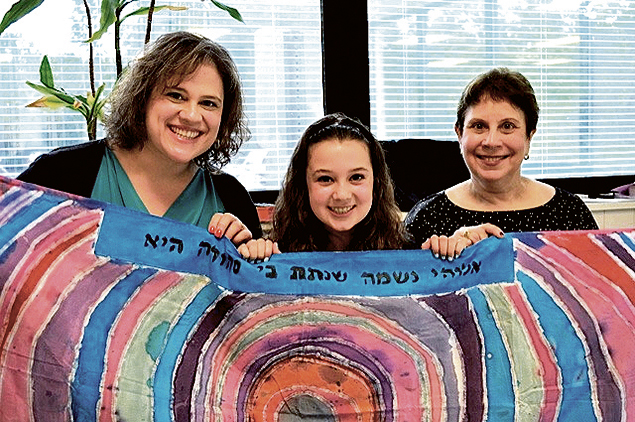
She’s not alone in that feeling, Ms. Siegel added. “25 percent of our current student body are the children of alumni or former students.” Some people move back to the area because they love it so, and others because they want their children to go to GOA. And a few kids who I taught have kids in the lower school this year.”
Students go to GOA from all over, Ms. Siegel said. “Our catchment area is very broad. We have students from 45 communities and many synagogues.”
Administrators are focusing on working with families from Hudson County, she said. “We have a group, maybe 15 kids now. Their families are choosing to stay in Jersey City and Hoboken, and we are working with them to make sure that the commute isn’t too hard. We’re sponsoring transportation and helping them see that they can have both worlds — the world of this school, and the urban world where they want to live.
“Wherever you go or don’t go to shul, wherever you belong, you can be part of us,” she added. “We are able to work with the broadest range of families who choose to be Jewish and an environment that respects their Judaism. People feel the respect. They feel welcome. When they make a decision to be part of us, they don’t always realize until they’re here how special it is.”
Ms. Siegel plans on spending time in both schools. She’s moved her office back to the upper school — where the head of school traditionally works — but she’s uprooting 18 years in the lower school, and she won’t let go of it.
“I will be present on both campuses. I will be in sacred spaces with teachers. Everybody who does this work does it in a very energized way, and I love that. That’s why I do what I do. That is my plan for continuing to grow. I am a big believer in the idea that you have to keep growing. You have to keep learning. And we model that for our kids. So I plan on taking everything that I have learned over time, and hopefully putting it to good use for my next chapter.”
She marvels at being 51 and having been at the school for most of its 60 years. “I want to give a nod to my predecessors,” she said. “To all the leaders, who have come before me and made me who I am. I have known and worked in some capacity with every one of them. These are the people who made me who I am.
“This is a continuum, and to be here for the 60th is a privilege.”