

Groovy
Sharon and I have been “Sesame Street” fans for decades. Its songs not only reverberated in our house as our children were growing up but also echoed in our car during long family trips, especially the Bert & Ernie Sing-Along album. So permit me to relive those days by playing the game described in Sesame Street’s “One of those Things (Is Not Like the Other).”
Here are your choices: 1. Professional saxophone player; 2. renowned biblical scholar; 3. photographer par excellence; and 4. avid tennis player.
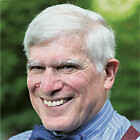
If you didn’t get the answer, don’t worry; it’s a trick question. Each of the four, as divergent as they are, is like the others because each one is among the many and varied talents and interests of Sharon’s brother, my late brother-in-law, Jordan Sterling Penkower, who died just before Rosh Hashanah in the Jerusalem he loved so dearly and lived in for 56 years.
After receiving his Ph.D. from Hebrew University, Jordan began an academic career that spanned decades as professor of Bible at Israel’s Bar Ilan University. His expertise, as noted by the Institute for Hebrew Bible Manuscript Research, was in “the transmission of the Hebrew Bible and the Masorah both in manuscripts and printed editions. His research and publications extend to broad aspects of the Bible in Rabbinic Interpretation, as well as Jewish Medieval Biblical Exegesis, especially that of Rashi. In his research on biblical manuscripts, including Torah scrolls, he visited the leading libraries and collections throughout Europe, Russia, United States, and Israel. Two of the major contributions of his research have been: (a) the importance of medieval Torah scrolls for the history of the transmission of the Pentateuch, and (b) the typological categorization of medieval biblical manuscripts and Torah scrolls according to geographical areas.”
Get New Jersey Jewish News's Newsletter by email and never miss our top stories Free Sign Up
Jordan’s oeuvre includes seminal work on the Aleppo Codex — the book that Maimonides relied on in setting down the rules for writing a sefer Torah. If you’ve read Matti Friedman’s book on the Aleppo Codex, you might also be interested in Jordan’s “New Evidence for the Pentateuch Text in the Aleppo Codex,” for which he received the 10th annual Samuel Belkin Award from Yeshiva University. But be warned — Jordan’s is in Hebrew, a language he learned to love, together with Zionist history, during summers spent in Camp Massad.
Whew, sounds pretty heavy. But one of the amazing things about Jordan was that he was able to take what might seem like a dry academic discipline and explain it with such clarity, depth, and excitement that he brought it alive to his listeners. This made them, both Jewish studies graduate students as well as those who never heard of Masoretic manuscripts, yearn for more.
And more is, in fact, coming; a two-volume collection of Jordan’s major articles (many of which he translated from the original Hebrew into English) is scheduled to be published posthumously by Brill.
Prof. Sid (I knew him as Shnayer in my Far Rockaway days) Leiman has already given it the following blurb: “The Penkower volumes will become required reading for every student and scholar who wishes to master the history of the formation of the Hebrew Bible and how it gained its present form (in terms of spelling, vocalization, cantillation, and its chapter and verse division) in print.”
Shnayer also sent an email to the family, which said, in part: “It is no exaggeration to say sar ve-gadol nafal be-Yisrael — a prince, a great man in Israel, has fallen this day. (Samuel 2 3:38) Jordan was a master scholar of Tanakh, Masoretic Studies, and Biblical Exegesis, and a dear friend. His passing is a staggering loss to the world of scholarship, and to all who knew him.”
Other leading scholars sent condolences as well. Rabbi Dr. Efraim Kanarfogel, professor of Jewish history, literature, and law at YU’s Bernard Revel Graduate School, called Jordan “a great scholar and a great fellow,” and Dr. Marc Brettler, professor of Judaic studies at Duke University, wrote, “I knew, liked, and respected him so much.”
These colleagues were Jordan’s friends and contemporaries. But Jordan’s influence and impact is broader than that. Just before Sharon and I left for Israel to visit with Jordan in the weeks before his death, we chatted with Dr. Yitz Landes, the son of a friend. Yitz is an assistant professor of rabbinic literature and cultures at the Jewish Theological Seminary. After realizing that Jordan was Sharon’s brother, Yitz told us: “I didn’t know him personally, but I use his books all the time.” Jordan’s scholarship thus touches not only Yitz’s generation but that of Yitz’s students as well.
Although Jordan was a product of YU — high school at MTA, BA from Yeshiva College, semicha from RIETS, an MA in math from Belfer Graduate School of Science, and an MA in Bible studies from Bernard Revel — the fact that a JTS scholar uses his work was not surprising. Indeed, JTS posted a deeply moving remembrance of Jordan on its Facebook page, calling him “a longtime friend of the JTS Library and Rare Book Room,” and noting that he “was a regular visitor here for many years, known for his keen eye, boundless passion for the text, and endearing manner. His curiosity and intensity made him both a serious scholar and a lively presence.” Whoever wrote that clearly knew Jordan well — endearing manner and lively presence, indeed.
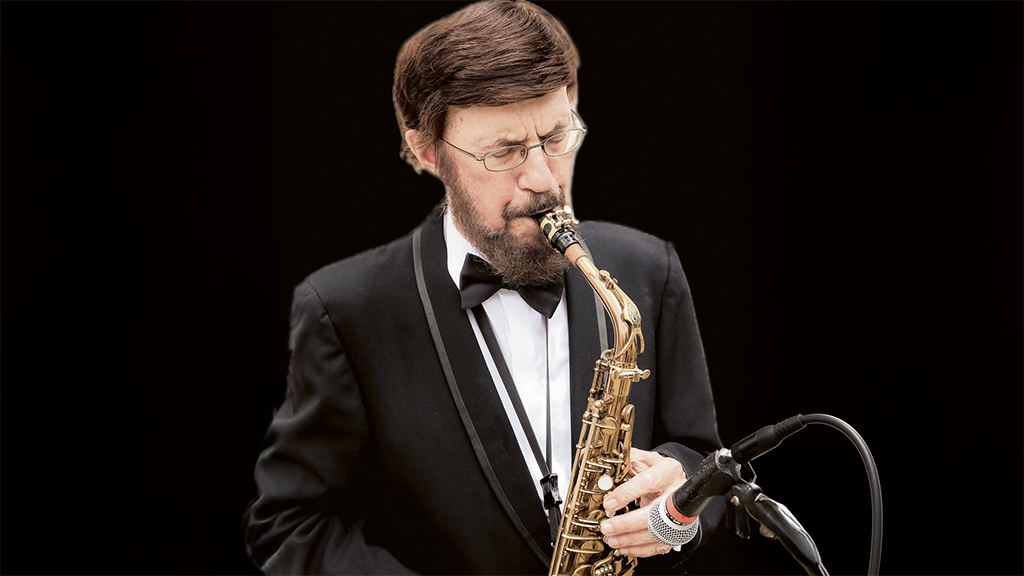
Returning to our “Sesame Street” quiz, let’s remember that there were other aspects of Jordan’s talents and interests that extended far beyond his scholarship. Jordan also was a superb alto saxophonist taught by the renowned Joe Allard, and his 1966 Mark III Orchestra’s “The New Jewish Sound” album was exactly that — a new sound for Jewish music that caught the attention of a younger generation and paved the way for much of the Jewish music we know today.
Jordan played the sax and led bands at weddings, especially family ones (ours was his first), until peripheral neuropathy cut his music career, as well as his tennis playing days, short. Or so we all thought. However, after Western medicine proved unable to cure him, he switched to a macrobiotic diet that he followed rigorously, and feeling eventually returned to his fingers, though he continued to live with pain that most of us did not realize because complaining was one of the few things he did not excel at. And so, at his niece Yonina’s wedding, after not having played his beloved sax for about 15 years, his heartwarming rendition of Ve-Ulai left many in the crowd, realizing what his playing meant, weeping tears of joy.
And then there’s his photography, which he loved so much and did at a professional level. He was our family photographer, with an extensive archive of photographs dating back to his teens, which he would often share with us. But when, at shiva, we laid out a slew of pictures of Jordan on the coffee table for visitors to peruse, there was a problem — they weren’t the best pictures of the event at which they were taken. The best ones were those Jordan took; the ones in which he appeared, of necessity taken by others, were good but without Jordan’s almost perfect eye and skill.
Jordan was also able to integrate his photography with his biblical scholarship. On his many international trips to examine manuscripts and Torah scrolls, he took time to visit and photograph synagogues, museums, and churches. A selection of such photographs formed a critical part of one of his most popular public lectures, “The Ten Commandments — From the Bible to Rembrandt,” which was a PowerPoint presentation on the history of illustrations of the Tablets of the Covenant and the Ten Commandments from the Bible through the Middle Ages, in both Jewish and Christian art.
There’s more, of course, but space constraints allow me to capture only so much. So, using Jordan’s terminology, I’ll end by giving you some rashei tevot — an abbreviated version — of a bit more of his very rich life.
He was a terrific guest, leading zmirot and teaching new ones at many a Shabbat table, accompanied by his trademarked finger drumming and conducting.
He was deeply committed to family, especially his parents, siblings, nieces, and nephews, and made an effort to visit the States each year, sometimes more than once, attending all family smachot and other events. (His very last trip was to attend and take pictures at our grandson Devin’s brit just over two years ago.) These visits would also include a whirlwind of excursions to museums, theaters, movies, libraries, parks, and historical houses, making it seem that there were more than 24 hours in his day.
He was an uncle par excellence to his nieces and nephews on both sides of the Atlantic, taking the American ones under his wing during their gap year in Israel, and being a surrogate father to the Israeli ones as they awaited the day of their Brooklyn parents’ aliyah following semi-retirement. And he knew each as an individual, sharing his recommendations for novels, articles, non-fiction histories, and movies with curated email groups, carefully choosing who received what based on their interests. And he rarely got it wrong.
And finally, some of you who didn’t know Jordan personally may be wondering about this column’s title. Here’s the explanation. In many ways, Jordan was a man of his times; in his later years he did much of his research on his computer while sitting in his apartment, examining manuscripts that earlier in his career would have required an international trip. And yet in other ways he always had a foot in the 1960s, especially in language. So Jordan often called things he liked “groovy,” and from him it sounded perfectly natural even in the 21st century.
It takes a special person to use, as Prof. Jordan Sterling Penkower did, “groovy” and “hapax legomenon” in the same sentence. It takes a sterling person indeed.
May his memory be for a blessing.
Joseph C. Kaplan, a retired lawyer, longtime Teaneck resident, and regular columnist for the Jewish Standard and the New Jersey Jewish News, is the author of “A Passionate Writing Life: From ‘In my Opinion’ to ‘I’ve Been Thinking’” (available at Teaneck’s Judaica House). He and his wife, Sharon, have been blessed with four wonderful daughters and five delicious grandchildren.