

Happy birthday, Temple Emanu-El!
You don’t look 180!
But in fact the venerable synagogue on Fifth Avenue in Manhattan is that old, and it’s marking the occasion with an exhibit about Jews of the Gilded Age — many of whom were members there then.
Among the objects on display is a portrait it borrowed of one of its storied neighbors from its regular home 20 blocks north.
“I am thrilled that for the first time, we have a loan from the Metropolitan Museum of Art,” Warren Klein, the director and curator of the synagogue’s Herbert and Eileen Bernard Museum of Judaica.
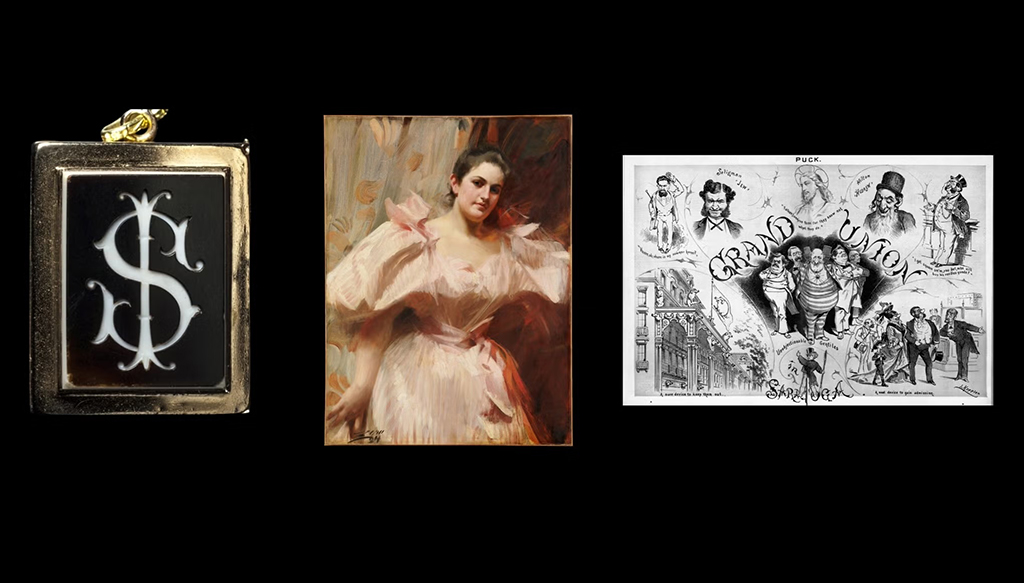
The portrait is of Frieda Schiff Warburg (1876-1958), philanthropist and daughter of banker Jacob Schiff. Her father was one of the Jewish titans of what is called the Gilded Age, a time of rapid economic growth in the United States, generally dated from the late 1870s to the late 1890s.
Warburg was associated with Emanu-El, making her a fitting addition to the retrospective on how the venerable Reform congregation helped shape American Jewry.
Founded in 1845 on the Lower East Side, Temple Emanu-El was the first Reform congregation in New York City. Though its beginnings were modest — the 37 founding members met in a rented room in a private home — it grew into one of the most influential synagogues in the United States. The congregation was an early adopter of mixed-gender seating and English-language prayer books, and it also introduced the use of organ music during services. (Its organ, still in use today, is the largest synagogue organ in the world.)
“We could have done an exhibition just on our history,” Klein said, pointing to unique artifacts in the museum’s holdings, such as the first Jewish hymnal printed in the United States, created by the congregation’s third rabbi, Gustav Gottheil (1827-1903).
But he said the popular HBO series “The Gilded Age” was one of several indicators of broader interest, spurring the museum to widen the exhibition’s scope.
“Drawing upon the recent zeitgeist and interest in all things Gilded Age, why not look at some of the Jewish stories that are often overlooked in the mainstream narrative?”
The two-room exhibition features one room dedicated to the synagogue’s own history. Items on display include a machzor, or High Holiday prayer book, written by Emanu-El’s first rabbi, Leo Merzbacher (1809-1856), and a deed for a pew — an old-fashioned way of maintaining membership at a synagogue.
The second room takes a closer look at some of the synagogue’s wealthiest and most powerful member-families of the late 19th century. To set the stage, there’s a large-scale, “extremely simplified” family-and-business tree depicting New York Jewish families of the Gilded Age. Taken from Stephen Birmingham’s 1967 book “Our Crowd: The Great Jewish Families of New York,” the tree shows how “The 100” — the Jewish version of high society’s “The 400,” which included families like the Astors and the Vanderbilts but excluded Jews — preserved their wealth and status through marriage and joint business ventures.
In addition to the Warburg portrait, there is also an antisemitic political cartoon depicting banker Joseph Seligman, also an Emanu-El member, being denied entry from a hotel in Saratoga Springs by owner Henry Hilton. It is believed to be the first documented instance of antisemitism to be widely condemned in both the Jewish and secular press in the United States.
Also on view are items belonging to Isidor and Ida Straus, the wealthy Jewish couple who famously died together on the Titanic. (Isidor [1845-1912], an immigrant from Bavaria, started out in New York as a crockery vendor at R.H. Macy and Co.; eventually he and his brother, Nathan, owned the entire department store.) Though Ida’s body was never found, Isidor’s was — a watch fob engraved with his initials, which likely hung on his pocket watch, was recovered from the wreck and is on display, next to the couple’s marriage certificate and photos of the Straus family.
“I think it’s very surprising for people to know that there’s something in our museum that was on the Titanic,” Klein said. “I think there is a great weight to an object like that that survived such a disaster. The owner didn’t survive, but this is still in the family.”
After years of renting rooms on the Lower East Side, Temple Emanu-El bought its first building, a former Methodist church at 56 Chrystie St., in 1848. The congregation moved to East 12th Street in 1854; in 1868, it moved to 43rd Street and 5th Avenue, where it erected a grand Moorish Revival synagogue. The congregation has been at its current address at 1 East 65th St. — an architectural marvel that’s a mix of Romanesque Revival, Moorish Revival, Byzantine and art deco styles — since 1929, following a merger with nearby Temple Beth-El. With some 2,500 member families today, Emanu-El is one of the largest synagogues in the world.
“Emanu-El at 180” is on view at the Herbert and Eileen Bernard Museum of Judaica, at 1 East 65th St., through May 17.
New York Jewish Week/Jewish Telegraphic Agency