

Hard hats, schmattas, and political violence
Our correspondent finds the unifying thread with filmmaker Marc Levin

It wasn’t so much a Zoom interview as it was a Zoom conversation with Marc Levin.
Mr. Levin is a filmmaker who has made some of the most thoughtful, important, and telling documentaries of our time, films that resonated when they first were released and proved prophetic years later. Many have won prestigious awards (Emmys, a Peabody, and film festival prizes).
Three in particular have left their mark on me.
They are “Schmatta: From Rags to Riches to Rags,” about the American garment industry; “An American Bombing,” about political violence in the country; and now, “Hard Hat Riot,” which debuts September 30 on PBS as part of the American Experience series. It deals with the attack by construction workers on people protesting the Vietnam War.
I start by asking if he feels there is a consistent theme to his work. “Well, I’m sure there are,” he said. “You might be a better judge of that than me. There are a number of areas I return to, and certainly, you mentioned ‘Schmatta.’ Obviously, what occurred to working families is an area of concern and focus of some of my films.
“‘American Bombing’ and quite a number of others look at the violence in our society and try to understand its roots. And again, the economy is certainly a key part of that, although there are a lot of other social issues at play.
“So, yeah, I guess the social, political, cultural morass and madness and trying to decipher and make sense of it is a consistent theme in my work.”
And, finally, “Hard Hat Riot,” about the time in May 1970 when construction workers attacked college students protesting the Vietnam War.
There is a connective tissue between these three films that starts with “Schmatta” and ends, well, where we are now.
“Schmatta” was about the garment industry, which in the 1950s was largely based in New York City. The industry was made up of mostly small, family-owned businesses that produced almost all the clothing worn by Americans — and provided thousands of jobs for immigrants like my father. It was a doorway into America and then into the middle class.
But often second- and third-generation owners had goals beyond the rag trade, and even those who wanted to stay in the business faced onerous inheritance taxes. So eventually family companies were sold to large corporations, and the emphasis went from long-term security to immediate reward, earnings per share, and stock options.
It was an early crack in the fabric that held us together.
Materials that used to be bought from the company down the hall were much cheaper when they were imported from Asia. Workers? Forget about looking for the union label. Companies moved their operations first to s union-free states in the South and then out of the country entirely.
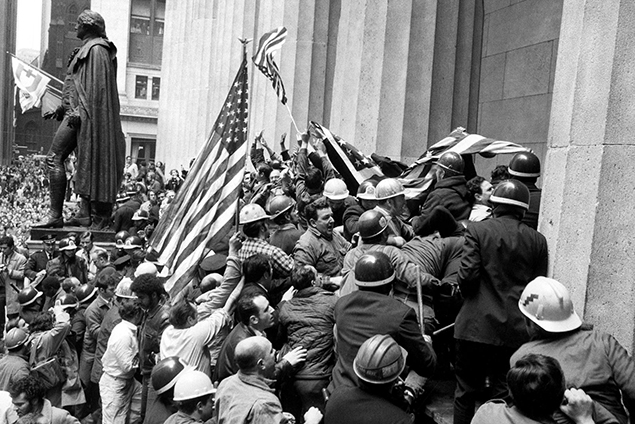
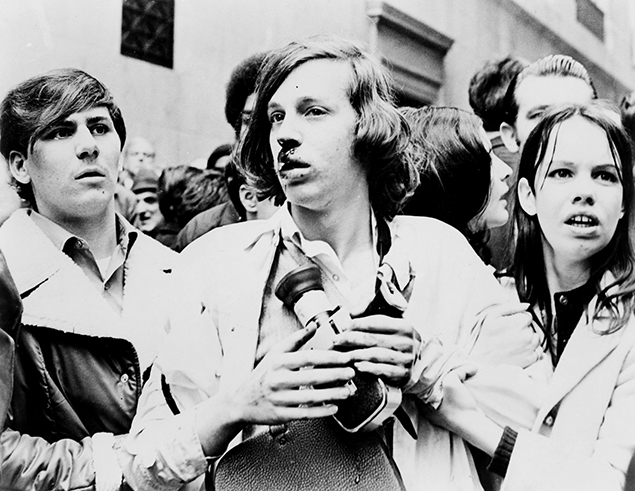
The new film, “Hard Hat Riot,” is chronologically the center of the triptych. It is set primarily in the first week of May, 1970, in the midst of student antiwar demonstrations. A few days earlier, National Guard troops had shot and killed four college students at Kent State in Ohio. Four days later, there was a massive student demonstration at the Federal Building in downtown Manhattan.
Hundreds of construction workers walked off their site at the World Trade Center and marched to the demonstration. A riot ensued.
Using archival footage and interviews with participants — both construction workers and students, politicians, and cops who were there — Levin paints an unexpected picture of the day’s events, at least as it struck me.
This may surprise you, I tell him. But your film gave me a lot of sympathy for the construction workers.
“It doesn’t surprise me,” he replies. “Because that was the intent. The book that inspired it” — “The Hard Hat Riot: Nixon, New York City, and the Dawn of the White Working Class Revolution” by David Paul Kuhn — “tried to help us understand how these construction workers and a lot of working-class families here in New York City back in the ‘60s and ‘70s saw it all. I didn’t want to stereotype them, turn them into cartoons or characters of disrespect.
“What makes it unusual is that it’s a film about 50 years ago, but it could really be about today. The spring of 1973 and the completion of the World Trade Center is really the end of the moment where working-class Americans were aggregating wealth.
“Ever since then, there’s been a greater and greater class divide, with a greater and greater percentage of our wealth going to the top 0.1 percent.”
But there was a cultural divide, too, “where it gets a bit confusing, and that’s what our film speaks to, also. There was a language of patriotism, faith, and family that some of the working class embraced. Even those who didn’t necessarily support the war. And after the Tet Offensive, the majority of Americans turned against the war.
“Still, they” — the construction workers — “respected the flag. They respected the veterans, and they felt the language of the counterculture and the antiwar movement was disrespecting, humiliating, and ignoring their concerns.”
While I obviously don’t endorse violence, as I watched this film I understood the frustration of these workers. They were sending their sons off to fight while (as they perceived it) these elitist college students were waving the Viet Cong flag and attending school to avoid the draft.
I didn’t understand this then, but it became clear watching the film now. Like them, I was raised to believe in America. An America that was always on the right side of history.
“It’s ironic that the guys who built the World Trade Center and came down from those iron beams to take on the student protesters were also the ones that were left behind by everything the World Trade Center came to symbolize — globalization, a new world order that was much more pointed in the direction of finance and business than it was for working people,” Mr. Levin said.
It also marked the beginning of the migration of working people — typically Democrats — to the Republican Party. Richard Nixon recognized the moment and curried favor with them, appointing labor leaders to high government positions.
“He had the intuition from his own working-class background to realize that the Republican Party, if it was going to have a future, couldn’t just be the party of the blue bloods, but that it had to include the blue-collar.”
That class divide, Mr. Levin continued, “is foundational to everything we’re dealing with, all the lunacy we’re dealing with this week.”
He was referring, of course, to the murder of Charlie Kirk a few days before we spoke. But there were other stories to enrage as well. The New York Times ran a front-page article about rich folks from Brooklyn, summering in Maine, who were upset that their neighbors’ trees blocked their view, so they poisoned them. The trees, not the neighbors. How entitled do you have to be to do something like that?
Read on.
The board of directors of Tesla offered Elon Musk a compensation package that would give him nearly $1 trillion if he meets certain performance targets. That’s a one followed by 12 zeros.
The Tesla board chair, Robyn Denholm, told the Times that “Mr. Musk could achieve world-changing technology if motivated by seemingly impossible goals.” How about keeping your job as an impossible goal, you know, like the rest of us?
Getting a little warmed up as we discussed this, I switched the subject and asked Mr. Levin where he had been on hard hat day.
A Knicks fan, the then-19-year-old was in New York, working as an apprentice on “Gimme Shelter,” the Maysles brothers’ film about the Rolling Stones. “I was listening to [all-news radio 1010] WINS because I was a basketball fanatic,” he said.
“I’ve been a high school player, and that night the Knicks were playing the Lakers in game seven of the NBA finals. I wanted to hear all the reports about Willis Reed, who had been hurt.
“All of a sudden, this news alert comes on: There’s fighting breaking out on Wall Street. I’m listening to it and thinking; : If I wasn’t at work, I’d probably be down there myself.
“That night the game was not on live TV. It was the beginning of cable. So I went to an Irish working-class bar on the Upper West Side and I remember wondering if any of those guys I was watching and cheering with were downtown early in the day stomping on my friends.
“Then celebrating the victory, the first NBA Knick championship, a bunch of working-class guys you know, me in the middle of it. The point being it was hard then and it’s hard now to find places where in such partition times, such charged times, such chaotic times, we can talk across political, ideological, and class differences and actually relate to each other.”
Mr. Levin was born in New York but grew up first in Elizabeth and then in Maplewood. His grandfather, Herman Levin, was president of the Conservative East Midwood Jewish Center on Ocean Avenue in Brooklyn. But he became involved in the Reconstructionist movement, which is why his bar mitzvah was at the Reconstructionist Center on the Upper West Side. Bar mitzvah guests included Mordecai Kaplan, the Reconstructionist movement’s founder — but not all of Marc’s friends.
“It was February 1964, and that Saturday the Beatles, who had just arrived in the United States on Friday, did a shoot in Central Park. When I was doing my haftarah on the bima, I looked down and saw all my friends leaving the shul and I was like, what’s going on? Later at the reception I heard they heard the Beatles were being photographed literally right down the street in Central Park, so they left.”
Despite that shaky start as a man, Mr. Levin reaffirmed his connection to his Judaism in the spring of 1973 when he went to Israel to shoot a film about the country’s 25th anniversary. Filming a military parade, he stood within feet of Golda Meir, David Ben-Gurion, and Moshe Dayan, “the founding mothers and fathers of Israel.”
“I ended up making friends there, getting involved,” he said. “It was an eye-opener, seeing a society where the bus driver is Jewish, the plumber is Jewish. Everybody’s Jewish. And as I said, I was a basketball player, and the star of my high school team was playing professional basketball in Israel, and I tried out. But it was a fantasy. I quickly got lost in that world. But I did live in the Sinai for a while when it was part of Israel after the ‘67 war. So you know that really deepened my connection.”
There was one more connection: his great-grandfather Isaac was a wealthy philanthropist who once owned a house that’s now on the Lubavitch grounds in Brooklyn and used to house women from Eastern Europe.
Mr. Levin was in the area filming “Brooklyn Babylon,” an interracial love story, when “I was called in to see the spiritual advisor of the Lubavitch.”
Mr. Levin doesn’t remember his name but was told he had been a close advisor to the late Rabbi Schneerson.
“He told me he’d heard about my film and said your great-grandfather is speaking to you right now right here. You know we inhabit that building. So why are you doing this? Why are you doing a love story about a young Orthodox Jewish woman and a young Black rapper?
“At that point I was deep into the Song of Songs elements of the Old Testament, where different characters cross over and become involved with someone that’s not part of the tribe. I told him there were these stories in the Bible of those who had stepped out, like Solomon and Sheba.”
The rabbi’s response: “I’m surprised you are so well-read.” And that ended that.
“Hard Hat Riot” debuts on September 30 on PBS American Experience.