

How do you debrief a hostage?
Glenn Cohen’s winding career prepared him for that task
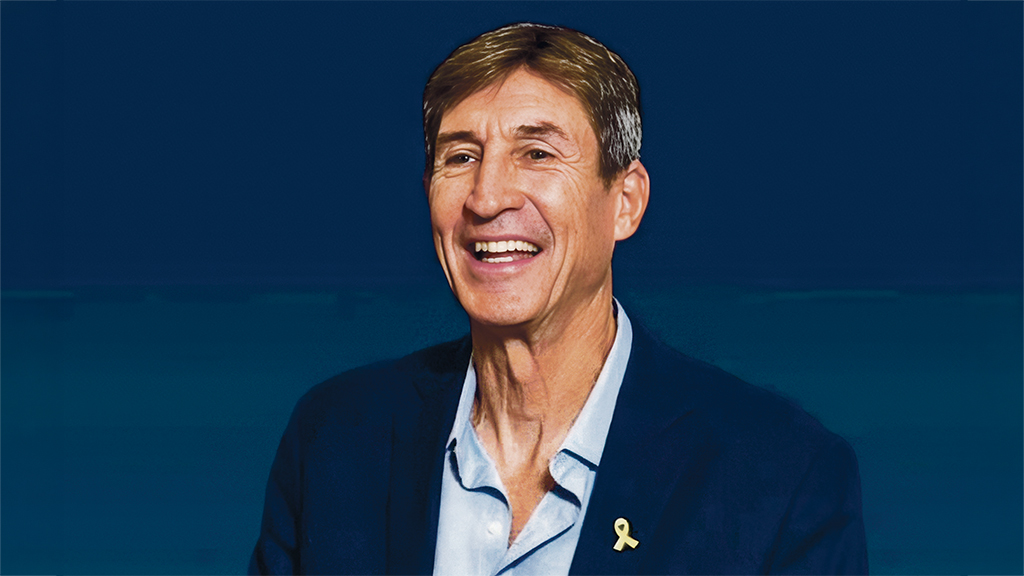
To call Glenn Cohen’s life trajectory unlikely is to understate.
It is in some ways almost a Horatio Alger story, except that Mr. Cohen was born not only with unusual talents but also with some advantages, even though he faced outsize challenges, which he overcame with fierce determination as well as élan. (And of course Horatio Alger’s heroes never were Jewish, so there’s that.)
It’s both deeply American and deeply Israeli. (That part makes sense — Mr. Cohen was born in New York, made aliyah, and now lives in the Judean Hills.)
Mr. Cohen was the Mossad’s chief operational psychologist, and he was in charge of the teams that debriefed every hostage who had been held in Gaza and released alive.
He is going to speak about the hostages for the Jewish Federation of Northern New Jersey on April 30. (See below.)
Mr. Cohen grew up in Queens — in Whitestone, and then in Bayside. His grandfather was Rabbi Dr. Boaz Cohen, whose smicha was from the Jewish Theological Seminary and doctorate was from Columbia. Rabbi Cohen, who taught at JTS, where he also was known as Professor Cohen, was a prominent scholar of both classical and medieval rabbinic literature, the author of such academic book-length works as “Law and Tradition in Judaism,” “Jewish and Roman Law, a Comparative Study” and “An Annotated Bibliography of the Rabbinic Responsa of the Middle Ages,” and a posek, a decisor of halacha, ruling from his position on what was then called the Committee on Jewish Law.
Mr. Cohen’s father, Raymond, and his mother, Barbara, had a classic meet-cute, possible only in that more innocent time, but their strength comes through. “In the late 1950s, when there were barely any airplanes, and almost no one got on one, my mother flew to the States from Sweden to be an au pair for a family in Englewood Cliffs,” Mr. Cohen said. “On one of her days off, she came into the city on a Sunday and was walking down Eighth Avenue when my father came out of a Knicks game at the Garden.
“The Knicks lost, and my father wasn’t a happy camper, but then his eyes lit up, he would say, as he saw a gorgeous blonde walk in his direction. As he passed her, he said, ‘Nice shoes!’ and she saw this tall, handsome guy, and she said, ‘Thank you,’ and he invited her for a cup of coffee.
“And the rest is history.”
They got married. “My grandfather also fell in love with my mother. He asked her to promise that her children” — who were not yet born — “would get a proper Jewish education, and she promised him that they would.”
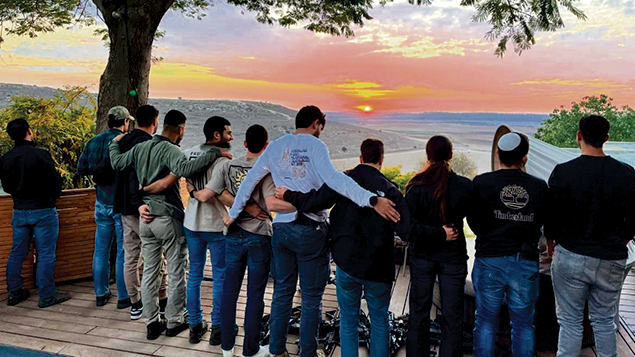
(All photos courtesy Glenn Cohen)
Rabbi Cohen died when Glenn was 4. “I remember his apartment in Washington Heights,” he said. “There were thousands of books. Ten thousand books. He left then all to JTS, except the Encyclopedia Britannica, which he left to my brother, and a Shas, the Talmud, that he left for me.”
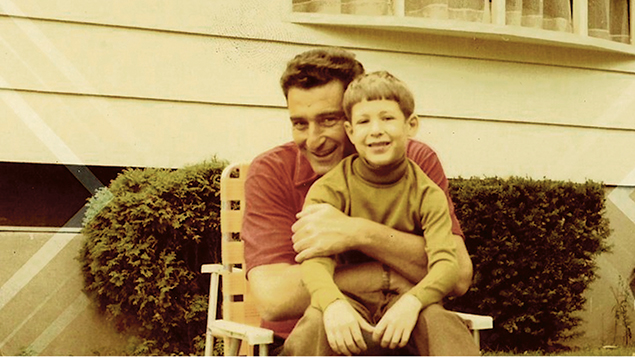
Rabbi Cohen’s death was hard — he was only 69 years old — but a worse blow came just two years later. “My father died when I was 6,” Mr. Cohen said. “He was 41 years old.
“Trauma is an opportunity for growth,” he continued. “In retrospect, that became the defining moment in my life.”
That’s when he became the Iceman internally. “I decided at that moment that I don’t need anybody,” he said. “‘I am a rock. I am an island.’” In an odd twist of connectedness, here was one Jewish boy from Queens quoting another one, Paul Simon of Forest Hills.
The situation was grim. “My mother was left alone, a Swede, in New York City, with no family there,” Mr. Cohen said. “I was 6. My brother was 10. So she took us back to Sweden to be close to her family.
“We studied for a year at the Anglo American school in Stockholm. She took us to a few different Sunday schools to see if we could get a Jewish education, but I will never forget what she said.
“She said, ‘This isn’t good enough for Grandfather Boaz. I promised him a proper Jewish education, and this isn’t good enough.’ So she brought us back to the jungle of New York City.
“That is integrity.”
Mr. Cohen is also a motivational coach, speaker, and writer; he draws inspiration from his life. He teaches leadership and calls his model ELITE — the I at its center is integrity. When he thinks of that attribute, he thinks about his mother. When he explains it to his students, he talks about her.
Back in New York, Ms. Cohen enrolled her sons in the Heller Hebrew Academy (now part of the Yeshiva of Central Queens); when they graduated from eighth grade there, they went on to the Ramaz School on the Upper East Side.

“We really had no money,” Mr. Cohen said. “Our mother was living off her Social Security. HHA and Ramaz took us in and gave us financial aid. Many people get financial aid. Only when I was in my 30s did I learn what Ramaz really did for us.”
Here, Mr. Cohen credits one of the “guardian angels,” people who “extended an arm or a hug,” looked closely, cared deeply, and did what they thought was necessary.
“My first guardian angel was a teacher at the Heller Hebrew Academy, Rabbi Shmuel Shoham,” Mr. Cohen said. “He looked out for us. He petitioned our cause. He got us into Morasha for summer camp — it gave us a full scholarship — and then he petitioned our cause at Ramaz.
“After Rabbi Shoham passed away, I made a donation to the Ramaz scholarship fund in his memory, and I wrote a letter to Rabbi Lookstein,” Mr. Cohen said. (Rabbi Haskel Lookstein now is rabbi emeritus of Congregation Kehilath Jeshurun, the shul to which Ramaz is connected; he led it for more than 50 years. He also was Ramaz’s principal for almost all that time.)
In that letter, “I asked him if he remembered the story” of Rabbi Shoham advocating for the Cohen brothers, “and asking — hoping — that there is no statute of limitations on gratitude. On hakarat hatov. It was a very emotional letter.
“He wrote me back a beautiful letter, saying that of course there is no such limitation on hakarat hatov, and that yes of course he remembers the story. Yes, Rabbi Shoham petitioned your cause, and yes, you paid $25 a year in tuition.
“Together we paid $200 to go all the way through Ramaz. Two hundred bucks.
“I want people to hear that story. As long as I can give Rabbi Lookstein a little bit of nachas, it is such a privilege to do it.”
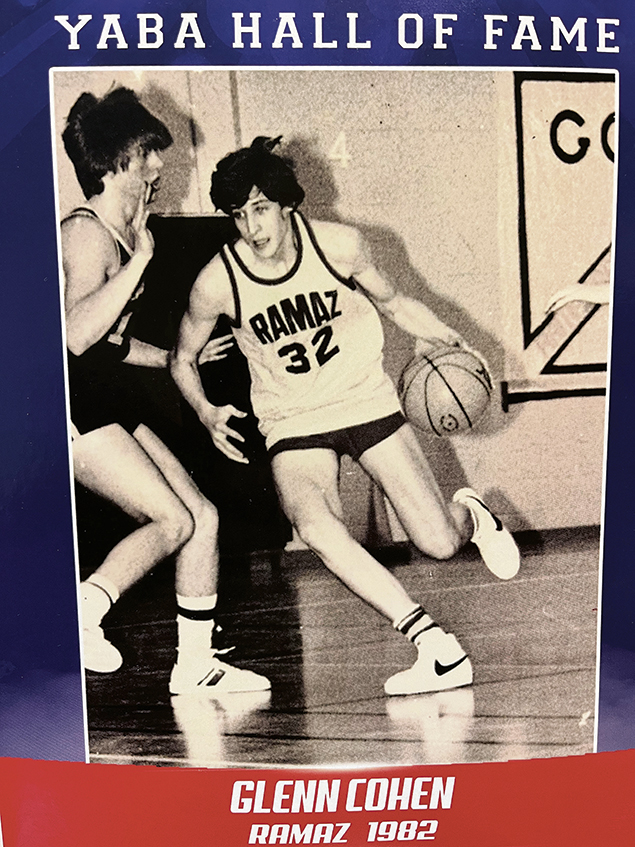
Mr. Cohen played basketball at Ramaz; not only was he a gifted player, he was also 6’4”. My nickname at school was the Iceman,” he said.
That’s because, “in the Marc Sackin Memorial Tournament at Flatbush in 1981, I sank eight foul shots in the last minute of the championship game.
“There were 600 fans booing and hissing and banging pots and pans, and I sank eight in a row. The next day, in the Ramaz school newspaper, the Rampage, the headline was The Bush Burneth as the Iceman Cometh.
“So Iceman was my nickname.” It was official. “People said that I had ice in my veins” — and they were right.
“Rabbi Lookstein also was a basketball player,” Mr. Cohen continued. “He had a two-handed set shot. He would play in the student/faculty game. He appreciated me. I became the captain of the varsity team. He was proud of me.
“In 2019, I was inducted in the Yeshiva High School Basketball Hall of Fame,” Mr. Cohen said, jumping ahead in time to continue his story. “Before I went to get this honor, as soon as I got off the plane, I went straight to Rabbi Lookstein’s office. I met with him, and brought him my second pair of air force wings, in a frame, with a dedication saying ‘I owe these wings to you. Ramaz enabled me to soar high.’
“Rabbi Lookstein has a lot of stuff in his office,” memorabilia showcasing former students’ accomplishments, “but he put this one front and center on his desk, and to this day it is front and center,” Mr. Cohen says. “I’m a Ramaz poster boy; he tells donors my story.”
Mr. Cohen graduated from Ramaz in 1982. “I got a scholarship to Brandeis.” His plan was to play basketball at Brandeis, graduate from Brandeis and then become a lawyer. But first, he wanted to spend a year in Israel.
By now, it is so standard for yeshiva graduates to do a gap year in Israel that it tends to be more surprising when they decide to go straight to college or spend the year elsewhere. In fact, Mr. Cohen said, when he decided to spend his gap year in Israel, the term gap year was yet to be coined. But he went.
“It was 1982, the first Lebanon war,” he said. “I had never been to Israel before. I was overwhelmed by discovering my roots and my connection to Jewish history, the Jewish people, and Jewish continuity. It was such a powerful experience.
“And also, this was during wartime. I would see guys my age going back and forth to Lebanon to fight for the state of Israel, and I was on my way to drink beer and play basketball. That created a sense of dissonance for me.
“Another turning point in my life was in November 1982. It was the Tyre disaster, when a suicide bomber brought down the IDF headquarters in Tyre, Lebanon; 75 IDF soldiers and Shin Bet operatives were killed in one shot. There hadn’t been anything like it.
“There was a mass funeral at Har Hertzl. Dozens were buried at the same time. I was at BMT — it’s now called Torah Shraga — and they sent a bus of us to the funeral.
“This was my first funeral. My mother protected us. She didn’t allow me to go to my father’s funeral. So here I am, at my first funeral ever, with thousands of Israelis converging on the graves and walking down the aisles and crying and wailing.
“It was a very powerful experience for me. At that moment, I had an epiphany.
“The Israeli reality became crystal clear to me. Every single Israeli knows someone who is a casualty. I realized that if I want to feel that I have an equal stake in the state of Israel, I have to risk my life.
“At that moment, I decided to stay there. I never went back on that decision. I never went to Brandeis. The joke is that to this day, Coach Kevin O’Brien is still saying, ‘Cohen! Where is he?’”
But how can he convince his mother? “I made a plan,” he said. “I called it the salami plan. I did it slice by slice. I didn’t tell her immediately that I wanted to go to the army. In order for me to have the most meaningful military service, I had to be as prepared as possible, and that meant improving my Hebrew.” Even though Ramaz had a good Hebrew-language program, he wasn’t quite ready to live a fully Hebrew-speaking life. “A year at Bar Ilan would improve my Hebrew,” he said.
“So I told my mother that I want to go to university. And what Jewish mother would say no? She was fine with that.
“But I knew that after a year I would go and draft, so in the middle of the year a week before Purim, I wrote a letter to my mother.”
Mr. Cohen’s mother died about five years ago. “I went through her apartment, and I found a box of letters that she’d kept,” he said. “It included this one.” When he reread it, 40 years later, he saw that “I wrote, ‘Mom, I have decided that I want to join the IDF.’ And she wrote commentaries in the letter,” like in a textbook, “and she underscored that line with three exclamation marks and wrote WHAT?
“And then she got on a plane and showed up in Israel the next day to convince me not to go into the army. She had never been to Israel before. I decided to show it to her. So we would drive up north and pick up a guy in his 50s on reserve duty, or see an 18-year-old with a rifle across his knees sitting on the bus.
“That exposed her to the reality of life in Israel. It showed her that the army is part of life there. We had heart-wrenching discussions and arguments. She begged me not to go. A lot of tears were shed in the Carlton Hotel in Tel Aviv, sitting there in that room overlooking the sea.
“This went on for a week. Finally, on the last day, I took her to the airport, and as we were going to the gate she turned around and said, ‘Glenn, I understand. You have my blessing.’”
Mr. Cohen studied geography and Land of Israel studies at Bar-Ilan. “I grew up in Queens, with no nature around,” he said, underplaying Jamaica Bay and the city’s park system, but still making his point. “The big school outing, once a year, was to Central Park, for Lag B’Omer,” he said. “But when I got to Israel, all of a sudden everything was so close. Everything was so accessible, and full of history and natural history. In a three-hour drive, you can go from snowcapped Mount Hermon to the lowest place on earth,” the Dead Sea.
“So when I got to Israel, I discovered two passions. One was for the land of Israel, and the other was for the State of Israel.”
He got a new nickname then. He was Map Man. And it represented growth. Some of the ice started to thaw.
Mr. Cohen is a big proponent of the gap year. “It has the potential to be transformative,” he said. It was for him.
“For me, it was being so connected to the land of Israel. I wasn’t an outdoorsman in Israel, but I became a tiyul animal.” An obsessive journeyer. “I led a group of 10 yeshiva guys on a tiyul, Yam el Yam,” from the Mediterranean to the Sea of Galilee. “We were thrashing through the bush on the first day, and when we get to the resting spot, they all said, ‘Glenn, we are going to the Netanya beach instead.’ And I am like, ‘I’m okay. I am a rock. I don’t need you guys.’ But my roommate decided to stay with me, and we did the whole thing. We had just a map and a compass, and we navigated our way to the Kinneret. And an incredible sense of accomplishment kicked off my career as a tiyul animal, fueled by the passion to really know the country. To know the land.”
The term to know the land is yidiat ha’aretz in Hebrew, Mr. Cohen said. That’s the same verb the Bible uses to describe the relationship between husband and wife. It’s a very intimate kind of knowledge. “I fell in love with the country,” he said.
He developed a new life goal. “I wanted to be a tour guide,” he said. That’s a different kind of job in Israel than it is in the United States; it’s “almost like being an ambassador,” he said. It involves showing the land’s marvels and helping that shape people’s understanding of both the land and the state.
But then there was his other, longer-term dream. To join the IDF. More specifically, to become a pilot, because if he was going to fight to be in the IDF, there was no reason not to fight harder to get a position that could make a difference.
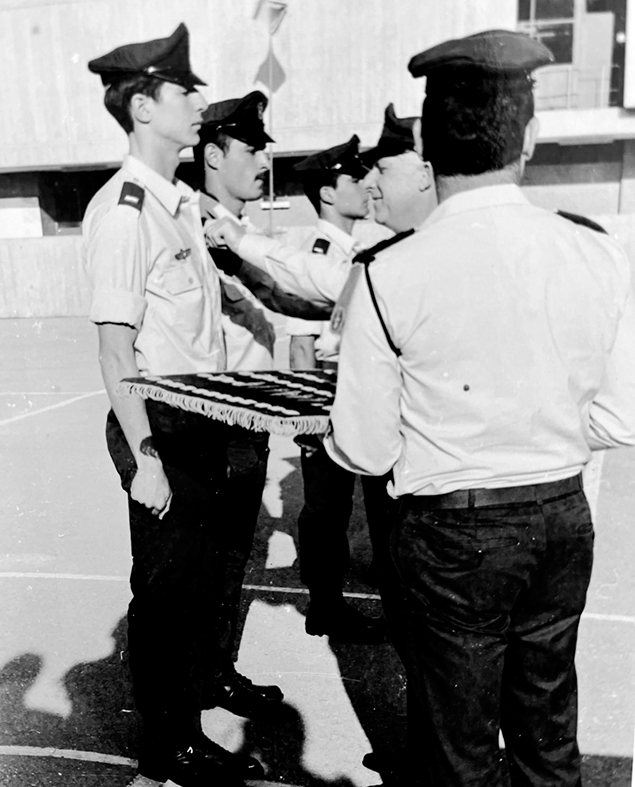
He became a lone soldier, lived at Kibbutz Alumim, “and I show up at the induction in 1984, passionate about getting into a top unit. The induction officer says to me, ‘Okay, what do you want to do?’ I say, ‘Be a pilot,’ and he laughs in my face. ‘What are you talking about?’”
It turns out that it’s not so easy to become a pilot. There’s a long vetting process. So Mr. Cohen volunteered and became a paratrooper. Every week, he’d fill out a form requesting that he be moved to pilot training. “Every week, the NCO in charge of soldiers’ welfare would take my form to the next room, and in retrospect I realize just throw it into the garbage.”
Then he injured himself during a training exercise — nothing serious, a torn ligament, he said — and had to go to the hospital. The doctor he saw asked him what unit he was in; when Mr. Cohen said, “I am in the paratroopers,” the doctor said, “No, you were in the paratroopers.” There’s a profile that shows soldiers’ fitness for duty. Mr. Cohen had been at 97 out of 97; after his injury, he went down to 64. The cutoff for combat service is 65.
Mr. Cohen was devastated at first, but then he was able to comfort himself by thinking that he could be a tour guide, a position in the IDF. “But the army said, ‘Don’t worry. We have a position for you.’ They send me down to Beersheva, take me to the headquarters, and say, ‘Do you see that room in the corner? Do you see that Xerox machine there? You are now in charge of that machine.’
“So that was my job. I was 20. I was doomed to spent 2 1/2 years as a photocopying clerk. I was clinically depressed.
“But as I was leaving my apartment to go to the base to face the photocopying machine, I saw an envelope sticking out of my mailbox. On the outside there were colorful F4 Phantom jets. It said, ‘Your challenge is in the air force. Come for the training course.’ My profile was 64, but they didn’t know that.”
So he went to the screening. “I go through all the doctors, and everything’s fine, until I get to the orthopedist, and he says ‘This guy cannot be in combat.’ He writes it in big red letters. But I continue, and I get to the final doctor, who is supposed to integrate everything.
“I see his name on the door — Dr. David Forecast — and I go in. He’s a British new immigrant, and we start chatting. We speak in English. We click. He hears my story, sees that I have a fire in my belly, and he says, ‘There is that 64 on your profile, and means that it’s a no-go, but I see your motivation, and I am really impressed by you.’
“He says, ‘Do you really want to be a pilot?’ I say, ‘I am dying to be one.’ So he says, ‘I will give you a chance. Go be a pilot. But if you hurt yourself in training, I will kill you.’”
This is against all odds, and Dr. Forecast is another of Mr. Cohen’s guardian angels.

But now there’s another problem. “The height limit for pilots is 6’3”. I’m 6’4”. They send me back to the base, put me in the smallest fight jet, they give me a helmet, and they say, ‘Sit straight. We will close the canopy.’
“They close the canopy, I slouch down, it closes on my helmet, and I say, ‘No problem.’”
Well, not really no problem, but next problem.
“They say, ‘How many years have you been in the country?’ I’ve been in Israel for two years but this is a sensitive position. It needs security clearance, and that needs five years in the country. So they send me to the field intelligence, they interrogate me for five hours, they are unimpressed by my Swedish family, but finally they are convinced.”
(Dan Senor and Saul Singer wrote a chapter about this episode of Mr. Cohen’s life in their book “The Genius of Israel.”)
So Mr. Cohen — finally! — is in flight school. “You start with 200 people, and only about 10 percent finished,” he said. His friends there told him that “I am the most extraordinary soldier in the army,” he said. “That’s not necessarily good,” he added. “But it is different.
“I am a new immigrant, religious, a lone soldier, with a profile lower than what would be accepted in combat, and half Swedish. They would joke that I was planted here as a spy.”
“One of the most important elements in succeeding is your belief in your ability to succeed,” he said. He had that belief. “It was so hard even to be chosen, and then with that the attrition rate…” He explained that attrition did not very often come from students choosing to drop out. They failed out.
“I knew the numbers,” he said. “I knew that I had so much going against me. But I believed in myself. I believed that I could finish. I am now also an ultramarathoner. I do extreme stuff. I believe that it is 80 percent in our minds and only 20 percent in our bodies. It’s mind over matter.
“And you need grit. I worked 10 times harder than anyone else. Lights were out at 11, and I was up with my flashlight, poring over my books.”
“I had to believe that I was capable. I decided that if Dr. Forecast thought that I had the right stuff, I did, and I would prove him right. Like Shlomo Carlebach said, all a child needs is an adult to believe in him.”
The training course was two years. Once it was over, Mr. Cohen became a search-and-rescue helicopter pilot. “I ended up saving a lot of lives,” he said. “I had the opportunity to save lives instead of taking them.”
He flew for another five years, fulfilling his obligation to the IDF, and then “I shifted into the Mossad and spent 25 years there. I retired with the equivalent rank of colonel 10 years ago.
After his time in the air force, when he was in his 30s, he restarted the work of melting the metaphoric ice that had encased him. “I was still the Iceman,” he said. “A woman told me that she loved me, and I felt the same about her, but I couldn’t admit it. So instead I said thank you.
“She accused me of being an emotional cripple, and that launched me into a quest to get in touch with my emotional core. The Iceman had served me as a basketball player and as a pilot flying into enemy territory without breaking into a sweat,” but it didn’t serve him as well after that.
“That launched me into a process,” he said. “It allowed me to see the price I was paying to be the Iceman, and it launched me into a quest for emotional connection. And I translated it into becoming a clinical psychologist.”
He did his undergraduate degree at the Hebrew University and got a graduate degree in psychology from Bar-Ilan, and had a four-year internship in psychology in the army, in military intelligence and the combat stress unit. He’s also a combat PTSD specialist, he said. (He’s Mr., not Dr., because the Israeli educational system is different than the one here, he said. Were he to have had the same education in the United States, it would have earned him a doctorate.)
He’s married now, to Orit, “who met the 2.0 version of me,” he said. “We have been married for 26 years. She gave birth to three children — they’re 25, 21, and 17 now — and we also have a fourth child who has been living with us for five years.
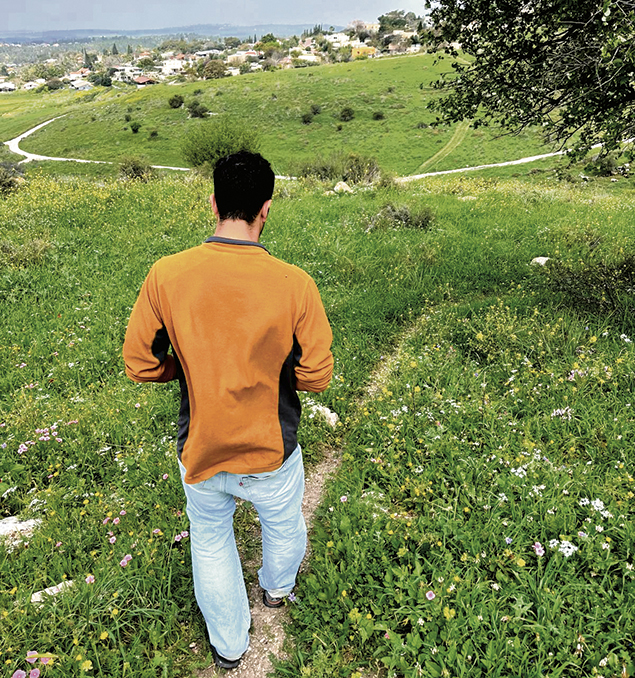
“We live in a moshav in the Judean Hills, close to nature. About half of what I do today as a therapist is nature therapy. We meet outside the house and walk into the woods. When you sit on our porch, you only hear crickets. A few years ago I came to visit Manhattan and I remember being overwhelmed by the stimuli, the noise, the big buildings, and I realized that my psyche has changed. My nervous system has calmed down. I am wired differently now.”
Mr. Cohen developed his leadership method in the Mossad, he said. It’s called ELITE — that stands for Emotion, Learning, Integrity, Toughness, and Execution. He’s been teaching it for the last 10 years.
Everything he’d done until then led to a logical, historic, and difficult assignment in 2023.
“On the seventh of October, I was drafted to the IDF hostage negotiation unit,” he said. “I have been in the reserves for over 20 years, but there hasn’t been that much activity. For decades, I also have been training top commandos and pilots in POW training.
“I was the first mental health professional to meet the first hostages to be released,” he said. “Judith and Natalie Raanan. They were released on October 20. I realized that there was no protocol for this, so I basically created one. It was for debriefing the hostages when they returned.”
It’s complicated, Mr. Cohen said, because the debriefing has two possibly contradictory goals. One is “to give them the soft landing they deserve,” he said. It’s not therapy — that was on offer, but not immediately — but to help them decompress from horror and back into normal human trust. “The second goal is to get information.”
That’s when his Iceman persona returned and was very useful. “I could feel comfortable in that situation,” he said. “The protocol I created was that we work in pairs, a psychologist and someone in intelligence.
“It’s not for the fainthearted,” he added. “People in general — and also clinicians — can get upset. It’s hard to deal with. Clinicians have the tendency to treat the trauma, but we had to keep a clear focus. Give them a soft landing, but the goal is really to get intelligence, and to be sure that it’s done in a way that’s not upsetting.
“It’s a real challenge.”
And it was a constantly shifting challenge. At first, the hostages hadn’t been held for that long and the need for intelligence was acute. Later, the released hostages had been held for a long time, they could be fragile, and there already had been much information gathered. There always was a tension between the goals, but the fulcrum moved.
“The success of the protocol was based on my belief — which turned out to be true — that the debriefings were not only good for the country but also good for the survivors. I firmly believed that. Many people were skeptical. Many people, especially during wartime, see in black and white. They saw it like an interrogation, as something negative. Most people thought that we should leave the hostages alone. Why are you burdening them?
“But I was convinced that this was good for two reasons. First, because it was empowering, giving them the opportunity to help save their brothers and sisters and friends. That is huge. And I was convinced, as a clinician dealing with trauma, that what happens in trauma is that your primitive brain, the amygdala, is triggered. You have to transfer that to the neocortex.
“I wouldn’t have done it if I didn’t believe in it.
“The advantage of taking extreme cases is that kal v’chomer, how much more so, is my takeaway. I believe that we all are capable of so much more than we imagine we are. Every trauma is an opportunity for growth. We know that in theory, but I saw that in these extreme cases of captivity, where people assume that they’d be better off dead than in captivity, somehow we can survive — and even thrive.
“It means that we not only have the resilience to survive and bounce back, but that we can bounce forward. It doesn’t have to lead to PTSD. It can also lead to PTG, post-traumatic growth.”
That doesn’t mean that the growth is worth the trauma, Mr. Cohen added. But “in certain cases, particularly in prolonged trauma, you can experience growth even before the post-trauma stage.
“It is a bit of a paradox. There are other ways to grow, but if you already are going through a trauma, know that you can grow from it. That it can give you a lot of strength. And paradoxically there is more potential for growth from trauma than from regular life. One of the definitions of trauma is that you are exposed to something life-threatening, but I want to expand that idea. Trauma can be anything that shakes your core beliefs. And that shaking enables more growth.
“When something is shattered, when the mold is gone, you have to create a new mold. That is very painful, and you pay a high price, but the potential reward is higher as well.”
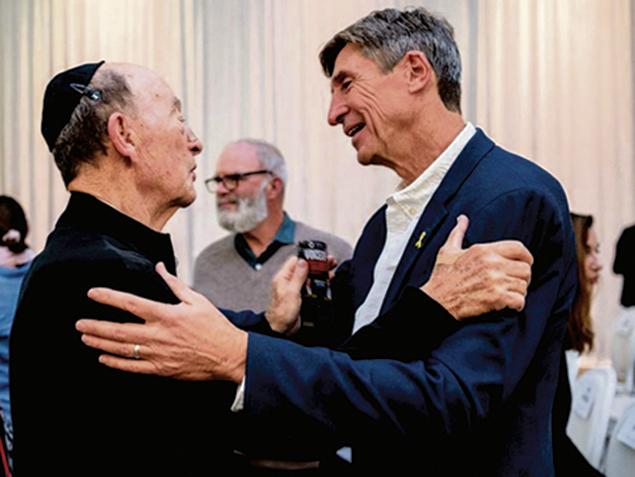
Mr. Cohen will talk about his work with the October 7 hostages for the Jewish Federation of Northern New Jersey on April 30. He is working on a book that will be published by Simon and Schuster.
Learn more about Mr. Cohen at his website, www.glenn-cohen.com.
Who: Glenn Cohen
What: Will talk about his experiences as the Mossad’s former chief operational psychologist and the leader of the IDF’s hostage debrief team
When: On Thursday, April 30
Where: You’ll find out when you register
Why: He’s speaking as part of Visionary Voices 2026, the Scott Pazer Memorial Speaker series
Who’s the sponsor: The Jewish Federation of Northern New Jersey and the JCC of Northern New Jersey
How much: $18
To register: Go to jfnnj.org and scroll down the homepage to Jewish Federation Happenings, then click on “Visionary Voices,” or call the federation at (201) 820-3900.