

‘How do you tell it to your mind?’
Dr. Arnold Eisen does his own theology in his new book
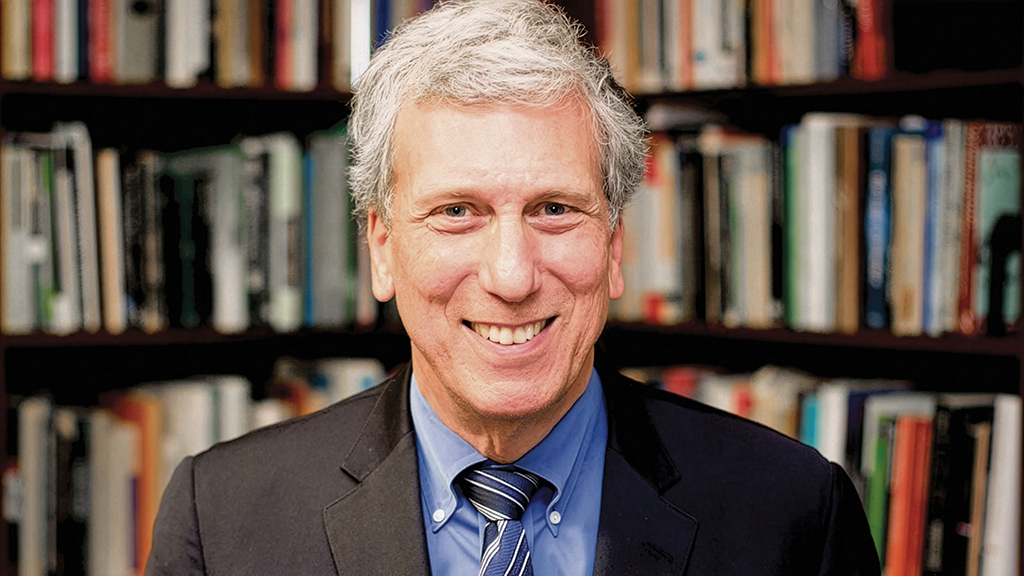
How long can you marinate in theology — read it, teach it, analyze it, write academic papers about it, argue about it with colleagues, friends, and students, and in your own head, because one Jew, at least 95 theologies — before you decide that it’s been long enough? That it’s time to write your own theology?
It took Arnold Eisen, who is the chancellor emeritus of the Jewish Theological Seminary, the Conservative movement’s flagship academic institution, and still a professor of Jewish thought there, about 50 years, he said.
Despite all the ways that he engaged in theology, “I never forced myself to ask myself, ‘What do you believe about God’s role when you pray?’” Dr. Eisen said. “‘Does God hear prayers?’ All those basic questions that Jews ask. But like many Jewish thinkers, particularly American Jewish thinkers, I never forced myself to give an account of what I believe about these things.
“This might seem strange, but it’s quite typical, and I think that it’s particularly typical of Conservative Judaism, to have an aversion to theology. The irony was that I’m a professor at the Jewish Theological Seminary, I was the leader of the Jewish Theological Seminary — and there hasn’t been a lot of theology done there since the days of Heschel and Kaplan.”
Those are the two most prominent and in many ways opposing midcentury Conservative Jewish theologians — Abraham Joshua Heschel, who perhaps most famously married Jewish social justice teachings to the civil rights movement, and Mordechai Kaplan, who founded the Reconstructionist movement. Both taught at JTS.
And there was a notable, more recent exception to that trend, Dr. Eisen said. Rabbi Neil Gillman, who taught at JTS and died in 2017, was a theologian who talked about God and encouraged his students to do that too; he was a great influence on Dr. Eisen. “Sometimes I feel like I am channeling Neil Gillman,” Dr. Eisen said.
In 2020 he turned 70, Dr. Eisen said, and that’s an age at which it’s best finally to do whatever it is that you most want to have done. “If not now, when?” he said. “I realized that my wife and I have two children, they’re both in their 30s, and we’d never talked about God. And I had a sabbatical. And it was during the pandemic. So I had the perfect opportunity and there I was in my apartment, not able to go anywhere, with lots of time to think.
“And because of covid, every time I opened my newspaper, I saw that 10,000 or more people had died. Did God have a role in that?”
So he wrote a book.
Last year, the Teaneck-based publisher Ben Yehuda Press published Dr. Eisen’s “Seeking the Hiding God — A Personal Theological Essay,” and Dr. Eisen has been discussing it with groups around the country since then. He’ll be at Congregation Beth El in South Orange on Sunday, October 26, to talk about it. (See box.)
“It’s a personal book,” Dr. Eisen said. “It’s not scholarly at all. I had written a book somewhat similar to it in 1997, ‘Taking Hold of Torah,’ but that wasn’t remotely as personal as this one is. That was me talking about American Judaism. This is me confronting faith and doubt and God and meaning.
“I’m writing as a Jew. I am not speaking for Judaism or Conservative Judaism or the Jewish Theological Seminary. I’m speaking only for me, and I’m not trying to persuade you to agree with me. I’m just trying to share my commitment as honestly as I can, and I hope that you will do the same, and that this book will stimulate a conversation.”
He is also speaking as a deeply observant Jew, whose observance of the mitzvot and participation in communal life do not change, whether or not he fully believes every word of the liturgy he’s davening.
“I’ve been traveling around the country for a year, talking about the book, which means talking to people about God,” Dr. Eisen said. “The conversations are really rewarding. I’ve rarely had conversations like this as a scholar, or even as chancellor. People respond to my openness with their own openness, and we have had some wonderful conversations about God.
Why do Jews generally not talk about God? (Although he knows most about Conservative Jews, Dr. Eisen said, he’s talked to enough Reform Jews, particularly at his talks, when they open up about it, to know that they don’t like to talk about God either. Although he’s talked to fewer Orthodox Jews about it, he thinks, from what he does know, that it’s true for them as well.)
What most people say to him — although they all say it differently, because every person and every life is different — tends to fall into two categories, Dr. Eisen said. “Either it’s something like ‘30 years ago I prayed for the health of my teenage child, and my child did not get better, and I haven’t talked to God since.’ Or the reverse, the child did get better. The relationship to God changes with a personal tragedy or celebration.
“The other reaction is ‘Thank you for telling me that I don’t have to feel guilty for not believing things that I just don’t believe. Thank you for freeing me from that guilt.”
What is it that Dr. Eisen believes? “I believe, as my subtitle indicates, that the God we pray to and try to love and to serve is not a God who is readily available to most of us,” he said. “I used to feel that it was my fault. That if I were more pious, more learned, more devout, then God would be more accessible to me. That might be true — I don’t know, I am who I am — but the tradition that means the most to me is the tradition of the hiding God.
“A few weeks ago, between Rosh Hashanah and Yom Kippur, we read Parsha Vayelech, where God says three times that God is going to be a hidden God. Sometimes Jews have interpreted that to mean that when there is a tragedy, like the Holocaust, that we can’t explain, it is hester panim, God’s hiding God’s face. That’s a traditional way of saying ‘I don’t know.’ Heschel does that, and so did the major Orthodox thinkers Eliezer Berkovits and Joseph Soloveitchik. I like that response much better than people who tell me that they know why God let six million Jews die.
“Then there’s the response from Richard Rubenstein, in his ‘After Auschwitz,’ which is, ‘well, this is the end. We can’t believe in God anymore,’ he said.”
Dr. Eisen’s view is not Rabbi Rubenstein’s. “God is problematic,” he said. “Faith in God is problematic. Nonethless, despite science that renders God kind of irrelevant in discussions about why things happen in nature, and despite all the tragedies of history, nevertheless, Jews have a long tradition of protest and of questioning, but also of experiencing God.
“My life has been graced with experiences of God. I talk about those moments, like when I watched my daughter being born. You have a sense of miracle. You have a sense of God’s presence.
“There have been other moments in my life where I’ve had that feeling, and I try to talk about them in my book, not drawing great theological conclusions, but just saying, ‘Okay, this is why I am the person I am, and this is what enables me to pray and to go forward as a believing Jew and a faithful Jew, despite all my doubts and all my experiences of God’s absence.”
Those experiences, of God’s failure to show up but instead remaining in hiding, far outnumber the other ones, Dr. Eisen said. “When you read the blessings and curses, as we did in the Torah a couple of weeks ago, in Parshat Ha’azinu, there are 14 verses of blessing and 54 verses of curses. That’s about right for many periods of Jewish history, and that’s about right for my experiences of God’s absence versus God’s presence.” But the experiences of God coming out of hiding, no matter how rare, now matter how brief, are profound, he said.
That doesn’t mean that he doesn’t question, Dr. Eisen said. “There is almost no thoughtful modern person who never questions.
“But the most important Jewish thinker in my life, the presiding presence in this book, is Heschel. I talked to him when I was a 20-year-old student reporter for the Daily Pennsylvanian, and he changed my life.”
Arnie Eisen, then a student at the University of Pennsylvania, had gone to JTS to interview Rabbi Heschel. The short time he spent with the theologian, talking honestly about religion and belief and God, was revelatory. “Heschel gave me the confidence that religion can matter,” Dr. Eisen said. “That words can matter. That religion can have an impact on the world.
“Heschel says somewhere in ‘Man Is Not Alone’ that at a certain point in life, you have no doubt anymore that God exists and is present in the word. The question, he says, is, how do you tell it to your mind?
“I love that phrase: How do you tell it to your mind?
“Heschel lost almost all his family to the Nazis. Theywere almost all killed in the Holocaust. Nonetheless, he retains faith. How is that? I have often wondered how that can be, so I read Heschel with that question in mind.
“Heschel does not believe that God is in charge of history,” Dr. Eisen said. “God does not run history. God is not the master of what happens in the world. God is involved, but there is no simple answer — God did this or God didn’t do that.
“I think that the answer, which is his belief, which his books testify to, is that he had experience. He had powerful experiences of God in his life. He had tradition, and he had his mind — it was a great mind — but he had experiences of God.
“When these three things — the tradition, your mind” which includes “your reason, your right-thinking mind, your conscience — and your experience — all come together,” that’s where a person’s awareness of God comes in. Sometimes those things “argue with each other, and sometimes they are on the same page,” Dr. Eisen continued.
He’s uncomfortable talking about belief, which seems as if it must be a bedrock foundation for any talk about God. It’s because he doesn’t like the word “belief.”
“It’s not just belief,” he said. “For a long line of Jewish thinkers, it’s not primarily belief. Sometimes we translate the word ‘emunah’ as faith, and we translate faith as belief, because we live within the Christian culture,” and that’s how Christians use the word faith.
“But for Jews, it’s much more about trust. It’s about relationship more than abstract belief. You don’t do theology in an ivory tower. If you’re a Jew, you do theology in the midst of history.
“That’s one of my operating assumptions here. History could be the Exodus or the destruction of the Temple or the Holocaust or the creation of the state of Israel.
“Jews deal with history, and history is a complex business. History is not remote, and you as an individual Jew experience it.”
For Dr. Eisen, the history he lived through that most influenced him was Israel’s Yom Kippur war. That happened in 1973, when he was a graduate student working toward his master’s degree at Oxford University, and then in 1975, when he went to Israel. (His doctorate is from the Hebrew University in Jerusalem.)
His book, which begins and ends with email exchanges with friends about God and belief — “because “I wanted the voices of other people, who also think about these issues, in the book” — is divided into three main sections. One is about Yom Kippur, and it is shaped by his experience in shul in Israel in 1975. He was at Yizkor — one of the three annual services where everyone remembers their own dead — and he realized that for many people there, “it wasn’t just Yizkor, but it was yahrzeit, because they had lost loved ones on Yom Kippur.
“That changed my experience of Yom Kippur,” he said. And he sympathizes with those Jews who find the stark theology unendurable.
Another section is about Passover, which focuses on God’s role in history. And the third is about “covenants, God, and mitzvah,” Dr. Eisen said. He writes about the Christian concept of the God of love — that’s their God — and the God of wrath and judgement and harsh law who oversees the Jews. That’s not a true understanding of the God of the Jews, and his book is in large part a contradiction of that view.
In this part of his theology, Dr. Eisen’s new book dovetails with Rabbi Dr. Shai Held’s most recent book, “Judaism Is About Love.” That’s coincidental and perhaps a bit zeitgeisty; Dr. Eisen is a link in the chain that connect Rabbi Heschel to Rabbi Gilman in one direction, and to Rabbi Held in the other.
Dr. Eisen would be glad to talk about all this and more at Beth El and wherever else he might find himself as he discusses “Seeking the Hiding God.”
Who: Dr. Arnold Eisen
What: Will talk about his new book, “Seeking the Hiding God.”
Where: At Congregation Beth El in South Orange
When: On Sunday, October 26, at 9:30 a.m.
For more information: Go tobethelnj.org or call (973) 763-0111