

‘I pray that these things never end…’
Folksbiene presents ‘Hannah Senesh’ to speak to our troubled times
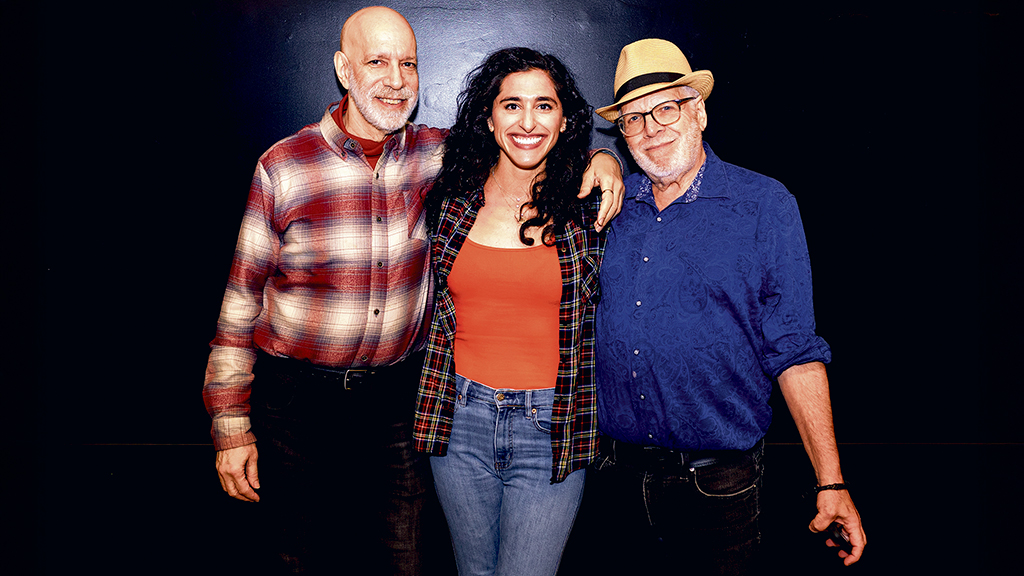
This is the kind of story that the Jewish community needs right now, Zalmen Mlotek said.
Mr. Mlotek, who lives in Teaneck, is the artistic director of the National Yiddish Theatre Folksbiene. He’s talking about “Hannah Senesh,” the limited-run one-woman play that will be running at the Theatre Row on Broadway from October 19, when it opens in preview, to November 9. (See below.)
Part of his very big job is deciding “what to present to the public,” he said. “What to present to the Jewish public in these times. And there was this heroic story of a young woman who chose to give her life not only for her mother, but for Hungarian Jews.”
“Hannah Senesh” tells the story of the extraordinary young Hungarian Jew who left her home to fight for Palestine and then returned to Hungary during the Nazis’ brutal invasion to try to save her mother. She accomplished that feat, but at the cost of her own life.
Hannah was, among many other things, a poet. The play’s words come mainly from her diaries. There are some songs in it too; she wrote most of them.
Not only was she emotionally and intellectually brave, she also demonstrated the kind of physical courage that most of us cannot imagine even approaching. She left her family for Palestine, joined the Haganah, trained as a parachutist, and then volunteered to parachute into Nazi-occupied Europe. She did so, even after many of the men with her decided the situation was too dangerous. She was caught, tortured, tried, and killed.
Throughout those ordeals, she kept writing. She kept a diary; she also wrote poetry. One of her songs has entered the Jewish consciousness as if it had always been there. It’s “Eli, Eli.” In Hebrew, it continues, “shelo yegamer l’olam.” In English, it’s
O Lord my God
I pray that these things never end
The sand and the sea
The rush of the waters
The crash of the heavens
The prayer of man
To read these words is to hear the song in your head. That’s how central Hannah Senesh is to Jewish life today.
“I feel like stories like these are the kinds of stories that we have to put out there now,” Mr. Mlotek said. This was the fight against fascism. This was the fight against totalitarianism. This is the fight against antisemitism.” Those fights no longer seem only historic. They have renewed urgency today.
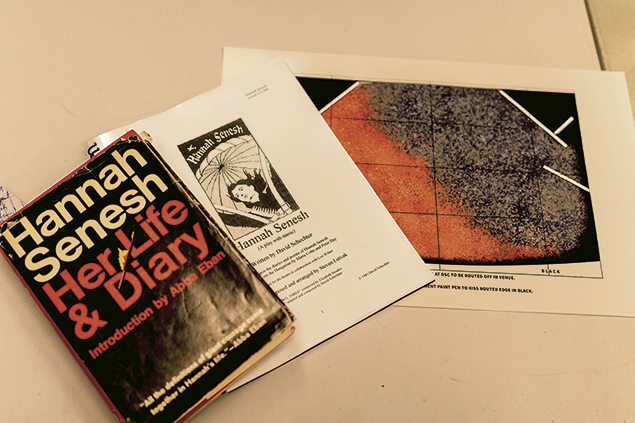
Although most of the Folksbiene’s productions are in Yiddish, because doing so is a large part of the company’s mission, “we purposely are presenting this one in English so the widest possible audience can come.”
Part of his goal, he said, “is that this is our cultural legacy.
“In these times of crazy antisemitism, and with totalitarianism hovering in the air, we need to stand together as a community. We need to support our cultural activities, and hopefully we have to educate. That’s the worst thing now — how badly people are educated. Instead, they just spew the propaganda they hear and read about in social media.
“What better way is there to bring the community together than to tell stories of Jewish pride and Jewish heroism?”
Yes, Mr. Mlotek acknowledged, Hannah’s story ends with her death by firing squad, when she was 23, but not only had she accomplished more in her life than most people who live to 93, but also her story ends “with the creation of the state of Israel.” It’s not quite direct cause and effect, but it is a historic progression.
The Folksbiene “engaged Jennifer Apple, a wonderful actress who was in the ‘Band’s Visit,’” the 2017 Broadway musical based on an Israeli film, Mr. Mlotek said. “She’s a very respected actress, and very passionately Jewish. We presented this play some years ago, it was reviewed really well, and the word of mouth was really good, so we thought that this is the right time to present it again.”
Jennifer Apple took the role of Hannah Senesh for a number of reasons.
First, she said, “I auditioned for it, and I got it.” She’s a professional. “I didn’t seek it out. I’ve known Jamibeth Margolis, the casting director, for many years. She’s a fan of mine. She has brought me in for many projects, and she brought me in for this one as well.”
Aside from the professional challenges of being in a one-character play, Ms. Apple graduated from Ramaz, the modern Orthodox day school on the Upper East Side. She’s deeply aware of the challenges of bringing Hannah Senesh to life onstage.
“It is a huge responsibility,” she said. “We are living through very complicated and interesting times. There is a lot of misinformation and lack of awareness and miscommunication. It is a politically charged time. And a lot of the buzzwords that are associated with her undersell who she was as a human being.” They simplify Hannah Senesh, Ms. Apple said.
What are those buzzwords? “Zionism,” Ms. Apple said. “Judaism. Israel. Palestine. Fascism. They are words that hold a lot of feelings for a lot of people for a lot of different reasons currently. And I’m doing a show, set in a different era, where I literally say these words many times.
“So in that way, it is very topical. But also, she is an icon, and for me, as a Jewish woman, to be able to play her is an honor and a privilege.
“She was somebody who believed things very deeply, and followed through with what she believed. With her, it was always action, action, action. She left her family — her mother and her young brother — because she believed so deeply in her mission.
“She was 18 when she left home, and it wasn’t easy to get to Palestine then. You didn’t just get on a plane. And she didn’t speak the language when she got there. But she immersed herself in it, and she became one of three women paratroopers. It’s wild!
“She already was in Palestine, she was there to build the land, but she decided to go back to Hungary to rescue her mother. She landed just before Hitler invaded Hungary.
“She chose to go directly into the fire. She said she had to save her mother and her people. A lot of people nowadays say a lot but they don’t do a lot. She was the embodiment of doing. Of letting her moral compass guide her. And she was proud to be a Jewish woman, and I relate to that very deeply.
“Yes, her death was tragic, but you learn a lesson from it. You can get a glimmer of inspiration from it. You get the idea that anything is possible. Not the outcome, of course — but the way that she lived, the reasons she did things, her clarity, her perspective, her intentions, her ability to really see things very clearly for what they are, not to mince words. She didn’t take things at face value.
“She was somebody who really questions a lot and really wants to understand why things are the way they are.”
The play, which is mainly taken from Hannah’s writings, put together and fleshed out by playwright and director David Schechter, is bookended by explanatory dialogue by Hannah’s mother, Catherine, also played by Ms. Apple. Both Catherine and Hannah’s brother George survived the war and they both ended up in Palestine. But the three never were reunited.
Ms. Apple calls herself a “multihyphenate artist,” she said. “I’m an actor, I’m an acting coach, I’m a podcast host, I’m a writer.”
Being the only performer in “Hannah Senesh” “is a lot of work and a big responsibility,” she said. “And simultaneously it’s a real privilege. You sink or swim on your own, and you have to rely on yourself. But this isn’t my first rodeo. I’ve been a professional actress for over a decade.
“I’ve written and performed two solo shows, but this is 100 percent different. It’s not your own, so you can’t change it. This is memorizing someone else’s script and intentions, making sense of somebody else’s vision and bringing someone else’s words to life. It is a very different marriage, and I’m using all of my skill sets.
“It feels like a real privilege as an actor to be given the opportunity to be able to access all parts of my creativity and all parts of my expression and use it all to bring Hannah Senesh to life.
“I have to bring myself to this role. She has to live through me, and I am the vessel through which she has to come alive. So there is a lot of self-reflection around the various parts of my identity and my way of communicating and my emotional life and my capacity for sharing. I have to recognize which parts of me are similar to her, and I think about things that she said or did that I might want to incorporate into myself.”
Who: The National Yiddish Theatre Folksbiene
What: Presents “Hannah Senesh”
When: Previews October 19-22; performances October 23-November 9.
Where: Theatre Row, Theater Three: 410 W. 42nd Street
For more information and tickets: Go to the Folksbiene’s website, nytf.org, or directly to the show’s page, at nytf.org/hannah-senesh.